
Market Overview
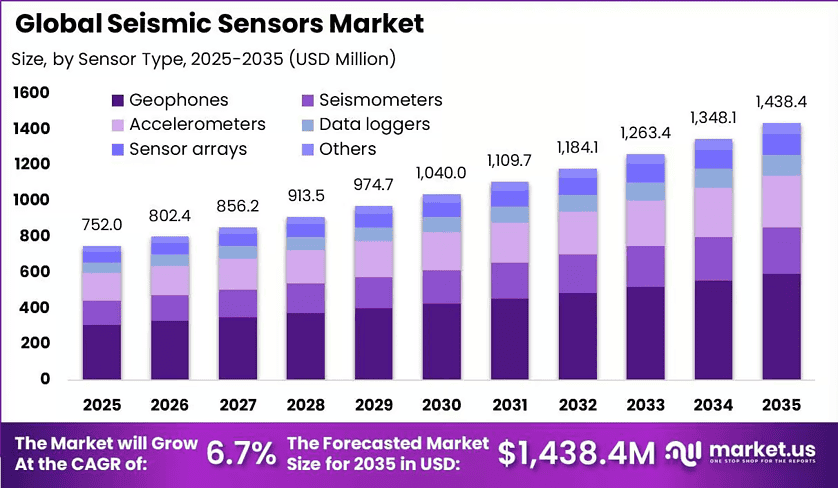
New York, NY – November 18, 2026 – The Global Seismic Sensors Market reached a value of USD 752.0 million in 2025. It should reach about USD 1,438.4 million by 2035, growing at a CAGR of 6.7% from 2026 to 2035. This steady growth points to rising demand for ground-motion monitoring tools around the world. North America led the market in 2025 with more than a 41.5% share and about USD 312.08 million in revenue.
Additionally, governments are spending more on early-warning systems, risk mapping, and monitoring of bridges, dams, and power networks. According to the U.S. Geological Survey, earthquakes caused yearly losses of nearly USD 14.7 billion to U.S. buildings in 2023. That figure is about 140% above the 2017 estimate, so the case for better vibration detection keeps getting stronger.
Furthermore, the USGS has proposed a 450-station early-warning network in Alaska. The plan includes 270 new stations, 160 upgraded stations, and 20 existing stations. Therefore, the project directly supports demand for broadband and strong-motion sensors and opens clear sales paths for equipment makers.
However, energy activity also plays a major role in market growth. According to the U.S. Energy Information Administration, U.S. crude output rose by 270,000 barrels per day in 2024 to a record 13.2 million barrels per day. This growth increases the need for subsurface mapping and supports an expected market gain of USD 686.4 million by 2035.
Key Takeaways
- The Seismic Sensors Market is valued at USD 752.0 million in 2025 and should reach USD 1,438.4 million by 2035 at a 6.7% CAGR.
- Geophones led the market with a 41.3% share in 2025.
- Digital sensors held a strong 35.6% share in 2025.
- Earthquake monitoring led the application segment with a 30.7% share in 2025.
- Oil and gas remained the top end-use segment with a 34.2% share in 2025.
- North America led the market in 2025 with over a 41.5% share and about USD 312.08 million in revenue.
➤ Evaluate the Report Quality with an Exclusive Sample Download – https://market.us/report/global-seismic-sensors-market/request-sample/
Seismic Sensors Market Segmentation
By Sensor Type
Geophones held a leading 41.3% share of the market in 2025. These devices turn ground vibrations into electrical signals for land-based surveys. Moreover, they help operators find rock layers, faults, and good drilling spots. Consequently, oil, mining, and civil engineering firms depend on them for accurate underground analysis.
Additionally, U.S. crude output reached 13.2 million barrels per day in 2024, according to the U.S. Energy Information Administration. Much of this growth came from the Permian region. Therefore, drillers there need detailed seismic data for well planning, which keeps demand for geophones steady.
By Technology
Digital sensors held a 35.6% share in 2025. They offer faster data processing, better signal accuracy, and precise time stamps. Moreover, early-warning systems benefit greatly from these features. Even a few seconds of warning help rail networks, utilities, and factories act quickly to protect people and assets.
Furthermore, according to the USGS, ShakeAlert included 1,553 seismic stations and about 1,100 geodetic stations by December 2024. These stations sent data every 1 second. Consequently, real-time alert networks of this size show why agencies keep choosing digital ground-motion technology.
By Application
Earthquake monitoring led applications with a 30.7% share in 2025. Public agencies treat this work as an ongoing safety need, not a one-time task. According to the World Bank, earthquakes cause losses equal to nearly 3.7 million jobs each year. Therefore, governments keep expanding networks to protect workplaces and local economies.
By End Use
Oil and gas led end uses with a 34.2% share in 2025. Operators use seismic surveys to map reservoirs before drilling. Moreover, according to OPEC, global oil demand rose by 1.49 million barrels per day in 2024. This large demand base keeps exploration active and supports steady orders for field sensors.
Regional Analysis
North America held a 41.5% share in 2025 and earned about USD 312.08 million. The United States drives this demand through city networks, energy fields, dams, and pipelines. According to the USGS, nearly 75% of the country could face a damaging earthquake. Consequently, buyers keep investing in new sensors, upgrades, and maintenance.
However, Asia Pacific should grow the fastest because of high quake risk and fast urban growth. China completed its National Earthquake Early Warning Project in 2024 with 15,899 monitoring stations. Additionally, Japan runs about 200 seismographs and 600 intensity meters. Therefore, the region offers strong long-term demand for monitoring equipment.
Key Market Drivers
Public early-warning growth remains a major driver of seismic equipment demand. According to the USGS, the agency gave more than USD 23 million for earthquake monitoring and research in 2025. Moreover, each new station needs sensors, telemetry, and field service. Consequently, this spending may add about 1.4% to the baseline growth rate.
Additionally, oilfield reservoir imaging keeps demand for ground-motion tools strong. According to the U.S. Energy Information Administration, U.S. crude output rose to a record 13.6 million barrels per day in 2025. Therefore, operators need more surveys for drilling and reservoir management, which may add about 1.0% to market growth.
Major Use Cases
City agencies use seismic sensors to send fast earthquake alerts to the public. These alerts help rail operators slow trains and help utilities protect key systems. Moreover, hospitals and schools gain time to move people to safety. Consequently, early-warning networks have become a core part of modern disaster planning in many regions.
Additionally, energy companies use sensor arrays to map underground rock layers before drilling. These maps help teams avoid faults and pick better well locations. Furthermore, engineers place sensors on bridges, dams, and tall buildings to track structural health. Therefore, asset owners spot damage early and plan repairs before failures occur.
Business Opportunities
Induced-seismicity monitoring offers a strong future opportunity for sensor suppliers. Geothermal, carbon storage, injection, and mining projects need ongoing ground-motion tracking. Moreover, many projects still rely on one-time surveys today. Consequently, suppliers can offer subscription services with automated alerts and compliance reports, which create steady recurring revenue.
Additionally, offshore wind projects and distributed fibre sensing open new growth paths. Wind developers need detailed seabed surveys before building turbines. Furthermore, energy, rail, and pipeline operators want fibre-based systems that monitor long corridors. Therefore, firms that combine hardware with managed services can win long-term contracts and stronger client loyalty.
Major Challenges
Shipping disruption remains a serious challenge for vibration-detection equipment makers. These firms depend on imported microchips, circuit boards, batteries, and cables. However, Red Sea problems have forced longer sea routes between Asia and Europe. Consequently, manufacturers face late deliveries, higher stock costs, and tighter cash flow across their supply chains.
Moreover, public budget dependence slows the growth of many monitoring networks. Government agencies often delay tenders when yearly funding stays flat or falls. Additionally, remote sites in Arctic, desert, and offshore areas cost more to service. Therefore, smaller suppliers struggle with idle factory time and slower inventory turnover during funding gaps.
Top Key Players in the Market
- Riverhawk
- PCB Piezotronics Inc.
- Geospace Technologies Corporation
- SiTime Corp.
- Azbil Corporation
- GeoSIG Ltd
- IMV Corporation
- Nanometrics
- Güralp Systems
- Sercel
- Gaiacode
- Lunitek
- Kinemetrics, Inc.
- Rogue Seismic
Conclusion
The seismic sensors market shows steady growth, supported by public early-warning programs, oil and gas exploration, and infrastructure safety needs. Geophones, digital sensors, earthquake monitoring, and oil and gas lead their segments. Moreover, North America leads regional demand, while Asia Pacific grows fastest. However, supply chain delays and budget limits remain hurdles. Therefore, suppliers offering smart, service-based monitoring solutions should capture the strongest long-term opportunities.
Discuss your needs with our analyst
Please share your requirements with more details so our analyst can check if they can solve your problem(s)