
Market Overview
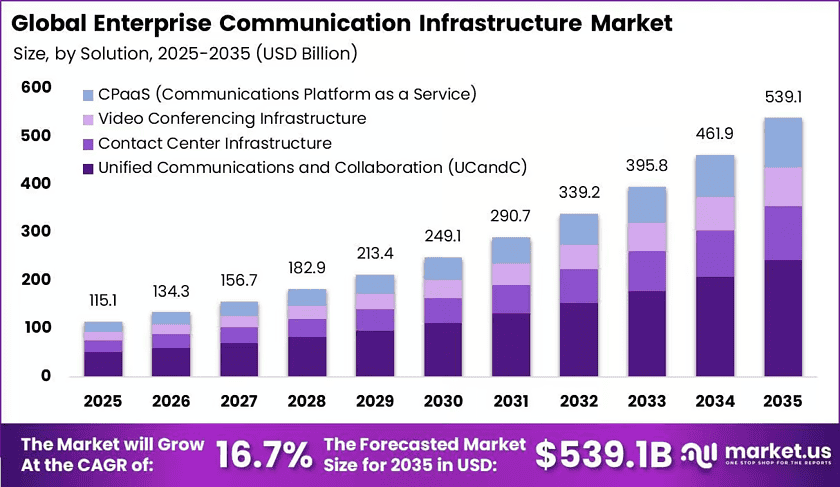
New York, NY – November 18, 2026 – The Global Enterprise Communication Infrastructure Market reached USD 115.1 billion in 2025. Analysts expect it to hit about USD 539.1 billion by 2035, growing at a 16.7% CAGR. North America led the market in 2025 with a 38.7% share and about USD 44.5 billion in revenue. This fast rise shows that businesses now treat connected communication tools as core operating assets.
According to the International Telecommunication Union, about 6 billion people used the internet in 2025, up from 5.8 billion in 2024. This means nearly three-quarters of the world is now online. Therefore, enterprises need stronger networks and cloud messaging tools to reach connected employees and customers.
Global 5G connections passed 2.7 billion by the end of 2025. Additionally, 5G carried 48% of global mobile data traffic. This shift pushes businesses to upgrade internal networks, video meeting systems, and data platforms. As a result, faster mobile networks lift demand for modern workplace communication systems.
Enterprises now invest heavily in AI-enabled contact centers, cloud PBX systems, and video collaboration tools. Furthermore, 5G coverage reached 60% of the world population, helped by about 400 million new users in 2025. This wider reach strengthens demand for fast and reliable business connectivity solutions.
Key Takeaways
- The Enterprise Communication Infrastructure Market is valued at USD 115.1 billion in 2025. It is projected to reach USD 539.1 billion by 2035 at a 16.7% CAGR.
- Unified Communications and Collaboration (UC&C) led the market with a 45.2% share.
- Cloud deployment led the market with a 63.2% share.
- Enterprise Collaboration held the top application position with a 40.7% share.
- Large Enterprises held the largest share at 54.3%.
- IT and Telecommunications led the end-user segment with a 20.8% share.
- North America led the market in 2025 with a 38.7% share and USD 44.5 billion in revenue.
➤ See the Full TOC, Market Tables & Figures in Your Sample Copy – https://market.us/report/global-enterprise-communication-infrastructure-market/request-sample/
Market Segmentation Analysis
By Solution
UC&C solutions led with a 45.2% share, driven by hybrid and remote work. According to the U.S. Bureau of Labor Statistics, 22.4% of U.S. workers teleworked in 2025. Consequently, companies now combine calls, chat, video, and file sharing on one platform instead of running separate systems.
By Deployment Model
Cloud deployment held a 63.2% share as firms move communication workloads off office servers. According to the U.S. Census Bureau, private data center construction reached USD 50.7 billion in April 2026, up 27.4% year-on-year. This growth shows rising demand for cloud capacity to host voice and video tools.
By Application
Enterprise Collaboration led with a 40.7% share. According to Eurostat, 52.9% of EU firms with 10 or more employees held online meetings in 2024. Moreover, 69.01% gave staff remote access to company documents. These habits show that distributed teams now depend on real-time shared workspaces.
By Organization Size
Large Enterprises captured a 54.3% share. According to Eurostat, 88.71% of large EU firms use ERP software, compared with 41.08% of small firms. Therefore, big companies need secure data links and unified tools to connect many systems across departments and countries.
By End-User Industry
IT and Telecommunications led with a 20.8% share. According to the International Energy Agency, data center power use reached about 485 TWh in 2025, up 17%. This growth signals heavy computing demand. Consequently, IT and telecom firms keep investing in high-capacity networks and internal coordination tools.
Regional Analysis
North America held a 38.7% share in 2025. According to the Fiber Broadband Association, fiber networks passed 84.6 million U.S. homes by year-end 2025, growing 11% a year. This strong fiber base lets companies adopt cloud PBX, video conferencing, and unified tools with fewer connection limits.
Asia Pacific is the fastest-growing region. According to the ITU, internet use across Asia and the Pacific reached 66% in 2024. Additionally, India crossed 1 billion broadband subscribers by November 2025. As a result, firms in India, China, and Southeast Asia expand mobile-first collaboration platforms and network hardware.
Market Drivers
AI-ready data center networking leads growth, adding about +2.4% to the baseline CAGR. The IEA expects data center power demand to rise from 485 TWh to about 950 TWh by 2030. Consequently, enterprises need more switching capacity, optical links, and bandwidth to support AI workloads.
Cloud UC migration adds about +1.9% to growth, mainly in North America and Europe. Moreover, Zoom Phone passed 10 million cloud calling seats in October 2025. This milestone shows that businesses steadily replace traditional PBX hardware with flexible, subscription-based cloud voice services that scale with demand.
Key Use Cases
Hybrid teams use unified collaboration platforms to hold meetings, share files, and chat from any location. Moreover, managers coordinate projects across offices and time zones without switching tools. Consequently, companies cut delays, improve teamwork, and keep remote staff as connected as office-based employees during daily operations.
Customer service teams deploy AI-enabled contact centers to handle calls, chats, and messages in one place. Additionally, banks, retailers, and hospitals use these systems to route requests faster. Therefore, businesses improve response times, personalize support, and build stronger customer loyalty across digital and voice channels.
Business Opportunities
Rural broadband expansion opens new edge infrastructure demand as public funding finally reaches deployment projects. Moreover, vendors that offer central network management can serve remote business sites with fewer field visits. Consequently, providers can capture new customers in underserved areas while improving service margins over the medium term.
Regulated industries create strong demand for sovereign unified communication platforms. Additionally, banks, healthcare groups, and government agencies need tools that keep data inside national borders. Therefore, vendors offering local hosting, compliance features, and secure messaging can win long-term contracts across Europe, the Middle East, and Asia Pacific.
Major Challenges
Data center power shortages slow the rollout of AI-enabled communication systems. Moreover, grid connection delays and limited transmission capacity push back new cloud regions and network projects. Consequently, enterprises may face longer wait times for capacity, which delays upgrades to switches, optical links, and collaboration platforms.
Telecom operators continue to limit capital spending on network upgrades. However, carriers remain major buyers of routing, optical, and radio systems. When operators focus on spectrum purchases or debt reduction, equipment orders shrink. As a result, enterprise deployment cycles stretch longer, and vendors face uneven short-term demand.
Top Key Players in the Market
- Microsoft Corporation
- Orange SA
- Avaya Inc.
- IBM Corporation
- Cisco Systems Inc.
- Alcatel-Lucent SA
- Verizon Communications
- DXC Technology
- NEC Corporation
- 88 Inc.
- Mitel Network Corporation
- AT&T Corporation
Conclusion
The enterprise communication infrastructure market keeps growing as businesses adopt cloud platforms, hybrid work, and AI-driven networks. Unified collaboration, cloud deployment, and large enterprises lead demand, while North America stays ahead and Asia Pacific grows fastest. However, power limits and cautious telecom spending slow some projects. Therefore, vendors that offer secure, flexible, and compliant solutions can capture strong long-term value.
Discuss your needs with our analyst
Please share your requirements with more details so our analyst can check if they can solve your problem(s)