
Market Overview
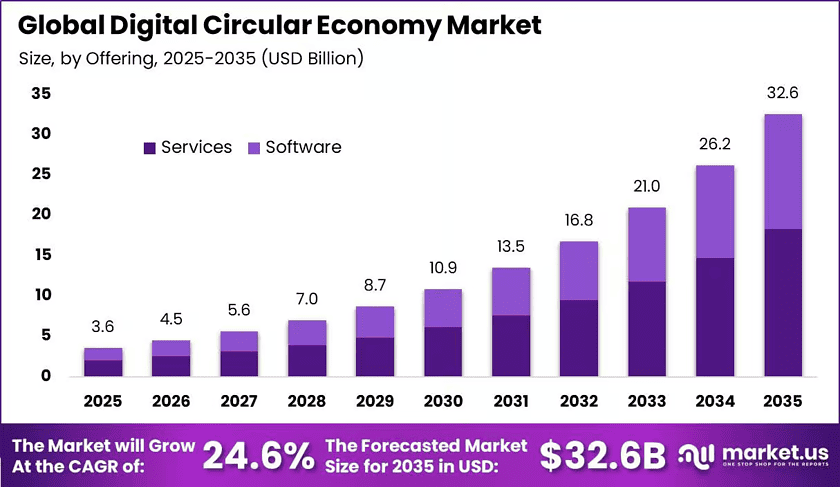
New York, NY – November 18, 2026 – The Global Digital Circular Economy Market reached USD 3.6 billion in 2025. Analysts expect it to hit about USD 32.6 billion by 2035, growing at a CAGR of 24.6% from 2026 to 2035. Consequently, digital waste and recycling solutions are moving from a niche into mainstream business planning.
Government rules, sustainability targets, and digital tools drive this growth. According to the report data, the world produced 62 million tonnes of e-waste in 2022. However, formal systems collected and recycled only 22.3% of it. This gap shows that companies need better tracking tools to recover valuable materials.
Moreover, the European Union treated about 1,992 million tonnes of waste in 2022, yet still disposed of 38.6%. Packaging waste reached 83.4 million tonnes, and only 40.7% of plastic packaging was recycled. These large volumes push buyers toward AI sorting, material marketplaces and product data platforms.
Additionally, recycled materials made up only 12.2% of total EU material use in 2024. Therefore, most production still depends on new resources. The EU plans to double recycled material use by 2030. It also wants recycling to supply 25% of strategic raw material needs, which opens new demand for circular technology.
Furthermore, EU packaging recycling must reach 70% by 2030. At least 40% of transport packaging must also be reusable from that year. From February 2027, battery passports will cover EV batteries and industrial batteries above 2 kWh. Consequently, lifecycle tracking platforms will become standard compliance tools.
Key Takeaways
- The Digital Circular Economy Market was valued at USD 3.6 billion in 2025 and is projected to reach USD 32.6 billion by 2035, growing at a 24.6% CAGR.
- In 2025, Services dominated the market with a 56.3% share.
- In 2025, Cloud Computing and Edge Computing captured a 27.8% market share.
- In 2025, Supply Chain and Material Tracking held a leading 24.5% share.
- In 2025, Industrial Manufacturing accounted for a dominant 25.7% market share.
- Europe led the market in 2025 with over a 36.4% share and around USD 1.31 billion in revenue.
➤ See the Full TOC, Market Tables & Figures in Your Sample Copy – https://market.us/report/digital-circular-economy-market/request-sample/
Digital Circular Economy Market Segmentation
By Offering
Services led the offering segment in 2025 with a 56.3% share. Many organizations need expert help to turn circular goals into working systems. Therefore, service providers map material flows, connect recyclers, prepare product data, and handle compliance reporting. This support lowers risk for companies that are new to circular operations.
Moreover, the size of circular activity keeps service demand strong. According to the report data, more than 4 million people worked in EU circular economy sectors in 2021. These sectors generated about EUR 686.9 billion in output. Consequently, repair, reuse, and recycling businesses need steady consulting and implementation support.
By Technology
Cloud Computing and Edge Computing captured a 27.8% share in 2025. Circular operations need fast, secure data sharing across factories, warehouses, and recycling plants. Additionally, 52.74% of EU enterprises used paid cloud services in 2025. This rise means more firms now have the digital base for circular tools.
Furthermore, the European Commission targets 75% of EU businesses using cloud-edge technology by 2030. Edge nodes grew from 498 in 2022 to about 1,836 in 2024. Therefore, companies can process data in real time. This speed helps them make quicker decisions on repair, reuse, and material recovery.
By Application
Supply Chain and Material Tracking held a 24.5% share in 2025. Circular supply chains need verified data from sourcing to final recovery. According to the OECD, counterfeit trade reached USD 467 billion in 2021. Consequently, businesses invest in QR codes, RFID tags, and secure records to protect product authenticity.
By End User
Industrial Manufacturing accounted for a 25.7% share in 2025. Manufacturers handle large volumes of raw materials, scrap and end-of-life products. Moreover, EU manufacturing generated about EUR 9.9 trillion in turnover in 2023. This scale means even small material savings create large financial gains for factory operators.
Additionally, manufacturing’s share of world GDP rose from 14.7% in 2000 to 16.7% in 2023. As output grows, manufacturers adopt digital twins, IoT sensors, and traceability tools. Therefore, these producers cut material loss, recover scrap, and meet sustainability reporting rules more easily.
Regional Analysis
Europe led the global market in 2025 with a 36.4% share and about USD 1.31 billion in revenue. Strict sustainability rules and a mature recycling system support this lead. Moreover, 85% of large EU enterprises used paid cloud services. This strong digital base speeds up adoption of product data platforms.
However, North America is expected to grow fastest. The US Infrastructure Investment and Jobs Act allocated USD 275 million to EPA recycling infrastructure for fiscal years 2022 to 2026. Additionally, the EPA announced USD 117 million in recycling grants. These funds boost demand for digital collection, sorting, and tracking solutions.
Market Drivers
Digital Product Passport rollout acts as a major growth driver. From February 2027, EV and industrial batteries above 2 kWh will need a battery passport. Consequently, companies must invest in product identifiers, cloud storage, and lifecycle records. According to the report data, this driver adds an estimated +3.2% to baseline CAGR.
Moreover, enterprise cloud adoption fuels steady market expansion. EU enterprise use of paid cloud services rose from 45.2% in 2023 to 52.7% in 2025. This growth means more firms can easily run SaaS compliance and data tools. Therefore, cloud adoption contributes an estimated +2.6% to the market’s baseline CAGR.
Key Use Cases
Recycling operators use AI-based sorting systems to separate mixed waste faster and more accurately. These tools identify plastics, metals, and packaging on moving conveyor lines. Consequently, recyclers recover cleaner materials and reduce manual labor. Moreover, better sorting quality helps them sell recovered materials to manufacturers at stronger prices.
Additionally, retailers and brands run digital take-back and resale programs. Customers scan QR codes to return, repair, or resell used products. Therefore, brands keep products in use longer and collect valuable lifecycle data. These programs also build customer loyalty and support sustainability reporting for retail and electronics companies.
Business Opportunities
Industrial material marketplaces offer a strong untapped opportunity. Secondary material supply remains scattered across waste generators, recyclers, and manufacturers. Digital marketplaces match buyers and sellers, verify quality, and track material origin. Consequently, platform providers can cut brokerage costs and help recyclers earn better margins on recovered materials.
Moreover, small and medium businesses create demand for simple circularity subscriptions. Many smaller firms lack budgets for large custom systems. Therefore, vendors can offer affordable cloud tools for tracking, reporting, and compliance. These ready-to-use packages lower entry barriers and open a wide new customer base for solution providers.
Major Challenges
Poor material data quality remains a serious challenge. Multi-tier supply chains often share incomplete or inconsistent product information. However, battery passport rules require accurate data through QR codes. Consequently, companies must improve supplier onboarding, data checks, and shared identifiers. Weak data can reduce platform use and weaken compliance results.
Additionally, high implementation costs slow adoption, especially among smaller firms. Circular systems need ERP integration, sensors, cybersecurity, and staff training. Moreover, small businesses face tighter financing than large companies. Therefore, vendors experience longer sales cycles and delayed approvals. This pressure also pushes providers to lower implementation pricing.
Top Key Players in the Market
- SAP SE
- IBM Corporation
- Accenture plc
- Microsoft Corporation
- Schneider Electric SE
- Circularise B.V.
- Rheaply Inc.
- Everledger Ltd.
- Resourcify GmbH
- Loopcycle Ltd.
- Veolia Digital Services
- TOMRA Systems ASA
- Avery Dennison Corporation
- Oracle Corporation
- Dassault Systèmes SE
- Hitachi Vantara LLC
- Infosys Ltd.
- Siemens AG
- PwC Circular Economy Services
- Capgemini SE
- Cognizant Technology Solutions
Conclusion
The Digital Circular Economy Market is growing quickly as rules, waste pressure, and digital adoption come together. Services, cloud platforms, and material tracking lead demand, while manufacturers remain the main users. Europe leads through strict rules, and North America is gaining ground through public funding. However, data quality and costs remain hurdles. Therefore, vendors offering affordable, connected solutions are best placed to succeed.
Discuss your needs with our analyst
Please share your requirements with more details so our analyst can check if they can solve your problem(s)