
Market Overview
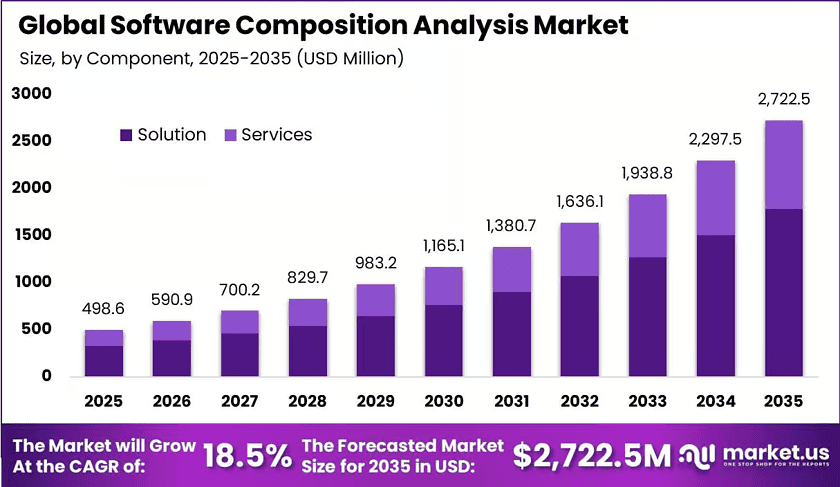
New York, NY – November 11, 2026 – The Global Software Composition Analysis Market reached a value of USD 498.6 million in 2025. The market will grow at a CAGR of 18.5% and reach USD 2,722.5 million by 2035. This steady rise shows that companies now treat open-source risk control as a core business need.
Moreover, more developers means more code that needs review. According to GitHub, the platform hosted more than 180 million developers in 2025, including over 36 million new users. Developers also made more than 1.12 billion contributions to public projects. Consequently, software teams add more open-source parts to their products, which raises demand for automated tracking tools.
Additionally, open-source code now forms the backbone of commercial software. According to Black Duck, 97% of commercial codebases contained open-source software, which made up 70% of total code. Each codebase used about 911 components on average. Therefore, businesses need SCA platforms to see what sits inside their applications and to manage hidden third-party risk.
However, this heavy reliance brings serious security exposure. According to Black Duck, 86% of assessed codebases held at least one vulnerable open-source component. Moreover, the average codebase carried 154 vulnerabilities. These findings mean security teams face large repair workloads. As a result, they adopt scanning tools that flag weak packages before release.
Furthermore, outdated code and new rules put more pressure on software buyers. According to Black Duck, 90% of codebases used components more than 4 years behind current versions. Meanwhile, the EU Cyber Resilience Act now sets security duties for digital products. Consequently, vendors and buyers invest in automated code auditing tools to prove compliance and reduce legal risk.
Key Takeaways
- The Software Composition Analysis market was valued at USD 498.6 million in 2025. It will reach USD 2,722.5 million by 2035, growing at a CAGR of 18.5%.
- The solution segment held a 65.5% share by component.
- The cloud-based segment held a 58.1% share by deployment mode.
- The large-enterprise segment held a 59.4% share by organization size.
- The BFSI segment led industry verticals with a 24.3% share.
- North America led in 2025 with a 36.7% share and about USD 187.1 million in revenue.
➤ See the Full TOC, Market Tables & Figures in Your Sample Copy – https://market.us/report/software-composition-analysis-market/request-sample/
Market Segmentation
By Component
The solution segment held a 65.5% share by component in 2025. Enterprises prefer automated platforms because manual checks cannot keep up with growing threat data. According to the NVD dashboard, more than 385,000 vulnerability records existed by 2026. Therefore, firms use SCA solutions that connect with code repositories and CI/CD pipelines to catch risky packages early.
By Deployment Mode
The cloud-based segment captured a 58.1% share by deployment mode. Teams spread across many locations need continuous scanning across apps, containers, and cloud workloads. According to Eurostat, 52.7% of EU enterprises used paid cloud services in 2025. Consequently, buyers choose cloud SCA for faster setup, easy scaling, central monitoring, and lower infrastructure costs.
By Organization Size
Large enterprises held a 59.4% share by organization size. These firms run large application portfolios, wide supplier networks, and strict compliance programs. According to IBM, the global average cost of a data breach reached USD 4.44 million in 2025. Therefore, big companies invest in continuous component monitoring to avoid costly incidents and protect customer trust.
By Industry Vertical
The BFSI segment led industry verticals with a 24.3% share. Banks and insurers must secure high-volume payment systems and customer apps. According to the U.S. Federal Reserve, non-cash payments reached 236.6 billion transactions in 2024. Moreover, the EU DORA rules now demand strong ICT risk control, which pushes financial firms toward SCA adoption.
Regional Analysis
North America led the market in 2025 with a 36.7% share and about USD 187.1 million in revenue. The United States drives demand through strong software activity and wide DevSecOps use. Additionally, according to Statistics Canada, Canadian software and computer services earned CAD 161.9 billion in 2024. This figure shows a strong regional base for security tool spending.
Asia Pacific will likely grow fastest during the forecast period. Expanding cloud services, digital payments, and government digital programs support this trend. According to the International Telecommunication Union, the region scored an average of 61 out of 100 on the Global Cybersecurity Index in 2024. Consequently, local firms adopt SCA tools to monitor third-party code and licenses.
Key Market Growth Drivers
Rising vulnerability volume is the strongest market driver. According to NIST, CVE submissions rose 263% between 2020 and 2025. NIST enriched nearly 42,000 CVEs in 2025 but still could not match new submissions. Therefore, enterprises use SCA platforms to automate dependency mapping and patch prioritization instead of relying only on public databases.
Additionally, secure software procurement rules shape buying decisions in North America and Europe. Government agencies and regulated buyers now ask suppliers for software bills of materials. According to CISA, SBOM guidance requires details such as supplier, version, and dependency links. Consequently, software vendors deploy SCA tools to produce accurate component records and win enterprise contracts.
Use Cases
Development teams use SCA tools inside CI/CD pipelines to scan code before each release. The tools flag risky open-source packages, outdated libraries, and hidden indirect dependencies. Moreover, they send alerts directly to developers. Consequently, teams fix problems early, which lowers repair costs and keeps release schedules on track.
Additionally, legal and compliance teams rely on SCA platforms for license management. These tools review open-source licenses and spot terms that conflict with business plans. Therefore, companies avoid legal disputes and protect their intellectual property. Furthermore, compliance teams create software bills of materials to meet customer and regulator requests.
Business Opportunities
AI model supply-chain security offers a strong growth path for vendors. AI systems add new dependencies across models, datasets, prompts, and APIs. Moreover, CISA has introduced AI SBOM guidance for organizations. Therefore, vendors that add model tracking, dataset checks, and malicious model detection can raise contract value and reach new buyers.
Additionally, managed SCA services create new demand in Asia Pacific, Latin America, and the Middle East. Many firms in these regions lack in-house security staff. Consequently, service providers can deliver scanning, reporting, and repair guidance as a subscription service. This model helps smaller companies get strong protection without heavy upfront spending.
Major Challenges
False-positive alerts create a major workload for SCA users. Many flagged vulnerabilities never reach production or cannot be exploited. However, developers still spend time reviewing each alert. Therefore, vendors must build stronger reachability analysis and runtime context. Without these features, alert fatigue reduces trust in findings and slows wider enterprise adoption.
Moreover, tight security budgets limit spending on standalone SCA tools. Software security competes with cloud, identity, and AI projects for funding. Consequently, mid-sized firms often delay purchases or choose bundled DevSecOps platforms. This shift creates pricing pressure for vendors and raises the cost of winning new customers in a slow economy.
Top Key Players in the Market
- Black Duck Software, Inc.
- Open Text Corporation
- Mend.io
- Sonatype Inc.
- Veracode
- Snyk Limited
- JFrog Ltd
- Flexera Software
- Checkmarx Ltd.
- Palo Alto Networks, Inc.
Conclusion
The Software Composition Analysis market shows strong momentum as open-source code spreads across commercial software. Rising vulnerability volumes, new security rules, and cloud adoption keep demand steady. However, false-positive alerts and tight budgets still slow some buyers. Moreover, AI supply-chain security and managed services open new revenue paths. Therefore, vendors that offer accurate, automated, and easy-to-use platforms will lead future market growth.
Discuss your needs with our analyst
Please share your requirements with more details so our analyst can check if they can solve your problem(s)