
Market Overview
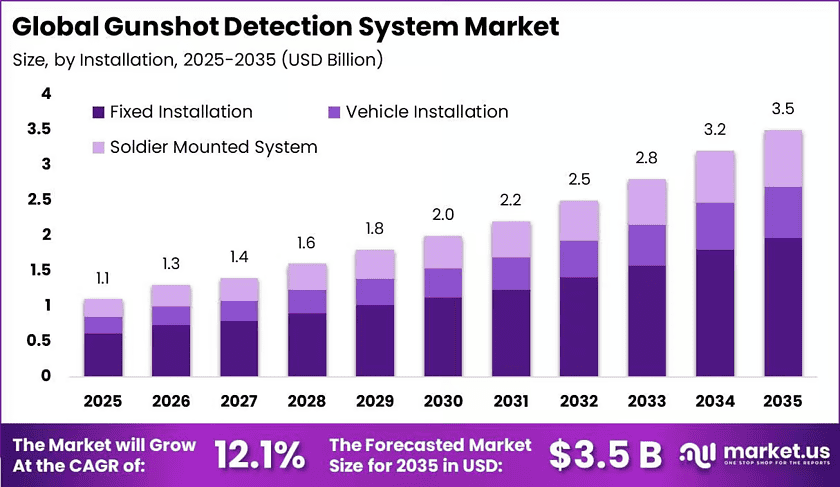
New York, NY – November 11, 2026 – The Global Gunshot Detection System Market reached USD 1.1 billion in 2025. Analysts project the market to hit USD 3.5 billion by 2035, growing at a CAGR of 12.1%. This steady growth shows that cities, schools, and defense agencies now treat acoustic gunfire detection as core safety infrastructure.
According to the CDC, the United States recorded 44,447 gun-related deaths in 2024. That equals about 1 death every 12 minutes. Moreover, the total fell 5% from 2023, yet the toll remains very high. Consequently, public agencies seek tools that send faster alerts and exact shot locations.
According to the FBI, the country saw 223 active-shooter incidents during 2020–2024. This figure marks a 70% rise over the prior five-year period. Additionally, the FBI counted 34 incidents in 2025, up 42% from 2024. Therefore, schools, transit operators, and city leaders now invest in rapid gunfire alert systems.
Government funding also lifts demand for shot detection technology. According to the U.S. Department of Justice COPS Office, the agency offered nearly USD 50 million in FY25. Moreover, it earmarked up to USD 73 million for FY26. These funds lower purchase barriers and help local buyers move safety projects forward faster.
Commercial adoption has also moved beyond the pilot stage. According to SoundThinking, ShotSpotter ran under contract in 178 cities and 22 campus sites at the end of 2025. Its network covered more than 1,092 square miles. Consequently, acoustic sensor networks now serve as proven tools for daily police response.
Key Takeaways
- The Gunshot Detection System Market was valued at USD 1.1 billion in 2025 and should reach USD 3.5 billion by 2035, growing at a CAGR of 12.1%.
- Fixed installation led the market in 2025 with a 56.2% share, while outdoor applications captured 84.7%.
- Outdoor applications dominate the Gunshot Detection System Market with an 84.7% share in 2025.
- The defense and government segment accounted for 78.6% of total revenue in 2025.
- North America led the market in 2025 with a 43.2% share, generating about USD 0.48 billion in revenue.
➤ Preview Key Insights with an Exclusive Sample Report Download – https://market.us/report/global-gunshot-detection-system-market/request-sample/
Market Segmentation
By Installation
Fixed Installation led the market with a 56.2% share in 2025. Buyers choose fixed systems because large sites need round-the-clock coverage. Moreover, these systems combine acoustic sensors, network links, and location software. As a result, security teams receive instant alerts showing the exact source of gunfire.
According to NCES, 99,073 U.S. public schools operated during 2024–25, serving 49.2 million students. This large base creates strong demand for sensors in classrooms, corridors, and parking areas. Additionally, vehicle installation and soldier-mounted systems serve mobile users who need protection during patrols and field missions.
By Application
Outdoor applications held an 84.7% share in 2025. Cities need detection across streets, parks, transit routes, and campuses where indoor systems cannot reach. According to the U.S. Bureau of Justice Statistics, nearly 576,000 firearm victimizations occurred in 2023. Therefore, police agencies rely on outdoor networks for hotspot monitoring and faster dispatch.
Indoor detection, however, forms a fast-growing expansion area. According to the UK National Protective Security Authority, one assessed system covers about 2,500 square feet per sensor. It reports detection in less than 1 second. Consequently, schools and offices can link indoor sensors with cameras, access control, and lockdown tools.
By End-Use
Defense and Government accounted for 78.6% of total revenue in 2025. Military bases, border posts, prisons, and critical sites need constant protection. According to SIPRI, global military spending reached USD 2.7 trillion in 2024, up 9.4% in real terms. Therefore, defense buyers hold strong budgets for force-protection technology.
Commercial users such as retail campuses, offices, and hospitals form a smaller but rising customer group. According to the U.S. Department of Energy, commercial buildings held 97.1 billion square feet of floor space in 2020. Consequently, private property owners present a wide base for future sensor deployments.
Regional Analysis
North America led the market with a 43.2% share, worth about USD 0.48 billion. The region benefits from strong defense purchasing and well-funded city, school, and transit agencies. Moreover, according to Public Safety Canada, the agency plans CAD 1.29 billion for community safety in 2025–26. This budget supports sensors, alerts, and dispatch tools.
Asia Pacific, however, stands as the fastest-growing region. Defense upgrades and smart-city projects drive protection of borders, ports, and transit networks. According to SIPRI, China raised military spending by 7.0% to USD 314 billion in 2024. Additionally, Japan lifted defense spending by 21%, its biggest yearly jump since 1952.
Key Growth Drivers
Federal school-safety grants make gunshot detection easier to buy. According to the DOJ COPS Office, two federal safety programs covered up to 75% of eligible installation costs. Consequently, schools can fund projects that once exceeded their budgets. This driver adds about 2.8% to the market CAGR in North America.
Rising urban gun incidents form a second key driver. Cities in North America and Latin America face dense firearm activity in crowded areas. According to Niterói officials in Brazil, ShotSpotter detected 92 shots during one nine-minute exchange in 2025. Therefore, city leaders adopt sensor networks to capture fast-moving gunfire events.
Key Use Cases
Schools and campuses use indoor detection to spot gunfire within corridors and classrooms. The system sends instant alerts to staff and police. Moreover, it can trigger lockdowns, open camera feeds, and guide responders to the exact room. Consequently, schools gain precious time to protect students during emergencies.
Military forces use vehicle- and soldier-mounted systems to locate hostile fire in the field. These systems give direction, range, and elevation data on incoming shots. Additionally, police departments link outdoor sensors with real-time crime centers. Therefore, officers combine acoustic alerts with camera and license plate data for faster investigations.
Business Opportunities
Commercial real estate, retail campuses, and corporate office parks offer a largely untapped market. Current deployments remain focused on public schools, transit hubs, and city sites. However, private properties face similar workplace violence risks. Therefore, vendors can bundle detection with existing access control and video contracts to reach new buyers.
Emerging markets offer a second strong growth path. Police forces in Latin America and Africa are now modernizing their tools and command centers. Moreover, drone-based detection payloads can extend coverage to remote or temporary sites. Consequently, vendors that offer flexible, software-led monitoring services can build steady recurring revenue in these regions.
Major Market Challenges
False alerts remain the biggest barrier to wider adoption. Acoustic sensors can confuse fireworks, vehicle backfires, and construction noise with gunfire. Consequently, police spend many hours on calls that involve no shooting. Moreover, these wasted responses weaken the return on investment that cities review during contract renewals.
High borrowing costs also slow city spending on safety technology. Many mid-sized municipalities delay discretionary purchases, which stretches vendor sales cycles. Additionally, shipping disruption and tariffs raise the cost of sensors, circuit boards, and copper wiring. Therefore, suppliers must manage inventory carefully and localize assembly to protect their margins.
Top Key Players in the Market
- ACOEM AB
- SoundThinking, Inc. (ShotSpotter)
- RTX Corporation
- THALES
- QinetiQ Limited
- Israel Aerospace Industries Ltd
- Databuoy
- ASELSAN AS
- Microflown AVISA
- Tracer Technology Systems Inc.
Conclusion
The Gunshot Detection System Market shows strong and steady growth across public safety and defense sectors. Fixed, outdoor, and government deployments lead demand today, while indoor and commercial use expands quickly. Moreover, federal grants and smart-city projects support new purchases. However, vendors must reduce false alerts and manage cost pressures. Consequently, companies that deliver accurate, integrated, and service-based solutions will capture the strongest future opportunities.
Discuss your needs with our analyst
Please share your requirements with more details so our analyst can check if they can solve your problem(s)