
Market Overview
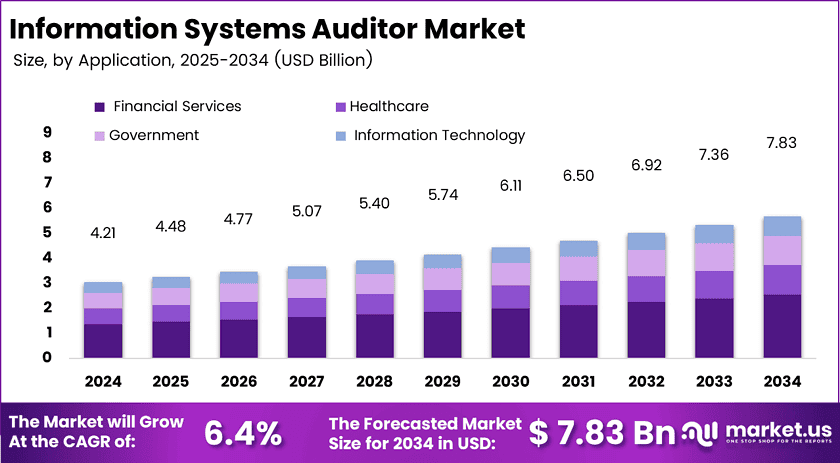
New York, NY – September 28, 2026 – The Global Information Systems Auditor Market generated USD 4.2 billion in 2024. The market is forecast to reach USD 7.8 billion by 2034. Consequently, the market will expand at a 6.4% CAGR from 2025 through 2034, supported by rising digital risk and compliance needs. North America led the Information Systems Auditor Market with a 39.2% share and USD 1.6 billion in revenue during 2025.
Organizations increasingly rely on cloud platforms, online payments, connected software, and artificial intelligence tools. These systems create more control points that require regular review. Moreover, information systems auditors test access rights, data protection, incident response, vendor controls, and business continuity processes. Their work helps leaders reduce exposure before disruptions damage operations or customer trust.
The FBI received 859,532 internet crime complaints during 2024, according to the FBI Internet Crime Complaint Center. Reported losses exceeded USD 16.6 billion, marking a 33% increase from 2023. Consequently, financial institutions, healthcare providers, government agencies, and technology companies need independent evidence that their digital controls operate effectively.
The North America region combines large cloud operations, strict disclosure rules, and substantial cyber exposure. Additionally, the World Bank reports that the United States supplies 87% of global cloud computing and data storage service exports. Cloud providers, data centers, software companies, and connected enterprises require recurring assurance services.
Key Takeaways
- The Information Systems Auditor Market generated USD 4.2 billion in 2024 and is forecast to reach USD 7.8 billion by 2034. The market is projected to grow at a 6.4% CAGR from 2025 to 2034.
- Information Security Audits led the service type segment with a 39.3% share.
- Financial Services led the application segment with a 32.6% share.
- On-Premise led the deployment type segment with a 61.8% share.
- Large Enterprises led the end-use segment with a 58.3% share.
- North America led the market with a 39.2% share and USD 1.6 billion in revenue.
➤ Evaluate the Report Quality with an Exclusive Sample Download – https://market.us/report/information-systems-auditor-market/request-sample/
Market Segmentation
Information Security Audits led the service type segment with a 39.3% share. Companies use these reviews to examine user access, network defenses, software settings, stored information, and recovery procedures. Moreover, cyber threats create frequent pressure for focused control testing. Auditors identify weak points and help management apply practical corrective actions before attacks cause larger losses.
Financial Services led the application segment with a 32.6% share. Banks, insurers, payment firms, and investment companies process valuable funds and sensitive information every day. Consequently, these organizations need regular reviews of transaction systems, access rules, recovery plans, supplier controls, and technology risk reporting to maintain customer confidence and regulatory compliance.
Healthcare represents a fast-growing application because hospitals, laboratories, insurers, and service partners store extensive patient data. According to the U.S. Department of Health and Human Services, large healthcare breaches increased 102% from 2018 through 2023. This rise shows why healthcare organizations need stronger reviews of records, devices, and external service providers.
On-premises deployment led the segment with a 61.8% share. Banks, government agencies, hospitals, and large companies often keep sensitive systems within their own facilities. Therefore, local deployment gives internal teams direct control over data location, access permissions, software changes, audit evidence, and integration with established security tools.
Cloud-Based deployment is growing as companies move applications and data to flexible online platforms. According to Eurostat, 52.7% of European Union enterprises bought cloud services in 2025. This level shows that auditors must evaluate shared responsibility, supplier oversight, identity controls, and remote evidence collection across expanding cloud environments.
Large Enterprises led the end-use segment with a 58.3% share. These organizations manage complex systems, multiple offices, large user groups, and broad supplier networks. Additionally, boards expect strong technology oversight because control failures can affect revenue, market standing, regulatory obligations, and customer relationships across several business units.
Regional Analysis
North America led the Information Systems Auditor Market with a 39.2% share and USD 1.6 billion in revenue during 2025. The United States supports demand through banking, healthcare, public markets, cloud services, and federal contracting. Moreover, Securities and Exchange Commission disclosure requirements increase the need for reliable cybersecurity governance and risk reviews.
Europe remains important because banks, manufacturers, public bodies, and digital service providers face broad privacy and cybersecurity obligations. Additionally, Asia Pacific offers expansion potential as China, India, Japan, South Korea, and Australia digitize payment systems, manufacturing, public services, and supply chains. These developments increase the number of systems requiring regular oversight.
Drivers
Cyber-resilience audit mandates drive recurring demand for assurance services. European Union requirements under NIS2 and DORA increase the need for control testing, technology records, and readiness reviews. Consequently, audit providers can move beyond annual projects and support continuous compliance work. This shift helps organizations maintain stronger evidence for regulators, customers, and insurers.
Cloud control assurance demand also supports market growth as enterprises place critical applications on external platforms. Companies must review service providers, identity systems, data protection, and shared security responsibilities. Moreover, corporate cyber disclosure rules increase management accountability. Auditors help leaders verify whether controls work before a material incident forces public reporting or operational recovery.
Use Cases
Financial institutions use information systems audits to review payment processing, fraud controls, customer data protection, and technology recovery plans. Auditors examine whether employees receive suitable access and whether critical systems produce reliable records. Consequently, banks and insurers can identify control gaps early, protect customer funds, and support regulatory reporting with clearer evidence.
Healthcare organizations use technology audits to protect patient records, connected medical systems, and third-party service relationships. Audit teams review access controls, data handling practices, backup arrangements, and incident response procedures. Moreover, these reviews help healthcare leaders reduce disruption risks while maintaining patient trust and supporting secure care delivery across connected facilities.
Business Opportunities
Continuous assurance subscriptions offer a strong opportunity for audit providers serving cloud-based and regulated businesses. Automated evidence collection can reduce manual preparation work and improve review speed. Therefore, providers can build recurring client relationships through ongoing control monitoring, exception reviews, and human-led assurance that supports faster business decisions and steadier revenue.
Operational technology assurance creates new opportunities across manufacturing, utilities, transport, and critical infrastructure. Industrial organizations connect production equipment with business networks, increasing the need for specialized control reviews. Additionally, providers can help clients assess system access, supplier risk, recovery readiness, and data integrity while protecting essential operations from costly interruptions.
Major Challenges
Specialized auditor talent shortages limit delivery capacity across cybersecurity, cloud controls, and regulatory compliance. Firms need professionals who understand both technical systems and business risks. However, competition for qualified staff raises labor costs and can delay projects. Providers must expand training, use shared delivery teams, and improve workflows to meet client demand.
Legacy and hybrid technology environments create another major challenge. Many organizations operate older systems alongside cloud platforms, modern applications, and external suppliers. Consequently, auditors must connect different control methods and evidence formats. Fragmented records can slow reviews, reduce consistency, and make it harder for management to understand enterprise-wide technology risk.
Top Key Players in the Market
- Capgemini
- Accenture
- IBM
- KPMG
- BDO International
- Crowe
- Hewlett Packard Enterprise
- McKinsey and Company
- Ernst and Young
- Deloitte
- RSM International
- Grant Thornton
- Protiviti
- Cognizant
Conclusion
The Information Systems Auditor Market will expand as organizations manage cyber threats, cloud adoption, regulatory duties, and connected business operations. Financial services, large enterprises, and on-premises environments currently shape demand. However, healthcare, cloud assurance, continuous monitoring, and industrial technology reviews create future growth paths. Providers that combine skilled professionals, practical automation, and sector knowledge can help clients build stronger digital trust.
Discuss your needs with our analyst
Please share your requirements with more details so our analyst can check if they can solve your problem(s)