
Market Overview
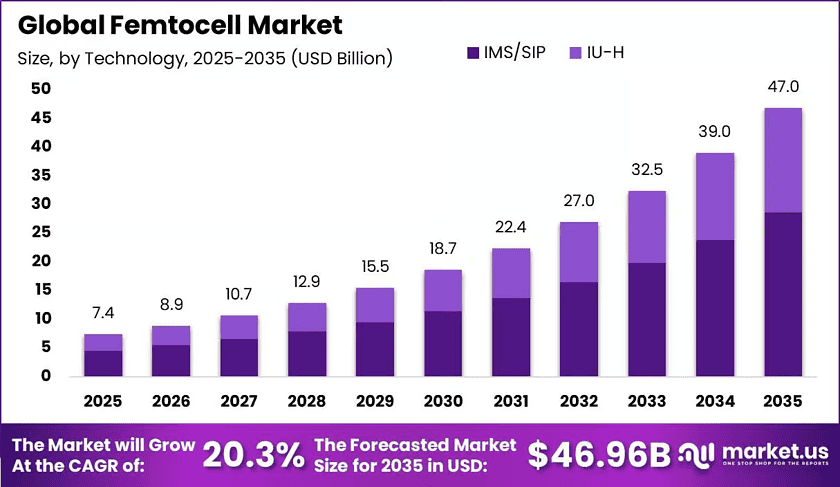
New York, NY – September 15, 2026 – The Global Femtocell Market reached USD 7.4 billion in 2025. Analysts expect the indoor small-cell sector to grow at a 20.3% CAGR from 2026 to 2035. Consequently, market value could reach USD 46.9 billion by 2035. This rise reflects steady demand for stronger in-building cellular coverage.
Rising mobile data use drives this expansion. According to the ITU, nearly 6 billion people, or about 74% of the world population, now use the internet, up from 60% in 2020. Therefore, more than 1.3 billion new users joined within five years, lifting indoor traffic loads.
Global mobile-cellular subscriptions passed 9.2 billion in 2025, while mobile broadband reached nearly 99 per 100 inhabitants. These levels show near-universal device ownership. Moreover, mobile data traffic may triple by 2030, so operators deploy femtocells to ease macro network congestion. Indoor coverage therefore becomes a priority investment.
The FCC has authorized more than USD 18 billion for rural broadband, while the Rural Digital Opportunity Fund adds USD 20.4 billion for underserved areas. Additionally, these programs fund the last-mile links that femtocells need, because every unit routes traffic over an existing broadband connection.
Global fixed and mobile broadband connections grew from 3.4 billion in 2014 to 9.4 billion by late 2024. Consequently, buyers want dependable in-building networks. North America led the market in 2025 with a 32% share and roughly USD 2.3 billion in revenue.
Key Takeaways
- The Femtocell Market stood at USD 7.4 billion in 2025 and may reach USD 46.9 billion by 2035 at a 20.3% CAGR.
- The IMS/SIP segment led technology with a 61.1% share, supported by wide VoLTE deployment.
- 4G/LTE femtocells held a dominant 41% share by type, while 5G femtocells grew fastest.
- Residential femtocells led end users with a 42.5% share, while enterprise units grew fastest.
- Indoor femtocells dominated applications with a 76% share, while outdoor units grow fastest.
- North America led in 2025 with a 32% share and USD 2.3 billion in revenue.
➤ Explore the Premium Report Sample with Full Table of Contents & Insights – https://market.us/report/femtocell-market/request-sample/
Market Segmentation
By Technology
IMS/SIP platforms led the market with a 61.1% share. According to the GSA, 375 operators across 156 countries invested in VoLTE by May 2025. Therefore, IP-based voice becomes the default architecture, and femtocells must link cleanly into these operator core networks.
GSMA data shows VoLTE and Vo5G connections passed 5 billion globally, near 60% of all mobile connections. This scale confirms that carriers retire older circuit-switched systems. Consequently, buyers favour IMS/SIP-ready units for homes, offices, and rural sites.
By Type
4G/LTE femtocells captured a 41% share because LTE still carries most mobile traffic. Mobile broadband now forms about 89% of subscriptions, against under 50% in 2015. However, only about 36% of these users moved to 5G, so LTE nodes remain essential and affordable.
5G femtocells grow fastest as carriers widen next-generation rollouts. Global 5G connections topped 2.7 billion by late 2025 and may add nearly USD 1 trillion to world output by 2030. Moreover, coverage reaches about 66% in cities but only 40% in rural areas, leaving clear gaps.
By End User
Residential femtocells led with a 42.5% share. U.S. Census data shows 15.1% of workers now work from home, against 5.2% in 2019. Therefore, households need steady signals for video calls and cloud tools, and home units strengthen coverage over existing broadband.
Enterprise femtocells grow fastest across offices, warehouses, and retail sites. The World Bank reports mobile network coverage near 98% of the population, so customers expect the same quality indoors. However, concrete walls and machinery weaken outdoor signals, which pushes firms toward dedicated in-building radios.
By Application
Indoor femtocells dominated applications with a 76% share. Global building floor area reached about 273 billion square metres in 2024, growing 1.7% in the year. Consequently, more enclosed space needs coverage, and indoor small-cell units already total around 5.6 million worldwide.
Regional Analysis
North America held a 32% share and about USD 2.3 billion in 2025. Mature LTE and 5G assets support this lead. Additionally, the FCC authorized over USD 18 billion for rural broadband, which funds the backhaul links that indoor cellular nodes depend on.
Europe grows fastest under Digital Decade 2030 goals. EU27 5G household coverage expanded to 96.8% in 2025, while mid-band coverage trails at 74.8%. Therefore, real capacity gaps remain indoors, and the European Parliament expects at least EUR 148 billion in connectivity investment.
Drivers
Enterprise indoor 5G coverage rules drive adoption in North America and Europe. EU household 5G coverage climbed from 89.0% in 2023 to 94.3% in 2024. Consequently, firms treat indoor connectivity as core infrastructure, and reported RFP-to-deployment timelines fell from about 9 months to under 6.
Hybrid work also lifts residential data demand. The Federal Reserve reports around 41% of workers spend part of the week remotely. Therefore, homes carry business-grade traffic every day. Moreover, Nokia notes that up to 80% of mobile traffic starts indoors, which favours home femtocells.
Use Cases
Remote workers use residential femtocells to hold stable voice and video sessions at home. The unit routes calls over household broadband, so signal strength no longer depends on distant towers. Consequently, families gain clearer calls, fewer dropped meetings, and better app performance across bedrooms and basements.
Enterprises install femtocells inside offices, hospitals, hotels, and warehouses. Thick walls, metal racking, and insulated glass block block outdoor signals in these spaces. Therefore, facility teams place small nodes near work zones to support handsets, scanners, and connected sensors without rebuilding the wider network.
Business Opportunities
Vendors can bundle femtocell hardware with private 5G-Advanced network slicing subscriptions. Mid-sized firms want managed indoor coverage rather than owned equipment. Consequently, suppliers shift from one-time sales to recurring service revenue, and analytics add-ons improve customer retention across multi-year enterprise contracts.
Rural gigabit programs open a second opportunity across Europe and emerging markets. Public funds co-finance network builds where mid-band coverage stays weak. Therefore, operators can pair subsidised backhaul with indoor nodes in schools, clinics, and small businesses, reaching users that macro towers still serve poorly.
Major Challenges
Shipping disruption in the Red Sea corridor delays component deliveries from Asia to Europe. Rerouting around the Cape of Good Hope stretches transit times and raises freight costs. Consequently, manufacturers hold larger buffer stocks, which ties up working capital and slows product launches.
A shortage of skilled RF engineers also limits growth in North America and Europe. Indoor network design needs careful planning for interference, handover, and spectrum use. Therefore, projects wait for scarce specialists, and vendors invest in automated planning tools and partner training programmes.
Top Key Players in the Market
- Cisco Systems, Inc.
- Nokia Corporation
- Telefonaktiebolaget LM Ericsson
- Huawei Technologies Co., Ltd.
- Samsung Electronics Co., Ltd.
- ZTE Corporation
- CommScope Holding Company, Inc.
- NEC Corporation
- Airspan Networks Holdings Inc.
- Qualcomm Technologies, Inc.
- Casa Systems, Inc.
- Baicells Technologies Co., Ltd.
- Other Key Players
Conclusion
The Femtocell Market moves toward steady long-term growth as indoor data use rises. IMS/SIP technology, LTE hardware, residential users, and indoor deployments lead today, while 5G, enterprise, and outdoor segments gain speed. North America leads revenue, and Europe expands quickest. However, supply-chain strain and skills gaps remain real hurdles for vendors and operators.
Discuss your needs with our analyst
Please share your requirements with more details so our analyst can check if they can solve your problem(s)