
Market Overview
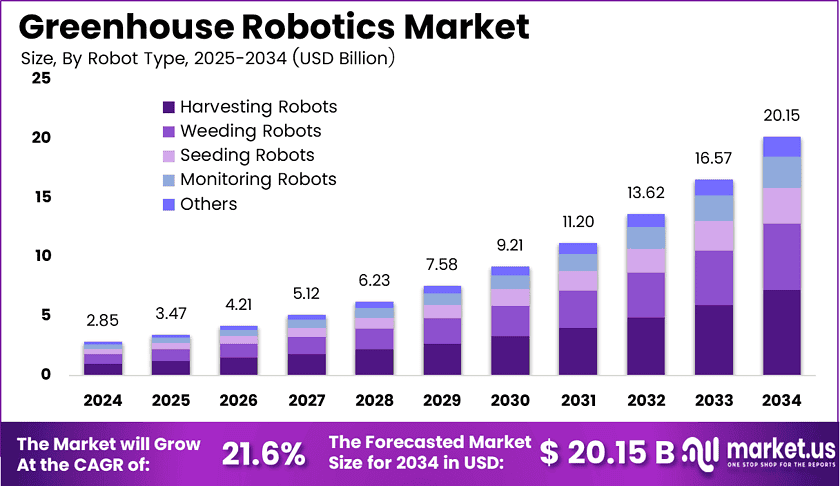
New York, NY – September 17, 2026 – The Global Greenhouse Robotics Market reached USD 2.8 billion in 2024 and should hit USD 20.1 billion by 2034. Growth runs at a 21.6% CAGR. Rising labor costs and controlled environment farming drive this fast expansion.
U.S. controlled environment agriculture operations grew from 1,476 in 2009 to 2,994 in 2019, while output climbed 56% to 786 million pounds. More indoor farms create more repeat daily tasks. Therefore, growers now look for machines to handle that work.
Greenhouse vegetable area covered 133 million square feet in 2022, with sales near USD 982 million. Large glasshouse space needs constant inspection and picking. Consequently, automation suppliers see a wide installed base for harvesting, scouting, and watering machines.
According to the USDA NASS Farm Labor Report, the average field worker wage reached USD 18.42 per hour in 2024, up 3% year on year. Hired workers rose to 797,000 in October. Moreover, costlier labor shortens the payback time on farm robots.
The Congressional Research Service reports that U.S. farmers hired about 1.2 million domestic farmworkers in 2024. The Department of Labor approved 363,000 H-2A certifications that year. Additionally, the FAO ranks agricultural robotics among the three fastest-emerging AI areas in farming.
Key Takeaways
- The Greenhouse Robotics Market held USD 2.8 billion in 2024 and will reach USD 20.1 billion by 2034. at a 21.6% CAGR during the 2025 to 2034 forecast period.
- By offering, hardware leads with a 56.7% share, while software grows fastest.
- By robot type, harvesting robots lead with a 35.8% share, while monitoring robots grow fastest.
- By application, crop monitoring leads with a 40.6% share, while harvesting grows fastest.
- By end-user, commercial greenhouses lead with a 52.7% share, while research institutes grow fastest.
- North America dominates with a 37.8% share and revenue of USD 1.08 billion in 2025.
➤ Download a Complimentary Sample of This Premium Report (Full TOC Included) – https://market.us/report/greenhouse-robotics-market/request-sample/
Market Segmentation
By Offering
Hardware leads the offering segment with 56.7%. Every greenhouse robot needs a mobile base, cameras, sensors, motors, and task tools. The International Federation of Robotics recorded nearly 20,000 agricultural robot sales in 2023 after 21% unit growth. Therefore, spare-part demand keeps rising.
Software grows fastest, however. Better vision models help one machine spot fruit colour, plant stress, weeds, and safe travel paths. Fleet tools let managers schedule many units from a single screen. Consequently, growers gain more output without buying extra machines.
By Robot Type
Harvesting robots lead with 35.8% because picking repeats daily and shapes saleable output. USDA data place wages and contract labor at 42% of greenhouse and nursery production expenses in 2022. Therefore, automated picking protects margins during peak weeks when fruit quality drops quickly.
By Application
Crop monitoring holds 40.6% of applications. Managers need daily plant and climate readings at every growth stage. The FAO estimates global greenhouse cover at 1.4 million to 2 million hectares. Moreover, that scale makes manual scouting slow, costly, and inconsistent.
Irrigation management should grow fastest as water rules tighten. An FAO-backed project in Al-Baha, Saudi Arabia, cut water use by about 24% and lifted irrigation efficiency from 50% to more than 92%. Consequently, buyers gain a clear payback case for smart watering.
By End-User
Commercial greenhouses lead with 52.7% because scale spreads automation costs across high crop volumes. USDA counted 23,060 U.S. horticultural specialty operations in 2024, with sales of USD 18.307 billion. Therefore, larger growers can fund robot fleets, service contracts, and staff training.
Research institutes grow fastest from a smaller base. Universities and public labs test grippers, machine vision, and navigation before growers adopt them. The National Science Foundation network had invested nearly USD 500 million in AI institutes by 2023. Additionally, public funding speeds up crop trials.
Regional Analysis
North America dominates with a 37.8% share and USD 1.07 billion in revenue. USDA recorded 11,465 greenhouse vegetable farms in 2022, and tomatoes, lettuce, and cucumbers form 60% to 70% of indoor output. Therefore, growers here adopt automation early.
Asia Pacific grows fastest through the forecast period. U.S. greenhouse tomato output alone reached 763 million pounds in 2023, yet Asia produces more than half of global vegetables. Moreover, government smart farm programs in China and South Korea fund robotic picking and AI monitoring pilots.
Drivers
Labor shortages in picking, scouting, and pruning push growers toward machines. USDA Economic Research Service analysis names labor availability a key constraint in indoor farming. Therefore, fewer skilled operators can manage larger areas, adding roughly 3.4% to the baseline CAGR of 21.6%.
Sensor-led climate control adds around 2.7% to forecast growth. Robots and connected sensors track heat, humidity, light, and moisture along fixed routes. Consequently, managers correct problems within hours instead of days, which protects yields and lowers energy waste across intensive horticulture regions.
Use Cases
Commercial tomato and pepper growers deploy harvesting robots along fixed row rails. The machines judge ripeness, cut stems gently, and place fruit into trays. Moreover, they work through evenings and weekends, which helps operators clear picking backlogs without hiring extra seasonal crews.
Leafy green producers use monitoring robots for daily scouting. Cameras flag pest signs, leaf discolouring, and uneven plant growth early. Additionally, irrigation robots map dry spots and leaks, then trigger precise watering, so nurseries protect plant health and reduce chemical and water waste.
Business Opportunities
Robotics-as-a-service contracts open the market to smaller growers. Monthly or seasonal fees replace heavy upfront spending, and suppliers keep ownership of the machines. Therefore, vendors earn recurring income from software, maintenance, and remote monitoring while buyers avoid long approval cycles for capital projects.
Retrofit automation suits existing glasshouses across Europe, North America, China, and Türkiye. Standard kits add rails, sensors, and vision units without rebuilding structures. Moreover, post-harvest links to sorting and packing lines let operators automate the full crop journey step by step.
Major Challenges
Crop variability still limits robot performance. Fruit hides under leaves, ripeness differs, and canopy density changes by season. Consequently, suppliers must fund crop-specific datasets, model retraining, and exception handling, which raises engineering costs and slows entry into new crops and climates.
High upfront costs and mixed equipment slow projects. Growers also budget for conveyors, safety gear, cabling, and greenhouse changes. Additionally, robots from different vendors rarely share one control system, so farm teams face integration work, data governance questions, and reliability issues in humid houses.
Top Key Players in the Market
- Iron Ox
- Root AI
- Octinion
- Agrobot
- FFRobotics
- Metomotion
- Spread Co., Ltd.
- Priva
- Certhon
- LettUs Grow
- Autogrow
- ecoRobotix
- Harvest CROO Robotics
- Bowery Farming
- Green Automation Group
- AeroFarms
- Robotics Plus
- Naio Technologies
- Blue River Technology
Conclusion
Greenhouse robotics moves from simple automation toward self-learning systems that pick, scout, and water crops. Hardware still leads sales, while software and monitoring tools grow quickest. North America holds the largest share, and Asia Pacific expands fastest. Labor shortages, water rules, and AI vision keep pushing adoption. Service-based contracts and retrofit kits should open doors for smaller growers. Buyers should compare payback carefully.
Discuss your needs with our analyst
Please share your requirements with more details so our analyst can check if they can solve your problem(s)