
Market Overview
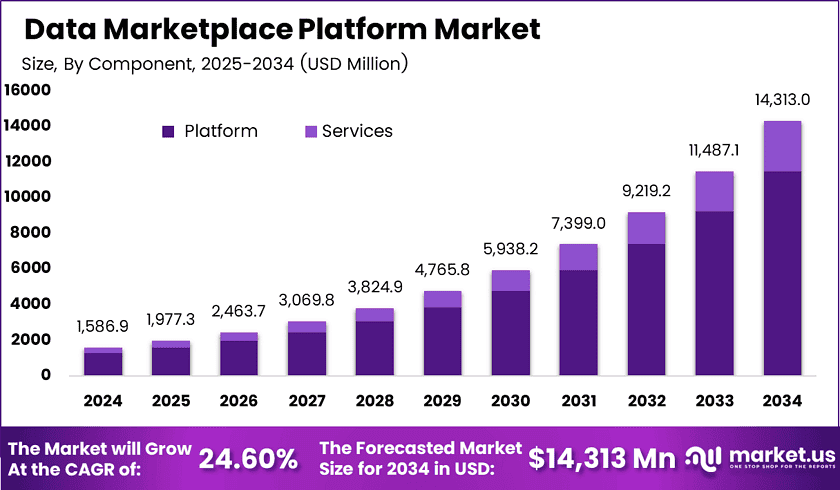
New York, NY – September 16, 2026 – The Global Data Marketplace Platform Market reached USD 1,586.9 million in 2024. Analysts expect the sector to hit USD 14,313.0 million by 2034. Moreover, that path reflects a 24.6% CAGR, as firms buy more trusted external data. North America captured more than 41.6% of global revenue in 2024, worth about USD 660.1 million.
Companies now need outside data for pricing, risk checks, customer analysis, supply planning, and AI model training. According to UN Trade and Development, business e-commerce sales across 43 economies rose nearly 60% between 2016 and 2022, reaching USD 27 trillion. Therefore, digital trade keeps feeding data demand.
The International Telecommunication Union reported that 66% of Asia-Pacific people used the internet in 2024. This large online base supports digital commerce, mobile services, and online payments. Additionally, every new digital service creates fresh records that platforms can package, license, and resell.
The World Bank found that East Asian firms investing in digital tools grew from 13% in 2020 to 54% in 2022. Other developing regions stayed below 30%. However, each new digital workflow still needs outside data on customers, credit, demand, and supply risk.
Key Takeaways
- The Data Marketplace Platform Market reached USD 1,586.9 million in 2024 and will touch USD 14,313 million by 2034 at a 24.6% CAGR.
- By Component: Platform led with an 80.4% share, driven by wider use of integrated data exchange and monetization tools.
- By Deployment: Cloud-based led with 90.7% share, helped by scale, flexibility, and lower infrastructure costs.
- By Revenue Model: Commission held a 45.2% share as platforms earned more from transaction-based pricing.
- By Enterprise Size: Large Enterprises held a 74.5% share, backed by strong digital systems and bigger budgets.
- By End-User: Financial Services led with 30.1% share, supported by demand for risk analytics and compliance data.
- North America led with USD 660.1 million in 2024, followed by Europe and Asia-Pacific.
➤ Get Instant Access to the Premium Report Sample Before Purchase – https://market.us/report/data-marketplace-platform-market/request-sample/
Market Segmentation
By Component
Platform leads the component segment with 80.4% share. Buyers prefer one place to find, test, license, and pay for external data. Moreover, Snowflake reported 13,296 customers as of January 31, 2026, with product revenue of USD 4.47 billion, up 29%. This scale shows strong network effects.
Services will grow faster because companies need help with integration, cleansing, governance, and staff training. Snowflake’s professional services revenue rose from USD 164.0 million to USD 211.6 million in fiscal 2026, nearly 29% growth. Therefore, wider platform use also lifts demand for migration and support work.
By Deployment
Cloud-based deployment holds a 90.7% share because firms trade data without installing local infrastructure. Eurostat reported that 52.7% of EU enterprises bought cloud services in 2025, up 7.4 points from 2023. Consequently, hosted data workloads keep shifting onto shared cloud exchanges.
Database hosting served 45.5% of enterprise cloud users, which signals ready capacity for marketplace workloads. Additionally, buyers can raise or cut usage without hardware spending, while sellers refresh central datasets faster. Therefore, cloud delivery will also record the quickest growth through the forecast period.
By Revenue Model
Commission pricing leads with a 45.2% share because sellers pay only after a completed sale. This low-risk model attracts more listings and ties platform income to deal value. Moreover, operators can price by data volume, freshness, and usage rights, which suits varied buyer needs.
Subscription models will grow fastest as enterprises want steady costs and always-on data access. Salesforce earned about 94% of fiscal 2025 revenue from subscription and support, with total revenue of USD 37.9 billion, up 9%. Informatica’s cloud subscription revenue reached USD 186.8 million, rising 33%. These figures confirm buyer preference for recurring services.
By Enterprise Size
Large enterprises hold a 74.5% share because they buy many datasets and face strict compliance rules. Their bigger IT teams manage licensing, integration, and access control at scale. Additionally, OECD data show 76% of large European firms employed ICT specialists in 2020, versus only 14% of SMEs. That skills gap explains the split.
SMEs will grow fastest as cloud tools, subscriptions, and managed services cut upfront costs. An OECD review of the United Kingdom in 2026 found more than 60% of surveyed firms invested in cloud computing, over 40% in analytics, and about 25% in AI. Consequently, packaged datasets suit smaller buyers.
By End-User
Financial services leads end users with a 30.1% share because banks, insurers, and payment firms need constant risk and pricing data. The World Bank Global Findex 2025 covered about 145,000 adults across 141 economies and found 79% held accounts. Therefore, digital finance creates very large data volumes.
Healthcare and life sciences will grow fastest as teams use clinical, claims, and genomic data. WHO Europe reported 44 countries with national digital health strategies, while only 19 had guidance for evaluating digital tools. However, that gap slows buying until clear evaluation rules arrive.
Regional Analysis
North America dominates with an estimated 41.5% share in 2024 and USD 660.1 million in value. Strong cloud adoption and data monetization investment support this lead. Moreover, the United States alone holds nearly 78.4% of the regional share, helped by major technology providers and advanced enterprise analytics.
Asia-Pacific will grow fastest at a 25.8% CAGR, backed by government data-sharing programmes in China, Japan, and India. Europe follows with about 27.6% of global revenue, supported by GDPR-led transparency rules. Additionally, the Middle East, Africa, and Latin America together hold roughly 10.9% through smart city and fintech projects.
Drivers
The European Union Data Act entered into force on 11 January 2024 and applied broadly from 12 September 2025. According to the European Commission, this rule opens governed access to connected-product data. Consequently, marketplaces can charge by query, tier, or permitted use, adding about 3.4% to forecast growth.
Enterprise AI training-data demand adds roughly 3.0% to the growth outlook. Model builders need labelled, refreshed, and rights-cleared datasets that internal systems rarely hold. Therefore, buyers turn to external catalogues for coverage and speed. Additionally, cloud-native procurement contributes about 2.6% by simplifying purchase and delivery.
Use Cases
Enterprises source external datasets to train and test AI models. Teams license market, location, and behaviour data instead of building collections from scratch. Moreover, clear usage rights help legal teams approve projects faster. Therefore, product groups move from pilot work to live deployment with fewer delays.
Retailers and consumer goods firms use bought-in data for demand planning and pricing. Analysts blend competitor prices, weather signals, and shopper trends to guide stock decisions. Consequently, planners cut markdowns and avoid empty shelves. Additionally, marketing teams sharpen targeting using verified audience and identity datasets.
Business Opportunities
Usage-governed AI data products remain open white space. Most inventory still sells as raw files or broad subscriptions. However, vendors can package curated sets with lineage, permitted model scopes, refresh promises, and usage metering. Therefore, platforms shift from bulk delivery toward recurring, governance-led services with better margins.
Federated confidential data exchanges create a second long-term opening. Partners can run joint analysis without moving sensitive records across borders. Moreover, this design suits banking, health, and public sector buyers with strict rules. Consequently, operators that master privacy technology can unlock datasets rivals cannot trade.
Major Challenges
Data quality standardization remains the main growth ceiling. Suppliers use different schemas, refresh cycles, and documentation depth. Consequently, buyers discount assets, limit use to pilots, and skip renewals. Therefore, operators must invest steadily in profiling, lineage capture, quality scoring, and buyer-facing validation tools.
Privacy compliance liability also lengthens sales cycles. A platform can host discovery and contracting, yet cannot remove legal risk from unlawful collection or unsuitable reuse. Moreover, suppliers hold back premium datasets while buyers demand indemnities. Additionally, scarce governance talent slows fixes across most regions.
Top Key Players in the Market
- Acxiom LLC
- Amazon Web Services
- Dawex
- Snowflake
- Quandl
- BattleFin
- Narrative.io
- Datatrade
- Oracle Corporation
- Microsoft Corporation
- Adobe
- SAP SE
- Cloudera, Inc.
- IBM Corporation
- Google LLC
- Informatica LLC
- Talend S.A.
- Others
Conclusion
Data marketplace platforms now sit at the centre of modern digital business. Cloud delivery, commission pricing, and platform models lead today, while services, subscriptions, and smaller buyers gain speed. North America keeps its lead, yet Asia-Pacific grows quickest. However, privacy duties, quality gaps, and unclear ownership still shape deal timelines. Therefore, vendors that combine governance, curation, and clear usage rights should win lasting enterprise trust.
Discuss your needs with our analyst
Please share your requirements with more details so our analyst can check if they can solve your problem(s)