
Market Overview
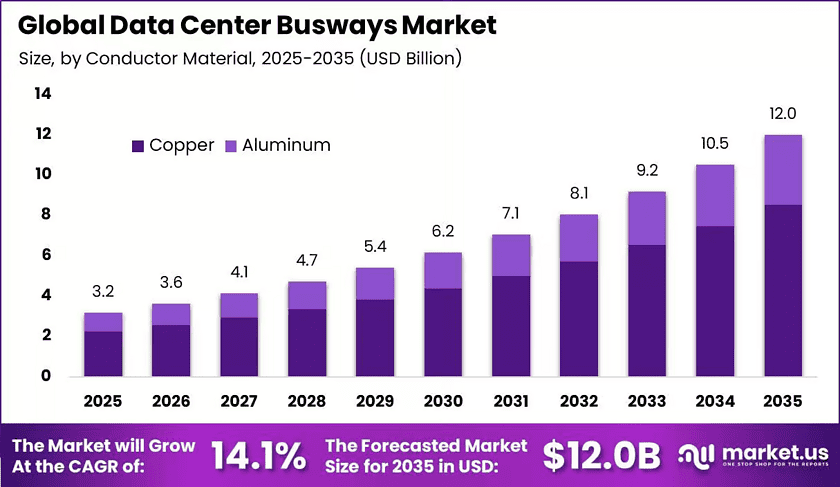
New York, NY – September 30, 2026 – The Global Data Center Busways Market reached USD 3.1 billion in 2025. The market may reach about USD 12.0 billion by 2035, expanding at a 14.1% CAGR as operators build larger cloud, colocation, enterprise, and AI-focused facilities.
Moreover, rising electricity demand is increasing the need for reliable power distribution. According to the IEA, data center electricity use reached about 485 TWh in 2025. Higher consumption increases current loads across server halls, creating stronger demand for scalable busway systems that distribute power efficiently.
Additionally, AI infrastructure is raising rack power density across modern facilities. According to Siemens and Rittal, AI data centers already operate above 100 kW per rack in many cases. Higher rack loads require larger conductors, flexible tap-off points, and power systems that operators can expand without major redesign work.
Data center construction also supports market expansion. U.S. data center construction spending increased from USD 31.1 billion in 2024 to about USD 41 billion in 2025. This growth creates direct opportunities for busway suppliers because every new server hall requires structured electrical distribution before racks enter service.
Furthermore, cloud growth is strengthening long-term infrastructure spending. Microsoft reported USD 59.3 billion in Microsoft Cloud revenue during the quarter ended June 2026. Expanding cloud workloads require additional racks, cooling systems, power equipment, and monitoring tools, which supports continued demand for advanced data center busway installations.
Key Takeaways
- The Data Center Busways Market reached USD 3.18 billion in 2025 and may reach USD 12.0 billion by 2035 at a 14.15% CAGR.
- Copper led conductor materials with a 71% share because of its high electrical conductivity.
- Sandwich Busway held a 40.9% share and may grow at a 14.1% CAGR.
- The 801–1,250 A segment held 32.9%, while Above 1,250 A may grow at 17.1%.
- Low Voltage held an 80% share, while Medium Voltage may expand at 19.9%.
- Overhead Busway held a 62.5% share and may grow at a 13.5% CAGR.
- Busway Trunking led with 47.25%, while Monitoring and Communication Modules may grow at 19.1%.
- Tier III held a 51% share, while Tier IV may expand at 16.15%.
- Hyperscale Data Centers led with 35.1% and may grow at a 16.85% CAGR.
- Power Distribution held 38.9%, while Cooling Infrastructure may expand at 15.5%.
- Cloud Service Providers led with 35.1% and may grow at a 16.35% CAGR.
- North America led with 38.1% and generated about USD 1.21 billion in 2025.
➤ Evaluate the Report Quality with an Exclusive Sample Download – https://market.us/report/data-center-busways-market/request-sample/
Market Segmentation
Copper led conductor materials with a 71% share. According to the International Annealed Copper Standard, copper provides 100% reference conductivity versus roughly 61% for aluminium. This performance helps busways carry high electrical loads through smaller conductors, supporting dense data center layouts.
Sandwich Busway led busway types with a 40.9% share. According to Uptime Institute, modal rack density exceeded 11 kW in 2026. Compact sandwich designs reduce electrical impedance and support higher currents, making them suitable for expanding cloud and AI server environments.
The 801–1,250 A category led power ratings with a 32.9% share. NVIDIA systems can require about 120–142 kW per rack. These power levels increase demand for higher-capacity busways that can support dense GPU installations while allowing future rack expansion.
Low Voltage held an 80% market share. Most servers, GPUs, and switches operate through common low-voltage power systems. Consequently, low-voltage busways remain the main final distribution link between electrical rooms and server racks across enterprise, hyperscale, and colocation facilities.
Overhead busways held a 62.5% share. High-density facilities increasingly place power systems above racks because raised-floor spaces now support cooling pipes and other infrastructure. Moreover, overhead systems simplify tap-off access, improve maintenance flexibility, and help operators expand rack capacity with less disruption.
Busway Trunking led components with a 47.25% share. Uptime Institute reported that power problems caused 45% of impactful outages in 2025. This risk supports strong demand for reliable trunking systems and monitoring modules that improve visibility across critical electrical infrastructure.
Tier III facilities held a 51% share because they combine strong redundancy with manageable infrastructure cost. Tier III designs provide about 99.98% availability. This reliability level supports commercial data centers that need continuous operations without the higher capital requirements associated with Tier IV designs.
Hyperscale Data Centers led facility types with a 35.1% share. Major technology companies continue investing heavily in AI and cloud infrastructure. Larger campuses require extensive power distribution across thousands of racks, which increases demand for modular busways, monitoring systems, and higher-capacity electrical components.
Cloud Service Providers led end users with a 35.1% share. AWS reported USD 42.2 billion in second-quarter 2026 sales. Rapid cloud expansion increases demand for new server racks and electrical capacity, directly supporting busway installations across large data center campuses.
Regional Analysis
North America led the market with a 38.1% share and about USD 1.2 billion in revenue. Virginia’s data center inventory reached roughly 4,039.6 MW by the end of 2025. This concentrated capacity supports continued investment in power distribution infrastructure.
Asia Pacific may grow at about a 16% CAGR. Data center capacity in India increased from about 375 MW in 2020 to nearly 1,575 MW in 2025. Expanding hyperscale developments across the region create strong demand for busways in power rooms and server halls.
Drivers
AI rack density is a major market driver. Rack power moved from about 9 kW in 2025 to above 11 kW in 2026. Higher GPU loads increase current requirements, encouraging data centers to adopt higher-amperage busways that can support future AI infrastructure.
Hyperscale investment also supports market growth. Eaton reported data center orders increasing about 200% year over year during the fourth quarter of 2025. Strong supplier demand shows that cloud and AI infrastructure spending is translating directly into larger electrical equipment backlogs and busway installations.
Use Cases
Power distribution remains the main use case for data center busways. Operators use these systems to move electricity from switchgear and distribution panels toward server racks. Moreover, modular tap-off points allow technicians to add or relocate rack connections without rebuilding large sections of fixed electrical infrastructure.
Cooling infrastructure also creates an important use case. Liquid-cooling pumps, chillers, coolant distribution units, and related equipment require dedicated electrical feeds. Consequently, busways help operators distribute power efficiently between computing racks and cooling systems while maintaining flexibility inside rapidly changing high-density data halls.
Business Opportunities
Embedded monitoring creates a strong opportunity for suppliers. Many older facilities still operate busways without real-time sensing. Vendors can retrofit temperature, current, voltage, and load monitoring modules, allowing operators to track electrical performance continuously while creating recurring software, analytics, and maintenance revenue opportunities.
Medium-voltage campus distribution offers another growth opportunity. Large AI and hyperscale campuses need efficient power movement across multiple buildings and substations. Therefore, suppliers that combine medium-voltage busways, monitoring systems, protection equipment, and engineering services can capture larger project values as data center campuses expand.
Major Challenges
Skilled electrical labor remains a major challenge for busway projects. Large data center developments require qualified electricians for installation, testing, commissioning, and maintenance. Consequently, labor shortages can extend project schedules, raise installation costs, and push suppliers toward prefabricated systems that reduce field work requirements.
Legacy facility retrofits create another challenge. Older buildings often have limited ceiling space, fixed cable routes, and existing cooling infrastructure. Therefore, suppliers must design flexible busway layouts that fit around operating equipment while minimizing downtime, safety risks, and disruption to active server environments.
Top Key Players in the Market
- Schneider Electric SE
- Legrand SA
- Eaton Corporation plc
- ABB Ltd.
- Siemens AG
- Vertiv Group Corp.
- USA TrackBusway LLC
- Zhenjiang Anyi Electrical Co., Ltd.
Conclusion
The Data Center Busways Market is expanding as cloud computing, AI infrastructure, hyperscale facilities, and higher rack densities increase electrical demands. Copper conductors, sandwich designs, overhead installations, and advanced monitoring systems remain important areas of development. Suppliers that support flexible power distribution, efficient retrofits, higher capacities, and integrated monitoring can strengthen their position as global data center construction continues.
Discuss your needs with our analyst
Please share your requirements with more details so our analyst can check if they can solve your problem(s)