
Market Overview
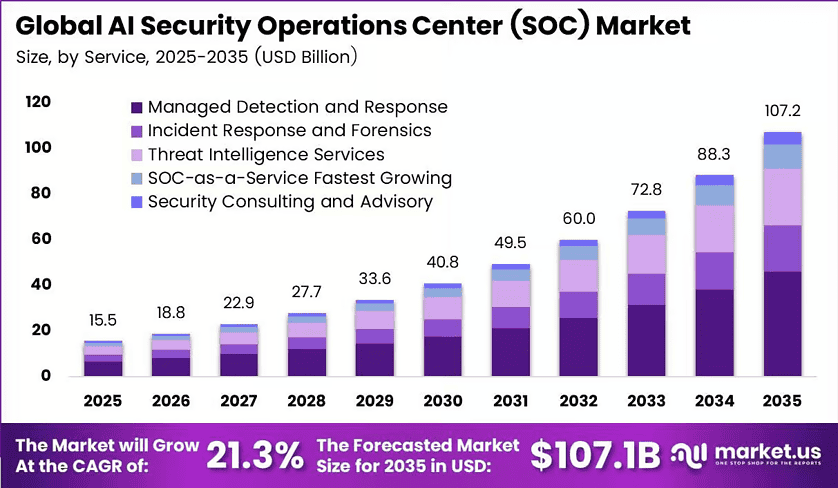
New York, NY – September 30, 2026 – The Global AI Security Operations Center Market reached USD 15.5 billion in 2025. The market is projected to reach USD 107.2 billion by 2035, expanding at a 21.3% CAGR. AI SOC platforms help security teams detect threats, connect alerts, and speed incident response across complex digital environments.
Moreover, rising cybercrime is increasing pressure on enterprise security teams. According to the FBI, internet-crime complaints reached 1,008,597 in 2025, while losses approached USD 21 billion. This increase creates larger alert volumes, making automated threat analysis and faster response essential for organizations.
Additionally, AI-enabled security operations reduce repetitive analyst work. These platforms review security logs, identify unusual behavior, and group related events into clearer investigations. Consequently, companies can prioritize serious incidents sooner, improve response decisions, and protect digital assets without expanding internal teams at the same pace.
Cloud adoption also supports demand for AI-driven security monitoring. According to Eurostat, 52.7% of European Union enterprises bought cloud computing services in 2025. This growing cloud use creates more identities, applications, access points, and audit logs that security teams must monitor continuously.
Furthermore, regulators are increasing expectations for continuous risk monitoring and incident reporting. NIST Cybersecurity Framework 2.0 supports stronger governance and reporting practices. Therefore, organizations are investing in AI security operations tools that improve visibility, strengthen compliance, and help teams manage threats across cloud, network, endpoint, and identity environments.
Key Takeaways
- The AI Security Operations Center Market reached USD 15.5 billion in 2025 and may reach USD 107.2 billion by 2035, growing at a 21.3% CAGR.
- Managed Detection and Response held a leading 43% share because organizations increasingly seek continuous external security monitoring.
- AI-enabled threat detection platforms accounted for 31.1% of the market as teams manage expanding vulnerability and network-event volumes.
- Cloud-based deployment held a 58% share, reflecting wider enterprise adoption of cloud infrastructure and hosted security software.
- Cloud Security Monitoring led applications with a 24% share because organizations require continuous oversight of cloud systems, identities, and audit logs.
- Agentic AI held a 30.5% share and grew at a 24.5% CAGR, supporting automated investigation, prioritization, containment, and remediation.
- Cloud Security held an 18% share and expanded at a 25.2% CAGR as cloud workloads create wider monitoring requirements.
- Small and medium enterprises held a 70% share because they represent the largest business population and need affordable security support.
- BFSI held a 21% share because financial institutions protect transactions, customer accounts, payment systems, and sensitive data.
- North America held a 42.0% share and generated about USD 6.5 billion in 2025, while Asia Pacific grew at a 25.8% CAGR.
➤ Evaluate the Report Quality with an Exclusive Sample Download – https://market.us/report/ai-security-operations-center-soc-market/request-sample/
Market Segmentation
Managed Detection and Response leads the service segment with a 43% share. According to the UK Government Cyber Security Breaches Survey, 48% of businesses used external cybersecurity providers. This preference shows that companies value specialist monitoring, threat investigation, and response support without building large in-house security operations teams.
Moreover, SOC-as-a-Service is expanding at a 30% CAGR because subscription models offer flexible security coverage. External provider use among UK micro businesses rose from 39% to 44%. This shift signals stronger reliance on outsourced monitoring among smaller organizations with limited security staff and budgets.
AI-enabled threat detection platforms hold a 31.1% software share because security teams face growing event volumes. According to NIST, CVE submissions increased 263% between 2020 and 2025. The rising volume makes automated vulnerability analysis important for faster prioritization and reduced analyst workload.
Additionally, threat intelligence platforms are growing at a 29.1% CAGR as teams seek faster information about attackers and malware. ENISA analyzed 4,875 cybersecurity incidents from July 2024 through June 2025. This large incident base increases demand for current intelligence that improves detection and response decisions.
Cloud-based deployment leads with a 58% share because enterprises increasingly run applications and data through hosted infrastructure. According to Eurostat, 65.5% of cloud users purchased cloud security software. This purchasing pattern supports demand for scalable AI SOC platforms that operate across distributed cloud environments.
Cloud Security Monitoring leads applications with a 24% share. The U.S. Government Accountability Office reviewed 8 federal cloud systems and found only 3 had fully implemented continuous monitoring. These gaps show why organizations need stronger visibility across cloud workloads, identities, logs, and network activity.
Furthermore, Agentic AI leads technology with a 30.5% share and grows at a 24.5% CAGR. The UK National Cyber Security Centre managed 429 incidents during 2024–2025. This workload supports tools that can investigate, prioritize, contain, and remediate threats with more operational independence.
Cloud Security leads the security environment segment with an 18% share and a 25.2% CAGR. FedRAMP lists 687 cloud products, including 636 SaaS offerings. This large cloud footprint creates more identities, APIs, configurations, and workloads requiring continuous security oversight.
Small and medium enterprises hold a 70% share because they form the largest business group. According to the U.S. Small Business Administration, the United States had 36.2 million small businesses in 2026. This broad customer base supports demand for accessible cloud-based monitoring and managed cybersecurity services.
BFSI leads industry demand with a 21% share because banks and insurers manage valuable digital assets. The European Banking Authority recorded more than 1,200 major ICT incidents during early 2025. These events increase demand for systems that detect payment fraud, account compromise, and network threats quickly.
Regional Analysis
North America led the market with a 42.0% share and about USD 6.5 billion in revenue during 2025. The region benefits from advanced cloud infrastructure, high cybersecurity spending, and broad AI adoption. Consequently, public agencies and enterprises continue investing in automated monitoring, threat detection, and incident response capabilities.
Asia Pacific is the fastest-growing region, expanding at a 25.8% CAGR. According to the International Telecommunication Union, 77.1% of the region’s population used the internet in 2025. This expanding digital base increases security needs across connected users, devices, applications, financial services, and cloud platforms.
Drivers
AI-powered and agentic cyberattacks drive demand for faster security operations. According to Fortinet, 86% of organizations experienced a cyber breach in 2024. This widespread exposure pushes companies toward AI-native platforms that detect, correlate, and prioritize threats before attackers cause wider operational or financial damage.
Moreover, multi-cloud adoption and identity growth expand the number of security events teams must review. Sumo Logic reported that more than 70% of security teams struggle with alert fatigue. This burden encourages companies to combine security information, automation, and orchestration tools into integrated security operations workflows.
Use Cases
Cloud Security Monitoring helps organizations track user activity, application behavior, access changes, and audit logs across cloud environments. Security teams use these platforms to identify risky configurations and suspicious actions quickly. Consequently, businesses can protect cloud workloads while maintaining visibility across distributed infrastructure and remote users.
Incident Response and Remediation support faster action after ransomware, credential theft, malware, or unauthorized access. AI SOC tools connect related alerts and recommend response steps for analysts. Additionally, automated workflows can isolate affected systems, preserve evidence, and reduce the time attackers remain active inside business environments.
Business Opportunities
Agentic AI creates an opportunity for vendors to deliver more autonomous security operations. These platforms can investigate alerts, collect evidence, prioritize risks, and execute approved response workflows. Therefore, providers can reduce manual analyst effort while helping customers improve response speed, service quality, and operational margins.
Compliance-focused SOC bundles offer another growth path for vendors serving regulated industries. Banks, healthcare providers, utilities, and government agencies need consistent monitoring and reporting. Moreover, suppliers can combine security analytics, audit trails, policy controls, and managed services into solutions designed for specific compliance and operational needs.
Major Challenges
Cybersecurity skills shortages limit the ability of organizations to operate advanced security platforms effectively. According to ISC2, 59% of professionals reported critical or significant skills gaps in 2025. This shortage increases demand for managed services, yet vendors must still provide training, integration support, and clear operational guidance.
Additionally, platform integration remains difficult when companies use separate SIEM, SOAR, XDR, cloud, and identity tools. Disconnected data can create incomplete investigations and delayed response decisions. Vendors must improve interoperability, normalize security data, and provide explainable audit trails that regulated customers can trust and review.
Top Key Players in the Market
- CrowdStrike Holdings, Inc.
- Microsoft Corporation
- Palo Alto Networks, Inc.
- SentinelOne, Inc.
- IBM Corporation
- Google LLC
- Cisco Systems, Inc.
- Fortinet, Inc.
- Check Point Software Technologies Ltd.
- Rapid7, Inc.
- Splunk Inc.
- Elastic N.V.
- Darktrace plc
- Exabeam, Inc.
- Securonix, Inc.
- ReliaQuest, LLC
- Arctic Wolf Networks, Inc.
- Sophos Limited
- Trellix, LLC
- Vectra AI, Inc.
Conclusion
The AI Security Operations Center market is growing as organizations face more complex cyber threats, wider cloud use, and increasing compliance demands. Managed detection, cloud monitoring, threat intelligence, and agentic AI are shaping buyer priorities. North America remains the largest market, while Asia Pacific offers strong growth potential. Vendors that simplify integration, improve trust, and automate practical response actions can build lasting competitive advantage.
Discuss your needs with our analyst
Please share your requirements with more details so our analyst can check if they can solve your problem(s)