Overview
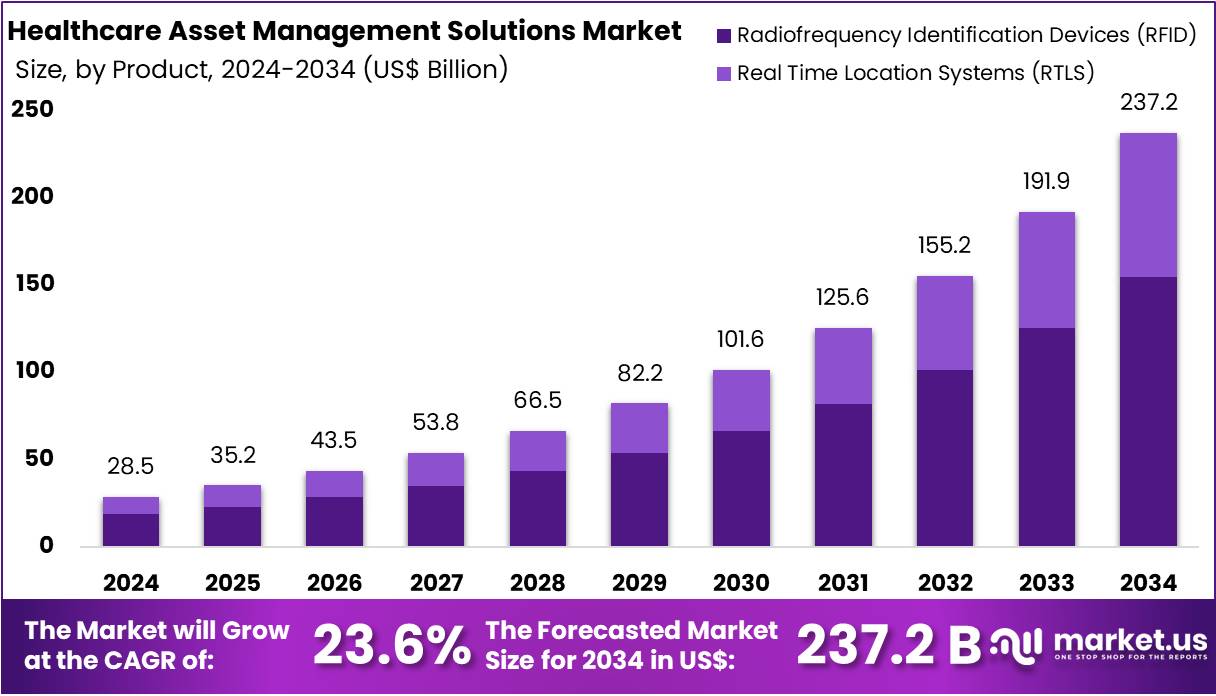
New York, NY – April 22, 2026 – The Global Healthcare Asset Management Solutions Market size is expected to be worth around US$ 237.2 Billion by 2034, from US$ 28.5 Billion in 2024, growing at a CAGR of 23.6% during the forecast period from 2025 to 2034. North America held a dominant market position, capturing more than a 42.6% share and holds US$ 12.1 Billion market value for the year.
Healthcare Asset Management Solutions are specialized systems designed to track, monitor, and optimize the utilization of medical equipment and infrastructure across healthcare facilities. These solutions integrate advanced technologies such as radio-frequency identification (RFID), real-time location systems (RTLS), and cloud-based software platforms to provide accurate visibility into asset location, status, and lifecycle.
The adoption of these solutions has been driven by the increasing need for operational efficiency, cost containment, and improved patient care outcomes. Hospitals and healthcare providers are able to reduce equipment loss, minimize idle time, and ensure timely availability of critical assets. It has been observed that effective asset management can lower capital expenditure by optimizing procurement cycles and extending asset lifespan.
Additionally, regulatory compliance and maintenance management are streamlined through automated tracking and reporting features. Preventive maintenance schedules can be adhered to more efficiently, reducing the risk of equipment failure and enhancing patient safety.
Market growth is supported by the rising digitization of healthcare infrastructure and increasing investments in smart hospital initiatives. North America currently leads adoption due to advanced healthcare systems, while emerging economies are witnessing gradual uptake driven by expanding healthcare networks.
Overall, Healthcare Asset Management Solutions are becoming essential tools in modern healthcare ecosystems, enabling data-driven decision-making and improved resource allocation while supporting long-term operational sustainability.
Key Takeaways
- By 2034, the global Healthcare Asset Management Solutions market is projected to reach a valuation of US$ 237.2 Billion, rising from US$ 28.5 Billion in 2024.
- A robust compound annual growth rate (CAGR) of 23.6% is anticipated over the forecast period from 2025 to 2034.
- In 2024, Radiofrequency Identification (RFID) devices dominated the product segment, contributing more than 65.3% to the overall market share.
- The Hospital Asset Management segment accounted for the largest share within applications in 2024, exceeding 53.6% of the total market.
- Hospitals led the end-use segment, capturing over 46.7% of the market share in 2024.
- North America held the leading regional position in 2024, representing 42.6% of the global market and achieving a valuation of US$ 12.1 billion.
Regional Analysis
In 2024, North America maintained a leading position in the Healthcare Asset Management Solutions market, accounting for over 42.6% share and reaching a valuation of US$ 12.1 billion. This dominance is attributed to the rapid integration of digital healthcare technologies across the United States and Canada, where healthcare providers increasingly deploy real-time asset tracking systems to enhance operational efficiency and control costs.
The region benefits from well-established healthcare infrastructure and a high density of medical facilities, supporting the adoption of advanced technologies such as RFID, RTLS, and IoT-based solutions. Regulatory requirements related to equipment maintenance and patient safety have further accelerated investments in asset monitoring systems.
Additionally, the rising prevalence of chronic diseases and increasing hospital admissions have driven demand for improved hospital capacity and operational efficiency. As a result, healthcare institutions continue to invest in scalable asset management platforms to minimize equipment loss and improve emergency response capabilities.
Emerging Trends
- Integration of AI and Predictive Analytics: Artificial intelligence is increasingly being integrated into healthcare asset management systems to automate tracking and enable predictive decision-making. These systems analyze historical data to forecast maintenance needs, reduce downtime, and improve overall asset lifecycle management efficiency.
- Adoption of IoT-Enabled Smart Tracking: The use of Internet of Things (IoT) sensors is expanding rapidly, enabling continuous monitoring of asset location, condition, and usage. This trend supports real-time visibility and enhances operational control across hospitals and healthcare networks.
- Growth of RFID and RTLS Technologies: RFID and real-time location systems (RTLS) are witnessing strong adoption due to their ability to provide accurate, automated asset tracking. These technologies improve inventory management, reduce search time, and optimize equipment utilization in healthcare facilities.
- Shift Toward Automation and Digital Workflows: Healthcare providers are increasingly shifting toward automated asset tracking and digital workflows. This reduces manual errors, improves compliance, and supports efficient resource allocation, aligning with the broader trend of smart hospital development.
Use Cases
- Medical Equipment Tracking and Utilization: Healthcare asset management solutions are widely used to track critical medical equipment such as infusion pumps and ventilators. Real-time tracking reduces search time, improves availability, and prevents unnecessary equipment purchases.
- Inventory and Supply Chain Management: These solutions enable efficient monitoring of inventory levels, pharmaceuticals, and consumables. Automated tracking ensures timely replenishment, minimizes waste, and enhances supply chain efficiency across healthcare facilities.
- Patient and Staff Tracking Applications: Asset management systems are utilized for tracking patients, staff, and critical movements within hospitals. This improves patient safety, enhances workflow efficiency, and ensures better coordination during emergency situations.
- Preventive Maintenance and Compliance Management: Healthcare providers use these solutions to schedule preventive maintenance and ensure regulatory compliance. Real-time data helps in reducing equipment failure risks, maintaining safety standards, and improving operational reliability across healthcare environments.
Frequently Asked Questions on Healthcare Asset Management Solutions
- What factors are driving the growth of the Healthcare Asset Management Solutions Market?
Market growth is primarily driven by increasing healthcare digitization, rising demand for operational efficiency, and the need to reduce equipment loss. Additionally, regulatory compliance requirements and growing investments in smart hospital infrastructure further support the expansion of this market. - Which technologies are commonly used in healthcare asset management?
Common technologies include radio-frequency identification (RFID), real-time location systems (RTLS), barcode systems, and Internet of Things (IoT) platforms. These technologies enable real-time tracking, data collection, and analytics, supporting efficient asset utilization and timely maintenance management across healthcare environments. - Which segment dominates the Healthcare Asset Management Solutions Market?
The RFID-based solutions segment dominates the market due to its high accuracy and efficiency in tracking assets. In terms of application, hospital asset management leads, supported by increasing demand for streamlined operations and improved patient care outcomes in hospitals. - Why are hospitals the leading end-users of these solutions?
Hospitals represent the largest end-user segment due to their extensive use of medical equipment and the need for efficient asset tracking. High patient inflow, complex workflows, and regulatory requirements drive hospitals to adopt advanced asset management systems for better resource allocation. - Which region leads the Healthcare Asset Management Solutions Market?
North America leads the market owing to its advanced healthcare infrastructure and early adoption of digital technologies. Strong government support, high healthcare expenditure, and increasing demand for automation contribute significantly to the region’s dominant market position. - What benefits do healthcare providers gain from asset management solutions?
Healthcare providers benefit through improved asset utilization, reduced operational costs, and minimized equipment loss. These solutions also enhance patient safety by ensuring timely maintenance, improving workflow efficiency, and enabling data-driven decision-making within healthcare organizations. - What is the future outlook for the Healthcare Asset Management Solutions Market?
The market outlook remains highly positive, driven by continuous technological advancements and increasing healthcare investments. Growing adoption of IoT-enabled systems and analytics platforms is expected to further enhance efficiency, supporting sustained market growth over the forecast period.
Conclusion
the Healthcare Asset Management Solutions market is experiencing strong growth, driven by increasing digital transformation, demand for operational efficiency, and rising healthcare infrastructure investments. The integration of advanced technologies such as RFID, RTLS, IoT, and AI is enhancing asset visibility, reducing costs, and improving patient safety outcomes.
North America continues to lead due to its advanced systems, while emerging regions are steadily adopting these solutions. With a projected CAGR of 23.6% through 2034, the market outlook remains highly positive. Continued innovation and expanding use cases are expected to strengthen adoption, making asset management solutions essential for sustainable healthcare operations globally.
Discuss your needs with our analyst
Please share your requirements with more details so our analyst can check if they can solve your problem(s)