Introduction
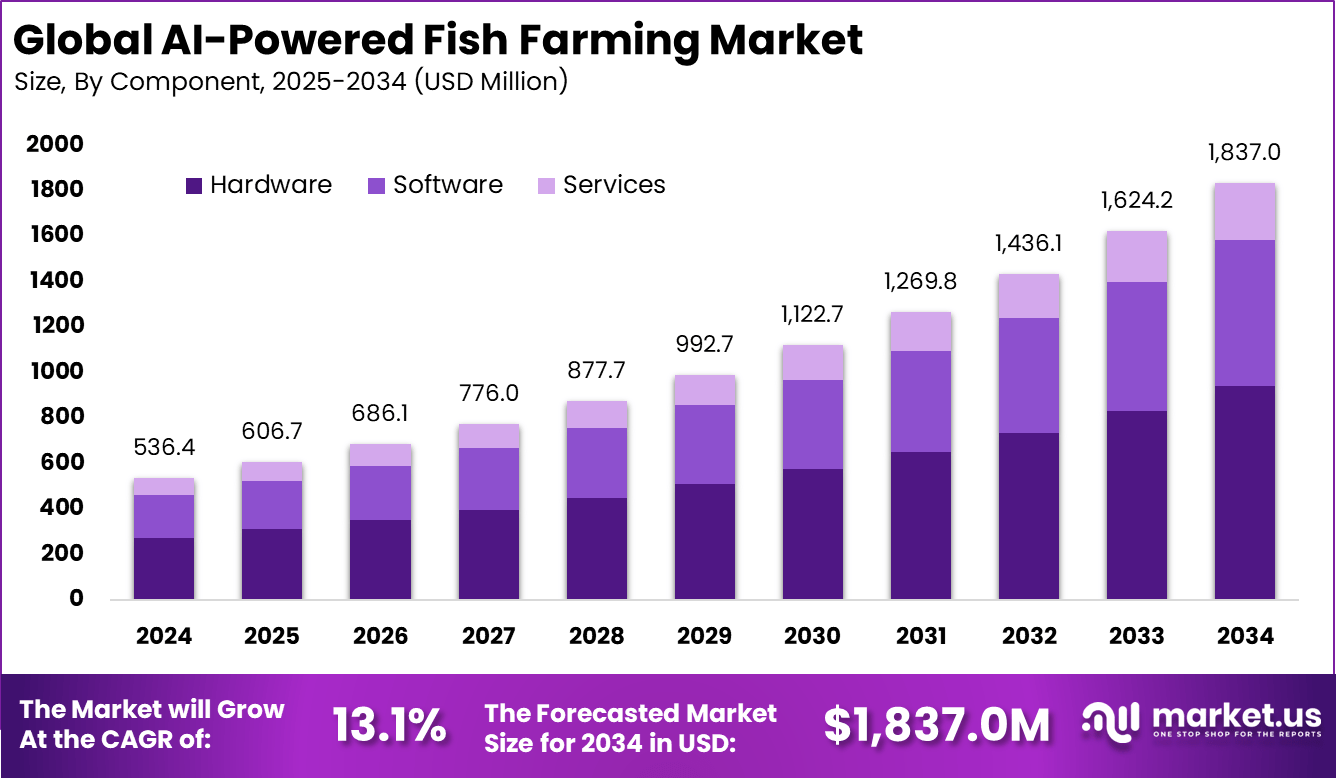
The Global AI-Powered Fish Farming Market reached USD 536.4 million in 2024 and is projected to hit USD 1,837.0 million by 2034, expanding at a CAGR of 13.1%. Europe dominated in 2024 with a 40.3% share and USD 216.1 million in revenue. Growth accelerates due to rising seafood consumption, automated aquaculture, and increasing demand for sustainable, technology-driven production.
How Growth Is Impacting the Economy
AI-powered fish farming strengthens the global economy by improving productivity, reducing operational inefficiencies, and lowering mortality rates through predictive analytics. This boosts output for major aquaculture nations, increasing export revenues and strengthening domestic food security. The adoption of AI-driven monitoring systems creates new high-skill jobs in data science, aquaculture automation, and marine robotics.
As fish farming shifts from traditional methods to smart systems, economic value increases through reduced feed waste, optimized harvesting cycles, and better disease detection. The sector also attracts investments from governments and private companies aiming to modernize food systems. Furthermore, AI improves resource efficiency, reducing environmental impact and ensuring long-term economic sustainability in the blue economy.
➤ Smarter strategy starts here! Get the sample – https://market.us/report/ai-powered-fish-farming-market/free-sample/
Impact on Global Businesses
Rising costs emerge as companies invest in sensors, underwater drones, and AI-based feeding systems. Supply chains shift toward automation vendors and smart aquaculture platforms. Sector-specific impacts include improved yields in salmon, tilapia, and shrimp farming; enhanced disease management in high-density farms; and reduced environmental risks in coastal aquaculture operations. Businesses gain better forecasting accuracy, reducing financial losses linked to unpredictable conditions.
Strategies for Businesses
• Invest in AI-based feeding automation
• Adopt predictive analytics for disease management
• Strengthen biosecurity through real-time monitoring
• Collaborate with marine-tech providers
• Implement sustainable and low-impact farming methods
• Use data-driven decision tools for stock optimization
Key Takeaways
• Market to reach USD 1,837.0 million by 2034
• CAGR at 13.1% supports long-term industry digitalization
• Europe leads with 40.3% share
• AI strengthens sustainability and yield efficiency
• Investors increase funding for smart aquaculture
➤ Unlock growth secrets! Buy the full report – https://market.us/purchase-report/?report_id=167865
Analyst Viewpoint
The market reflects strong momentum as aquaculture players transition toward intelligent farming for higher output and environmental stability. Current adoption focuses on feeding accuracy, water-quality prediction, and mortality reduction. Future prospects remain positive as fisheries integrate robotics, breed-optimization algorithms, and climate-adaptive systems. Continuous innovation and regulatory support position AI-powered aquaculture as a core pillar of sustainable food production globally.
Use Case & Growth Factors
| Use Case | Description | Growth Factors |
|---|---|---|
| Smart Feeding | AI optimizes feed supply and reduces waste | Rising feed costs, demand for precision aquaculture |
| Disease Prediction | Early detection using vision & sensors | Need to reduce mortality & antibiotic use |
| Water Quality Monitoring | Real-time AI-based analytics | Environmental compliance & sustainability |
| Stock Management | Tracking fish health and biomass | Higher yield expectations & export demand |
Regional Analysis
Europe leads adoption due to advanced aquaculture infrastructure, strict sustainability frameworks, and early investment in digital fisheries. Asia Pacific follows, with rapid expansion driven by the growing seafood demand of China, India, Vietnam, and Indonesia. North America sees increasing uptake in salmon and trout farms with focus on automation. Latin America develops gradually, supported by Chilean salmon farming modernization. The Middle East & Africa advance with smart aquaculture pilots addressing food security.
➤ Want more market wisdom? Browse reports –
Business Opportunities
AI-powered fish farming offers strong opportunities in automated feeding systems, underwater imaging technologies, environmental monitoring platforms, and disease-prediction tools. Emerging markets present demand for scalable AI solutions enabling sustainable fish breeding and offshore aquaculture. Companies can also expand into feed optimization, climate-adaptive farming, and integrated IoT-AI farming ecosystems. Investors gain opportunities in robotics, precision aquaculture software, and AI-enabled biosecurity services. As global protein demand rises, AI solutions unlock efficiency and resilience in fish production.
Key Segmentation
The market includes segments by component (hardware, software, services), by application (feeding optimization, disease prediction, water quality monitoring, stock management), and by farm type (onshore farms, offshore farms, recirculating aquaculture systems). Feeding optimization accounts for the largest adoption due to immediate cost savings. Water-quality monitoring expands rapidly due to higher environmental compliance needs. Offshore systems grow steadily as countries explore deep-sea aquaculture.
Key Player Analysis
Leading companies focus on developing integrated AI solutions combining sensors, machine vision, real-time analytics, and machine-learning models for predictive aquaculture. Their strategies include expanding product portfolios, enhancing cloud-based monitoring platforms, and forming partnerships with large aquaculture producers.
Innovation targets high-accuracy biomass estimation, automated feeding robots, and environmental analytics. Providers invest in R&D to strengthen disease prediction accuracy, improve underwater imaging, and reduce the energy consumption of autonomous systems. Many players also expand globally to support the digital aquaculture transformation.
- Aquabyte
- Aquaconnect
- Bioplan
- Cermaq Group AS
- Deep Vision AS
- GoSmart Farming
- NeuroSYS Sp. z o. o.
- ReelData
- SEAWATER Cubes GmbH
- Skretting by Nutreco N.V.
- TidalX AI Inc.
- xpertSea
- Others
Recent Developments
• Launch of next-gen AI feeding automation systems
• Expansion of digital aquaculture monitoring platforms
• Integration of underwater drones for biomass tracking
• Development of climate-adaptive aquaculture models
• Partnerships to scale AI-driven hatchery management
Conclusion
AI-powered fish farming delivers sustainable growth, operational efficiency, and improved yields. With rising global seafood demand, the sector’s digital transformation positions it for strong future expansion, enabling resilient, low-impact aquaculture ecosystems.
Discuss your needs with our analyst
Please share your requirements with more details so our analyst can check if they can solve your problem(s)