Introduction
Artificial intelligence has become a central force guiding how learning systems evolve across schools, universities and digital education platforms. Surveys indicate that about 86% of global students now use AI in some part of their learning routine, showing that the technology has moved from experimental stages to regular academic practice. This shift reflects growing familiarity and confidence among learners who use AI for explanations, revision support and language assistance.
At the institutional level, interest in AI is rising as educators seek solutions that reduce manual workload and improve instructional planning. Teachers increasingly explore AI tools for curriculum design and assessment preparation to handle large and diverse classrooms. The combination of learner acceptance and educator readiness signals a long term transition where AI will support both academic experience and institutional operations.
Get AI Enhanced Impact Insights on EdTech Industry in – PDF Brochure
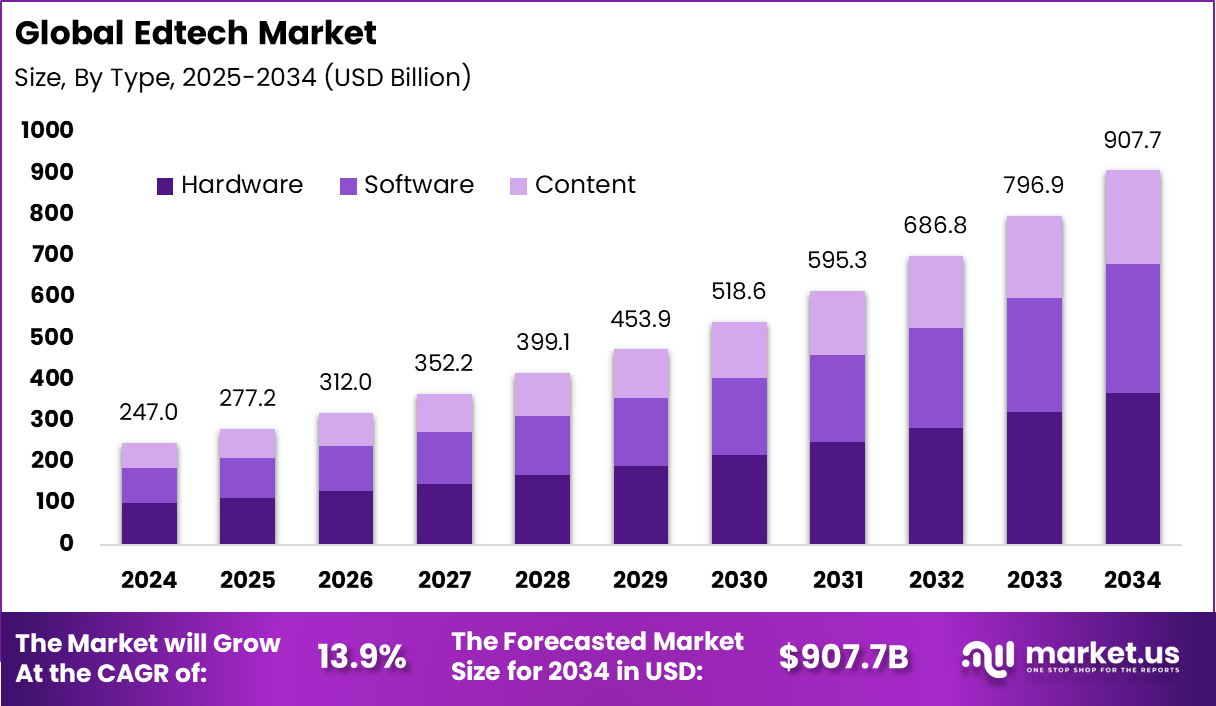
The global Edtech landscape continued its rapid expansion as the market generated USD 247 Billion in 2024 and is set to grow from USD 277.2 Billion in 2025 to nearly USD 907.7 Billion by 2034, supported by a steady 13.9% growth rate across the forecast period. This rise has been influenced by increasing digital adoption in classrooms, higher investment in online learning platforms, and stronger demand for flexible, technology-enabled education models.
North America maintained a leading role in 2024, accounting for more than 37.2% of total share and generating about USD 91.8 Billion in revenue. The region’s dominance has been supported by mature digital infrastructure, high device penetration among students, and continuous institutional adoption of advanced learning tools, positioning it as a central hub for Edtech innovation and expansion.
Top Market Takeaways
- On-premise deployment held 70.3%, showing that institutions still value higher control and stronger data security for their digital education systems.
- Hardware accounted for 40.5%, supported by rising demand for smart devices, interactive classroom panels, and connected learning tools.
- The K-12 sector led with 56.1%, reflecting strong early adoption of digital platforms in schools as part of curriculum modernization.
- Businesses represented 67.8%, highlighting continued investment in digital training and upskilling across corporate environments.
- North America captured 37.2%, driven by a mature EdTech landscape and consistent adoption by educational institutions.
- The U.S. market reached USD 84.14 billion with an 11.7% CAGR, showing sustained commitment to expanding digital learning infrastructure.
AI in the EdTech Landscape
Transformation of Teaching and Learning Models
AI is changing instructional models by helping move education from static lesson delivery toward more dynamic learning journeys. Students experience guidance that responds to their pace and understanding rather than fixed schedules or uniform content. This creates a smoother progression through subjects and reduces gaps that often appear when learners advance without mastery.
Teachers also benefit from this transformation as AI provides insight into class wide performance trends and individual challenges. With a clearer view of student needs, teachers can adjust teaching strategies and allocate one to one time more effectively. This shift is encouraging teaching models that combine human judgment with AI based recommendations.
Personalized Learning and Adaptive Pathways
Adaptive learning systems use AI to measure student progress, detect difficulty levels and adjust learning materials automatically. Studies have shown that such systems can raise completion rates by about 20% when learners receive content tailored to their abilities. This level of personalization supports continuous growth and reduces frustration among students who struggle with traditional one pace instruction.
Learners using these systems often report improved confidence because they receive targeted feedback and alternative explanations when needed. These adaptive pathways also help advanced learners progress faster without being limited by classroom averages. As more platforms adopt adaptive architecture, personalization is becoming a defining feature of modern EdTech.
AI Driven Assessments and Learning Analytics
AI supported assessment tools evaluate performance with greater speed and consistency, reducing delays in feedback that often hinder learning. Automated grading of quizzes, short responses and practice exercises allows students to identify mistakes immediately. This continuous evaluation cycle plays an important role in skill development, especially in subjects requiring frequent practice.
Learning analytics powered by AI help educators understand patterns in student engagement and difficulties. Insights such as declining activity, repeated errors or unusual performance shifts enable early interventions. These analytics strengthen academic planning and support systems that likely would not be possible through manual monitoring.
Intelligent Tutoring Systems and Virtual Assistants
Intelligent tutoring systems simulate one to one guidance by offering explanations, practice questions and troubleshooting based on a student’s progress. These systems operate continuously and help reduce learning gaps for subjects that require repeated reinforcement. Their availability beyond classroom hours is one reason why about 54% of students use AI weekly.
AI driven virtual assistants also handle academic queries, revision schedules and doubt clarification. These assistants help students work independently and support teachers by reducing repetitive question handling. Their contribution to academic assistance is becoming important in large classrooms and online programs.
Content Development and Curriculum Enhancement with AI
AI tools help educators and institutions create high quality learning materials more efficiently. Lesson outlines, reading content and practice sets can be generated or refined using AI, enabling instructors to focus on conceptual clarity rather than administrative preparation. This has contributed to rising AI usage among teachers, with some studies noting adoption rates of nearly 60% in recent school years.
Curriculum enhancement is also improving as AI highlights areas where learners commonly struggle. This allows educators to redesign content sections, simplify explanations and include more relevant examples. Over time, these data informed improvements lead to stronger curriculum structures aligned with learner needs.
Operational Efficiency and Automation in Education Institutions
AI supports administrative efficiency by automating tasks such as timetable planning, student support requests and documentation processes. Institutions using these tools report fewer delays in routine work, which helps teaching staff focus more on academic roles. Automated systems also reduce human error in operational workflows.
Predictive tools help institutions track attendance, engagement levels and progression trends to identify academic risks early. When combined with human mentoring, these systems improve student retention and academic planning. The operational value of AI is expanding as institutions seek scalable solutions.
AI for Accessibility and Inclusive Education
AI powered tools help learners with disabilities or language barriers by offering translation, speech to text, text simplification and audio support. These features help students participate more fully in academic activities and reduce dependence on classroom assistance. Studies show that adaptive accessibility features significantly improve comprehension for learners who need additional support.
The inclusive nature of AI tools helps institutions reach wider student groups, including first generation learners and multilingual communities. However, access still depends on reliable devices and connectivity. Without equal provision, benefits may remain concentrated among students with stronger digital access.
Impact on Student Engagement and Learning Outcomes
AI has improved engagement by offering interactive explanations, personalised feedback and immediate performance insights. Students using AI tools often report higher motivation because they receive support in real time. In many surveys, around 82.4% of students stated that AI improved their academic performance through better understanding and revision efficiency.
Learning outcomes also improve when students receive continuous guidance and tailored questions. AI supported learning keeps learners active and reduces passive content consumption. This shift toward engaged learning is strengthening the role of AI in modern education systems.
Data Privacy, Ethical Considerations and Governance
AI adoption raises concerns about data privacy and responsible usage. Institutions are increasingly establishing policies to guide acceptable use, model transparency and student data protection. In global surveys, nearly two thirds of universities reported that they had either implemented or were developing AI usage guidelines.
Teachers express strong concerns about academic integrity as AI generated content becomes harder to identify. In one study, about 45.2% of educators shared concerns about student dependence on AI, while 66.5% believed writing skill development may weaken. Clear governance frameworks remain essential to balance innovation with ethical practice.
Challenges Limiting AI Adoption in EdTech
Limited digital access in low income regions restricts uniform adoption of AI powered learning. Students without stable connectivity or adequate devices cannot benefit equally from AI supported platforms. This digital divide results in uneven academic outcomes even when AI driven solutions are available.
Teacher readiness and institutional training are additional constraints. Many educators still lack structured guidance on responsible AI use. Only 9.9% of teachers in one survey felt their institution had a clear AI policy, indicating substantial gaps in preparation and governance.
Opportunities for Innovation and Future Growth
AI offers opportunities for new learning models, immersive content development and advanced academic support tools. Intelligent simulations, real time coaching and automated content creation are likely to become more common. These innovations can raise learning quality and reduce barriers to high level instruction.
Institutions are exploring AI led administrative improvements that enhance resource allocation and student support planning. As tools mature, broader adoption could help institutions operate more efficiently and deliver better outcomes.
Regional Adoption Patterns and Emerging Policy Frameworks
AI adoption is gaining momentum in regions with high digital infrastructure readiness, including parts of North America, Europe and Asia. University level surveys in these regions show rising interest in AI guidelines, faculty training and student support policies. Regions with strong technology investment are also more prepared to integrate AI into formal education systems.
Developing economies are gradually increasing AI adoption through national digital education initiatives. Policy frameworks in these regions focus on digital access, teacher training and ethical use. Adoption patterns are expected to widen as more countries introduce guidelines for AI in classrooms.
Future Outlook of AI Integration in EdTech
The long term outlook suggests that AI will become deeply embedded in both learning experiences and institutional operations. As models improve, AI will support personalised tutoring, advanced analytics and new forms of interactive content. Students will expect continuous learning support and quick feedback as standard features.
Institutions will rely more on responsible AI frameworks to address ethical and operational concerns. With rising global adoption, the EdTech landscape will combine human expertise with AI enabled efficiency, shaping a more adaptive and inclusive learning environment.
Read:
Global Edtech Market Size, Share, Industry Analysis Report By Deployment Mode (Cloud, On-Premise), By Type (Hardware, Software, Content), By Sector (K-12, Preschool,Higher Education, Other Sectors), By End-User (Business, Consumer), By Regional Analysis, Global Trends and Opportunity, Future Outlook By 2025-2034
Discuss your needs with our analyst
Please share your requirements with more details so our analyst can check if they can solve your problem(s)