Introduction
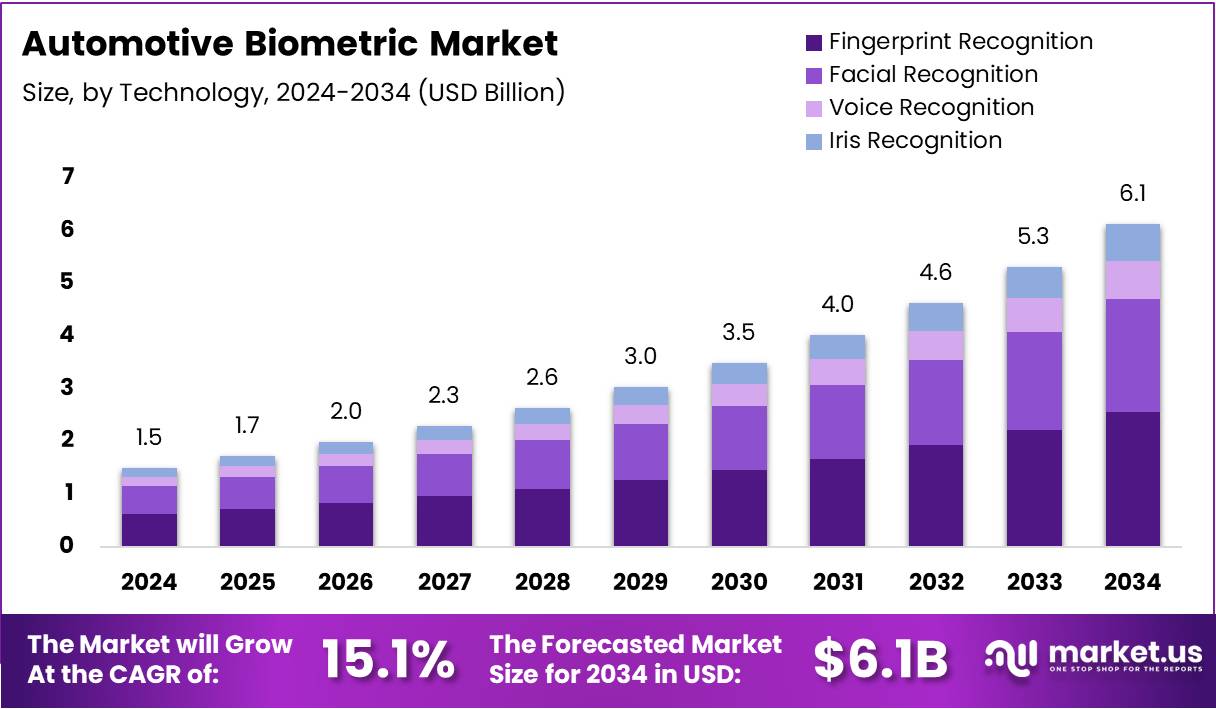
The Global Automotive Biometric Market is experiencing remarkable growth, projected to reach USD 6.1 Billion by 2034 from USD 1.5 Billion in 2024. This growth, at a robust 15.1% CAGR, reflects the increasing adoption of biometric technologies for secure, seamless, and personalized driving experiences.
Modern vehicles are rapidly transforming into intelligent ecosystems that prioritize driver authentication, personalization, and safety. Through fingerprint, facial, and voice recognition systems, automotive biometrics redefine security and convenience, enabling access control, customized settings, and safer mobility interactions.
As automotive OEMs accelerate digital transformation, biometric integration has become central to next-generation vehicle design. These innovations ensure trusted in-vehicle experiences while addressing rising security threats, theft prevention, and data protection demands across global markets.
Moreover, the synergy between technology developers, automotive manufacturers, and regulatory frameworks supports rapid market expansion. With consumers showing high acceptance of biometric usage, the industry stands poised to deliver smarter, safer, and more personalized mobility solutions for future transportation ecosystems.
Biometric technology is no longer a luxury but a necessity. Its applications across vehicle access, driver monitoring, and infotainment systems exemplify how innovation is transforming everyday driving. As a result, the automotive biometric market enters a new decade of advanced mobility and intelligent authentication.
This evolution also creates lucrative opportunities across fleet management, shared mobility, and connected car services. Combined with strong consumer trust, regulatory backing, and technological innovation, biometric systems are redefining vehicle security and personalization globally.
Key Takeaways
- Global Automotive Biometric Market expected to reach USD 6.1 Billion by 2034 from USD 1.5 Billion in 2024, growing at a 15.1% CAGR.
- By Offering, Hardware dominates with a 56.9% share in 2024.
- By Technology, Fingerprint Recognition leads with a 37.4% market share in 2024.
- By Application, Vehicle Access Control holds the largest share at 39.6% in 2024.
- By Vehicle Type, Passenger Cars dominate with an 83.7% share in 2024.
- Asia Pacific is the leading region with 42.8% market share, valued at USD 0.6 Billion in 2024.
Market Segmentation Overview
By Offering: The Hardware segment leads with 56.9% market share, driven by OEMs embedding biometric sensors, scanners, and modules across vehicle platforms. Meanwhile, Software solutions expand due to advanced algorithms and cloud-linked identity management improving recognition accuracy. Service offerings grow steadily through maintenance and subscription-based authentication systems.
By Technology: Fingerprint Recognition dominates with 37.4% share, valued for reliability and affordability. Facial Recognition gains traction as automakers implement hands-free authentication and driver monitoring. Voice Recognition enables secure infotainment control and payments, while Iris Recognition grows in luxury segments for high-precision identity verification.
By Application: Vehicle Access Control holds 39.6% share, leading due to rising consumer demand for secure, keyless entry. Driver Identification & Personalization enhance comfort via automated settings. Driver Monitoring Systems detect drowsiness and distraction, improving safety compliance. Infotainment & HMI Control leverage biometrics for intuitive and secure digital interaction.
By Vehicle Type: Passenger Cars command 83.7% market share due to strong integration of biometric systems in mid-range and luxury models. Commercial Vehicles also grow steadily as fleet operators use biometrics for driver verification, fatigue monitoring, and secure access management in regulated transportation environments.
Drivers
Enhanced Vehicle Anti-Theft Systems: Growing vehicle theft incidents push automakers toward biometric-based authentication. Technologies such as fingerprint and facial recognition ensure that only authorized users can access or start vehicles, providing superior security and fostering consumer trust in digital mobility ecosystems.
Adoption of Regulatory-Driven Driver Monitoring: Global safety standards increasingly require systems capable of detecting fatigue or distraction. Biometric sensors analyzing eye movement and facial patterns help prevent accidents and enhance compliance, reinforcing safety as a key differentiator in next-generation vehicles.
Use Cases
Secure Vehicle Access and Start Authorization: Biometric-enabled keyless systems allow drivers to unlock, start, and operate vehicles through fingerprints or facial recognition. This enhances security and convenience, eliminating traditional key dependency while preventing unauthorized access or theft.
Driver Monitoring and Fatigue Detection: Advanced in-cabin sensors use biometric signals to assess alertness and fatigue. When drowsiness is detected, the system issues warnings or activates safety features, significantly reducing accident risks and supporting intelligent driver-assistance systems.
Major Challenges
Data Privacy and Trust Concerns: Despite strong benefits, consumer hesitation persists over sharing biometric data due to fear of misuse or breaches. Uncertainty about data storage and ownership discourages mass adoption, compelling automakers to strengthen encryption and data protection measures.
Fragmented System Interoperability: Different manufacturers deploy proprietary biometric solutions, limiting cross-platform compatibility. This lack of standardization increases development costs and prevents users from transferring their authentication profiles between vehicles or brands, hindering market scalability.
Business Opportunities
Integration of Emotion and Voice Recognition: Emerging emotion-sensing and voice-analysis technologies personalize driving experiences. Vehicles adapting to driver mood or stress can automatically adjust lighting, temperature, or music, enhancing comfort and creating premium value propositions for automakers.
Growth in Biometric Payment and Smart Access Solutions: As connected car ecosystems evolve, fingerprint and facial recognition facilitate secure in-vehicle payments for tolls, fuel, or subscriptions. Biometric-enabled EV charging and parking access streamline mobility and reduce transaction fraud.
Regional Analysis
Asia Pacific Dominance: Holding 42.8% market share worth USD 0.6 Billion in 2024, Asia Pacific leads due to rapid connected vehicle adoption and government-backed smart mobility initiatives. Expansion of EV and luxury car production in China, Japan, and South Korea further strengthens regional leadership.
North America and Europe Expansion: North America’s market benefits from stringent safety standards and consumer readiness for advanced biometrics. Meanwhile, Europe advances through regulatory focus on driver monitoring and anti-theft measures, especially in premium vehicle segments emphasizing multimodal authentication.
Recent Developments
- In Nov 2025: Gentex Corporation acquired BioConnect, enhancing its biometric authentication portfolio for secure automotive identity verification.
- In Apr 2025: FORVIA and Smart Eye launched a system utilizing DMS cameras for iris and facial recognition, improving driver safety and personalization.
- In Nov 2024: Continental and trinamiX introduced the Invisible Biometrics Sensing Display, offering contactless in-car biometric authentication.
- In Oct 2025: Ping Identity acquired UK-based Keyless, expanding its global footprint in digital identity and biometric authentication solutions.
Conclusion
The Global Automotive Biometric Market is on a transformative trajectory, reshaping how drivers interact with vehicles. With projected revenues of USD 6.1 Billion by 2034, biometrics are becoming integral to automotive security, personalization, and compliance frameworks worldwide.
Despite privacy and interoperability challenges, the market’s future remains highly promising. Ongoing innovations in emotion recognition, contactless access, and in-vehicle payments are expanding use cases and creating new revenue streams. As automotive ecosystems evolve, biometrics will anchor the shift toward intelligent, secure, and human-centric mobility.
Discuss your needs with our analyst
Please share your requirements with more details so our analyst can check if they can solve your problem(s)