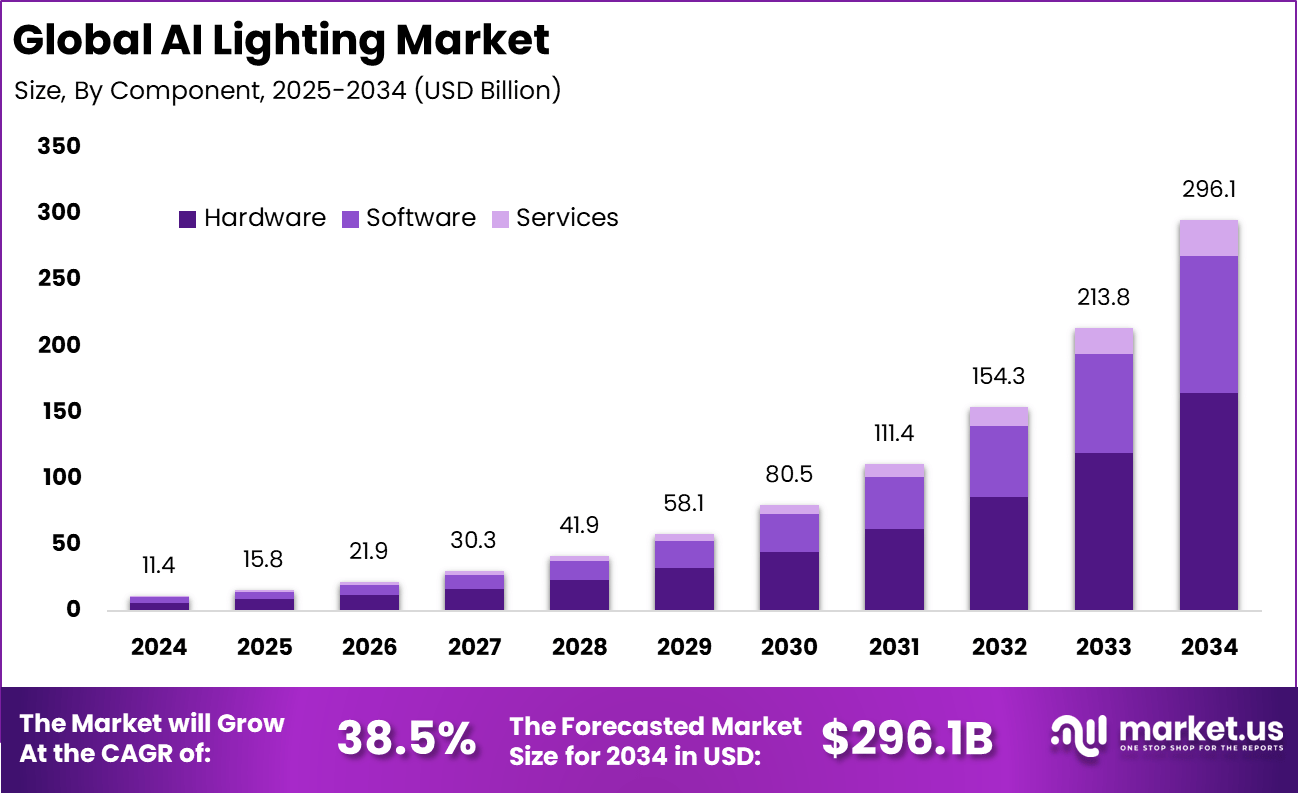
New York, NY – December, 2025: The global AI lighting market was valued at USD 11.4 billion in 2024 and is projected to reach approximately USD 296.1 billion by 2034, expanding at a strong CAGR of 38.5% during the forecast period from 2025 to 2034. In 2024, North America dominated the market with more than 35.3% share, generating around USD 4.02 billion in revenue, supported by early adoption of smart infrastructure and advanced lighting control systems.
The AI lighting market refers to advanced lighting systems that incorporate artificial intelligence to optimize performance, adapt to environmental conditions, and enhance user experience. These systems combine sensors, machine learning logic, and connected controls to adjust brightness, color, and timing in real-time based on human presence, natural light, or activity patterns, offering greater efficiency and comfort compared with traditional lighting.
Buy our report now to gain access to detailed analysis [Discounts: Up To 60% OFF]– https://market.us/purchase-report/?report_id=163503
The adoption of AI in lighting technology is closely aligned with the broader smart lighting sector, where digital automation and connectivity are foundational elements. AI lighting systems are increasingly used in commercial buildings, residential settings, urban infrastructure, and industrial environments where energy efficiency and adaptive control are priorities. Demand for AI lighting systems is being shaped by investments in smart buildings and public infrastructure that value operational efficiency, lower energy costs, and improved occupant experience.
Commercial sectors such as offices, retail, and hospitality are focusing on lighting that can automatically adjust to human presence and daylight cycles. Residential markets are also shifting toward AI lighting controls that offer personalized lighting scenes and remote management via mobile applications. In public spaces, adaptive lighting improves safety and reduces utility expenditure by adjusting outputs based on real-time traffic and environmental conditions.
Key Takeaway
- Hardware dominated with 55.8%, driven by strong adoption of AI-enabled sensors, smart bulbs, and intelligent lighting control systems.
- Deep learning technology held 38.7%, reflecting its expanding role in predictive illumination, occupancy sensing, and adaptive lighting environments.
- Wired connectivity accounted for 58.7%, supported by demand for stable, high-performance networks in large commercial and industrial lighting installations.
- Indoor applications led with 67.5%, fueled by smart building projects and energy-efficient automation across homes, offices, and retail spaces.
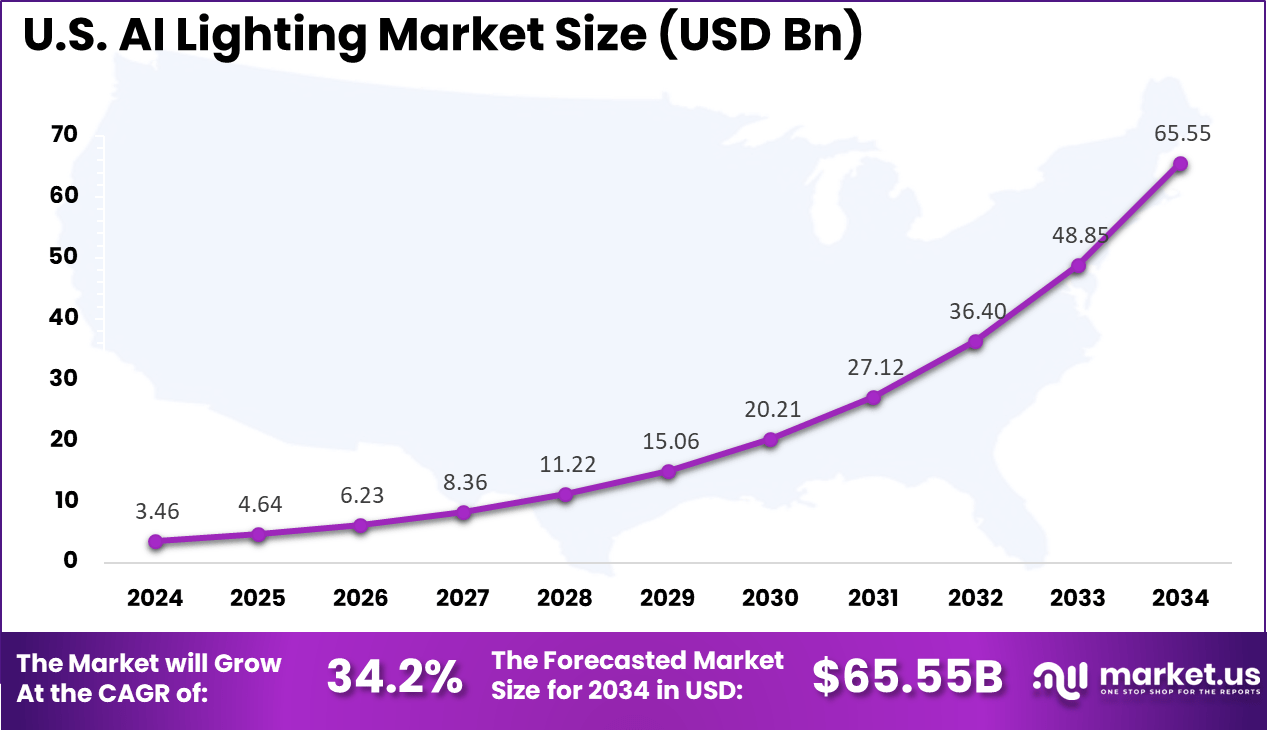
- The U.S. market reached USD 3.46 billion in 2024 and is growing at a strong 34.2% CAGR, driven by smart city initiatives and advanced lighting infrastructure.
- North America captured 35.3%, supported by high IoT adoption, sustainability programs, and rapid AI integration in building automation systems.
U.S. AI Lighting Market Size
The market for AI Lighting within the U.S. is growing tremendously and is currently valued at USD 3.46 billion, the market has a projected CAGR of 34.2%. The market is growing due to the increasing adoption of energy-efficient and smart lighting systems that integrate AI and IoT technologies. Consumers and businesses are driving demand for lighting solutions that offer real-time control, automation, and personalized user experiences.
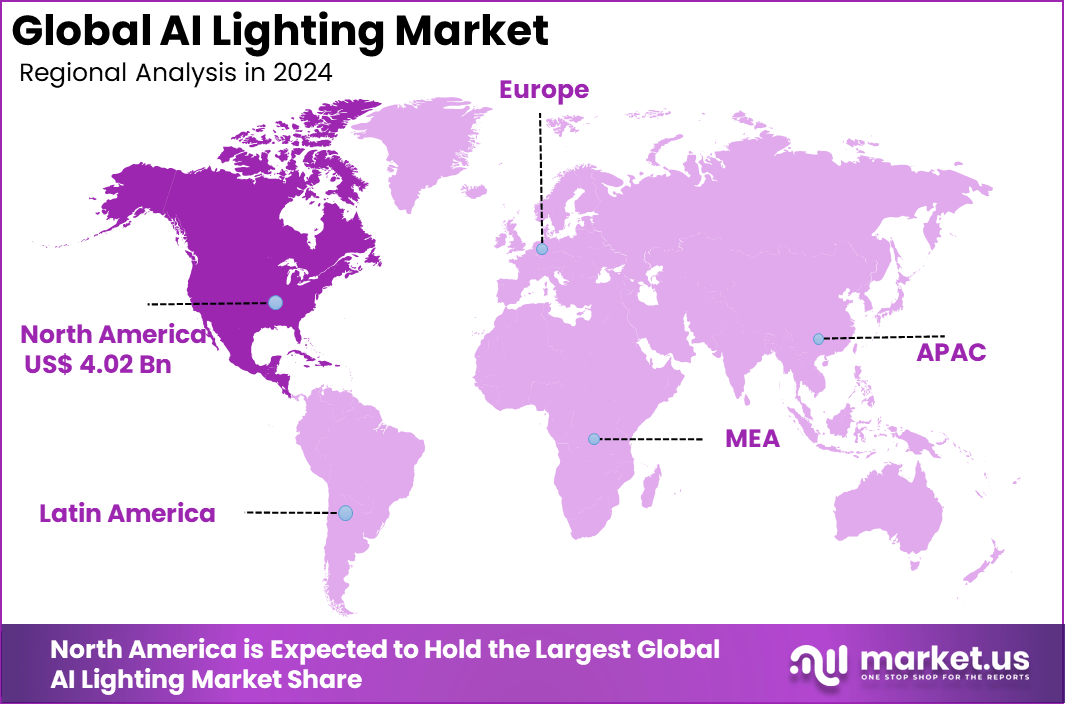
In 2024, North America held a dominant market position in the Global AI Lighting Market, capturing more than a 35.3% share, holding USD 4.02 billion in revenue. This dominance is due to widespread adoption of smart lighting solutions in new residential and commercial construction, fueled by evolving building codes and consumer demand for energy-efficient, intelligent lighting.
Emerging Trends
One trend in the AI lighting market is the shift toward adaptive, context-aware lighting. Systems now sense human presence, daylight levels, and activity patterns to adjust light output in real time. For example, lighting can dim in empty areas or change colour temperature to support work focus during the day and relaxation in the evening. This trend supports occupant comfort and reduces wasted energy.
Another trend is integration of AI lighting with broader building automation platforms. Organizations increasingly seek unified control of lighting, heating, ventilation, air quality and security. AI lighting systems that communicate with other building systems provide coordinated responses to occupancy and environmental changes. This integration helps facility managers achieve consistent performance and reduces manual adjustments.
Growth Factors
A significant growth factor is the global emphasis on energy efficiency and cost reduction. Lighting contributes a large portion of electricity use in commercial and industrial buildings. AI lighting systems that adjust output based on occupancy, natural light or usage patterns help lower energy consumption and reduce utility expenses. Many governments and building codes also encourage energy efficient technologies, which supports adoption of smart lighting solutions.
Another growth factor is rising demand for smart and connected infrastructure. As companies invest in digital transformation and modernize facilities, AI lighting becomes a key component of the connected ecosystem. Businesses view intelligent lighting as part of the overall strategy to improve operational efficiency, enhance occupant experience and support sustainability objectives.
Driver Analysis
A primary driver in the AI lighting market is the need to improve occupant comfort and productivity. Lighting quality affects work performance, mood and visual comfort. AI lighting systems that adapt light intensity and colour based on time of day or user preferences help create better environments. This shift toward human-centred design encourages more organizations to invest in adaptive lighting.
Another driver is the availability of affordable sensors and connectivity. Falling costs of motion detectors, light sensors and wireless connectivity make it easier for lighting systems to collect data and apply AI algorithms. As these components become more economical and accessible, more facilities can adopt AI lighting without prohibitive investment.
Restraint Analysis
A major restraint is the upfront investment required for AI lighting systems. New sensors, intelligent fixtures, network infrastructure and software subscriptions may represent a significant cost for small or budget-constrained organizations. This can delay adoption, especially when energy savings are perceived as long-term rather than immediate.
Another restraint is compatibility with existing infrastructure. Many older buildings have legacy lighting fixtures that do not easily support smart controls. Retrofitting such systems can require additional work in wiring, control interfaces and network connectivity. This complexity may slow adoption in older facilities or in regions with limited retrofit resources.
Opportunity Analysis
There is strong opportunity in residential smart lighting applications. As more households adopt connected devices and smart home systems, AI lighting that responds to routines, occupancy and daylight offers convenience and energy savings. Providers that design simple, user-friendly solutions for residential users can expand into this growing segment.
Another opportunity lies in outdoor and public lighting. AI lighting systems in streets, parking areas, campuses and public spaces can adjust output based on time, events, pedestrian activity and weather conditions. These applications offer potential for energy savings, improved safety and lower maintenance costs, especially in urban environments prioritizing sustainability.
Challenge Analysis
A key challenge is ensuring data privacy and security. AI lighting systems collect usage patterns, occupancy data, and sometimes video or sensor information. Without robust protections, this data could be misused or exposed. Ensuring secure communication, data storage and user consent is essential for wider acceptance.
Another challenge is standardization and interoperability. The AI lighting market includes many different manufacturers and platforms, and compatibility between systems is not always guaranteed. This can increase complexity for facility managers and slow adoption where multi-vendor environments are common.
Key Market Segments
By Component
- Hardware
- Lamp
- Luminaire
- Software
- Services
By Technology
- Deep Learning
- Machine Learning
- Natural Language Processing (NLP)
- Machine Vision
- Generative AI
By Connectivity
- Wired
- Wireless
By Application
- Indoor
- Residential
- Commercial
- Outdoor
- Highways and Roadways
- Architectural
- Others
Top Key Players in the Market
- Acuity Brands Lighting, Inc.
- Signify Holding
- Honeywell International Inc.
- Itron Inc.
- IDEAL INDUSTRIES, INC.
- Sengled Optoelectronics Co., Ltd.
- Verizon
- Schneider Electric
- Häfele America Co.
- Wipro Lighting
- YEELIGHT
- Others
Report Scope
| Report Features | Description |
|---|---|
| Market Value (2024) | USD 11.4 Bn |
| Forecast Revenue (2034) | USD 296.1 Bn |
| CAGR(2025-2034) | 38.5% |
| Base Year for Estimation | 2024 |
| Historic Period | 2020-2023 |
| Forecast Period | 2025-2034 |
Discuss your needs with our analyst
Please share your requirements with more details so our analyst can check if they can solve your problem(s)