Data Mining Tools Market Size
The Data Mining Tools Market refers to the segment of software solutions designed to discover patterns, correlations, and insights from large datasets. These tools apply algorithms and statistical methods to extract actionable information from structured and unstructured data. Adoption spans across industries including banking, healthcare, retail, and telecommunications where data driven decision making is prioritized. The market landscape is shaped by the need for real time analytics and the growth of big data environments.
Providers in this market offer solutions that support tasks such as classification, clustering, association rule mining, and anomaly detection. These capabilities help organizations improve operational efficiency and strategic planning. Data mining tools are delivered via on premise software or cloud based services to accommodate varying IT infrastructures. Continued demand for predictive insights supports ongoing innovation in this market.
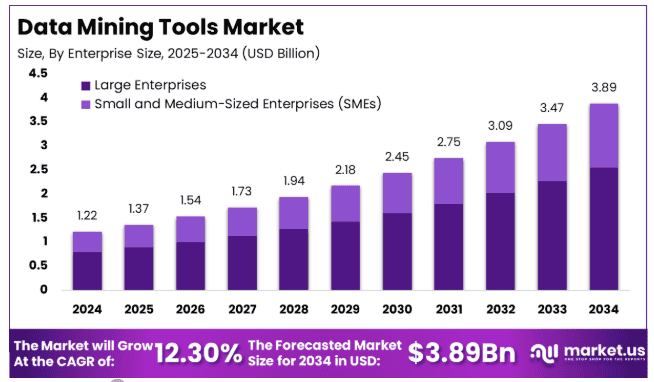
Key Takeaways
- The data mining tools market is set to expand from USD 1.22 billion in 2024 to USD 3.89 billion by 2034, registering a 12.30% CAGR as data-driven decision-making becomes central across industries.
- North America led with a 41.8% share in 2024, valued at around USD 0.50 billion, supported by advanced digital infrastructure and strong analytics adoption.
- The U.S. market reached USD 0.47 billion in 2024 and is projected to grow to USD 1.26 billion by 2034, advancing at a 10.4% CAGR.
- Software dominated by component with a 71.3% share, reflecting demand for advanced tools that extract actionable insights from large datasets.
- Large enterprises accounted for 65.7%, driven by use cases in operational efficiency, risk management, and strategic planning.
- Cloud-based deployment held 65.2%, favored for scalability, flexibility, and cost efficiency.
- The BFSI sector led end-user adoption with 25.5%, using data mining for customer analytics, fraud detection, risk assessment, and compliance.
Emerging Trend Analysis
The Data Mining Tools Market is increasingly influenced by the integration of artificial intelligence and machine learning capabilities that automate pattern recognition and predictive insight generation. These enhanced tools analyze large datasets with minimal human intervention, enabling organizations to uncover trends and anomalies more efficiently. As a result, decision makers are able to act on insights faster and with greater confidence. This shift reflects increasing demand for tools that can handle complex data environments with precision.
Another emerging trend is the rise of cloud-based data mining solutions that provide scalable computing power and flexible access for distributed teams. Cloud deployment enables organizations of all sizes to leverage advanced mining technologies without heavy investment in on-premises infrastructure. This accessibility supports collaboration among cross-functional teams and reduces time to value for analytics initiatives. Growing cloud adoption is therefore expanding the reach and utility of data mining tools across diverse sectors.
Top Driving Factors
One significant driver of the Data Mining Tools Market is the proliferation of data generated from digital interactions and connected devices. Organizations are challenged to convert this data into meaningful insights to remain competitive. Data mining tools enable extraction of patterns that support forecasting and trend analysis. This capacity to translate data into strategic value is pivotal for enterprise growth.
Another driving factor is the emphasis on enhancing customer experience and personalization. Businesses utilize mined data to tailor products, services, and recommendations based on user behavior. Improved understanding of customer needs can strengthen retention and drive revenue. As customer centric strategies become central to business models, demand for advanced data mining capabilities increases.
Demand Analysis
Demand for data mining tools is expanding in sectors with vast data flows such as finance and insurance. These industries require robust analytical tools to detect fraud, assess risk, and manage portfolios. Data mining capabilities support rapid identification of irregular patterns that could signal operational issues or opportunities. Growth in digital transactions fuels continued demand.
In healthcare and life sciences, demand is rising to support clinical research and patient outcome analysis. Data mining facilitates identification of disease patterns and treatment effectiveness from large clinical datasets. Healthcare providers and research institutions are adopting these tools to support evidence based decision making. This trend is reinforced by increasing digitization of health records.
Increasing Adoption of Technologies
Cloud computing has been widely adopted to enhance accessibility and scalability of data mining tools. Cloud hosted solutions provide on demand processing power to handle large scale analytics without heavy capital expenditure. Organizations can deploy data mining capabilities quickly and support distributed teams. Cloud integration also facilitates seamless data ingestion from multiple sources.
Artificial intelligence and machine learning technologies are increasingly incorporated into data mining tools. These technologies improve accuracy and automate pattern recognition tasks that were previously manual. Enhanced algorithms can adapt through learning from new data, improving performance over time. This integration strengthens predictive capabilities and supports real time insights.
A primary reason for adoption is the ability to improve operational efficiency through data driven insights. Data mining reveals inefficiencies and opportunities that may not be evident through traditional analysis. Organizations leverage these insights to optimize processes and reduce costs. This operational improvement is critical in competitive business environments.
Another reason for adoption is enhanced strategic planning supported by predictive analytics. Data mining tools can forecast trends and anticipate market shifts based on historical data. This predictive capacity supports informed decision making and resource allocation. Executives increasingly rely on these insights to guide long term planning.
Investment and Business Benefits
Investment opportunities exist in the development of next generation data mining platforms that integrate real time analytics. Solutions that can process streaming data and deliver immediate insights are highly valued in industries such as finance and logistics. Investors may find growth potential in tools that support hybrid data architectures. Focus on real time capabilities can differentiate offerings in a crowded market.
Opportunities also exist in vertical specific solutions that address unique industry needs. Tailored tools for sectors such as healthcare, retail, and manufacturing can attract niche clientele. Customization and industry expertise can command premium pricing. Partnerships with system integrators and cloud providers can broaden market access.
Adoption of data mining tools can significantly enhance decision making across organizational functions. By uncovering hidden correlations and trends, leaders gain deeper insight into business performance and market dynamics. This analytical advantage supports competitive positioning and operational responsiveness. Data driven decisions tend to reduce risk and improve outcomes.
Cost optimization is another business benefit derived from data mining. Organizations can identify redundant processes, forecast demand more accurately, and allocate resources efficiently. These improvements contribute to reduced waste and improved profitability. The cumulative effect of optimized operations and strategic insight reinforces organizational resilience.
Regulatory Environment
The regulatory environment for data mining tools is influenced by data privacy and protection laws. Regulations such as general data protection standards require organizations to handle personal information responsibly and transparently. Compliance with these rules is essential to mitigate legal and financial risks. Data governance frameworks also guide how data is stored, accessed, and used for analytical purposes.
Industry specific regulations can further shape how data mining solutions are implemented. For instance healthcare and financial services are subject to stringent confidentiality and reporting standards. Technology providers must ensure that tools support compliance and secure data management. Adherence to regulatory requirements strengthens trust and supports market acceptance.
Driver Analysis
A key driver of market growth is the continuous expansion of digital data generated by businesses, customers, and connected devices. The proliferation of structured and unstructured data sources has elevated the need for sophisticated tools that can extract meaningful insights. Organizations view data mining as critical for improving operational efficiency, enhancing customer experience, and informing strategic planning. As data volumes grow, investment in advanced mining capabilities continues to rise.
Another driver is the increasing emphasis on data-driven decision making across industries. Competitive pressures are motivating enterprises to adopt analytics tools that support evidence-based strategies. Data mining tools enable organizations to segment customers, forecast demand, detect fraud, and optimize pricing among other use cases. The growing recognition of analytics as a strategic asset fuels demand for powerful and flexible mining solutions.
Restraint Analysis
One restraint facing the market is the complexity associated with deploying and managing advanced data mining platforms. These tools often require specialized technical skills in data science, programming, and statistical analysis. Many organizations struggle to recruit or train personnel with the necessary expertise, slowing adoption and reducing the effectiveness of deployed solutions. Skill shortages remain a persistent barrier.
Another restraint is concerns about data privacy and regulatory compliance that limit access to sensitive information. Regulations governing personal and financial data impose strict controls on data usage and processing. Compliance with these frameworks can restrict the scope of mining activities and complicate project workflows. Organizations must balance insight generation with ethical and legal obligations, which can constrain tool utilization.
Opportunity Analysis
Significant opportunity exists in the development of intuitive user interfaces and automated workflows that democratize data mining for business users. Tools that simplify complex analysis through guided workflows, natural language queries, and visual exploration can empower non-technical stakeholders. This democratization expands the potential user base and accelerates insights across decision levels. Enhanced usability is anticipated to drive broader adoption.
Another opportunity lies in expanding analytics to edge computing environments where data is generated at source locations such as manufacturing floors or IoT networks. Edge-enabled mining tools can process data in real time, reducing latency and supporting immediate decision making. This capability is particularly valuable for applications requiring rapid responses to operational events. Innovation in edge analytics is positioned to open new segments within the market.
Challenge Analysis
A major challenge for the market is ensuring the quality and consistency of data fed into mining systems. Poor data quality, including incomplete or inconsistent records, can lead to inaccurate insights and misguided decisions. Establishing rigorous data governance, cleansing, and standardization practices is essential to maintain confidence in analytical outputs. Without reliable input data, even advanced tools cannot produce trustworthy results.
Another challenge is balancing analytic complexity with performance efficiency. High-volume data mining tasks, especially those involving deep learning or large-scale pattern extraction, demand substantial computing resources. Organizations must optimize processing capacity to maintain performance while controlling costs. Achieving this balance is difficult for enterprises with limited infrastructure or budget constraints.
Key Market Segments
By Component
- Software
- ETL and Data Preparation
- Data-Mining Workbench
- ML and Advanced Analytics Platforms
- Visualisation and Reporting
- Others
- Services
- Professional Services
- Managed Services
By Enterprise Size
- Small and Medium-Sized Enterprises (SMEs)
- Large Enterprises
By Deployment
- Cloud
- On-Premise
- Hybrid
By End-user Industry
- BFSI
- IT and Telecom
- Government and Defence
- Manufacturing
- Healthcare and Life Sciences
- Energy and Utilities
- Retail and E-commerce
- Transportation and Logistics
- Others
Top Key Players in the Market
- IBM Corporation
- Oracle Corporation
- Microsoft Corporation
- SAS Institute Inc.
- Teradata Corporation
- SAP SE
- Altair Engineering Inc. (RapidMiner)
- KNIME AG
- Google LLC (Kaggle)
- Amazon Web Services Inc.
- Alteryx Inc.
- OpenText Corporation
- Hitachi Vantara LLC
- TIBCO Software Inc.
- QlikTech International AB
- MicroStrategy Incorporated
- Sisense Inc.
- Orange S.A. (Orange Data Mining)
- Togaware Pty Ltd (Rattle GUI)
- FICO (Fair Isaac Corporation)
- H2O.ai Inc.
- Dataiku SAS
- Databricks Inc.
- Others
Report Scope
| Report Features | Description |
|---|---|
| Market Value (2024) | USD 1.22 Billion |
| Forecast Revenue (2034) | USD 3.89 Billion |
| CAGR(2025-2034) | 12.30% |
| Base Year for Estimation | 2024 |
| Historic Period | 2020-2023 |
| Forecast Period | 2025-2034 |
Discuss your needs with our analyst
Please share your requirements with more details so our analyst can check if they can solve your problem(s)