AI Lighting Market Size and Forecast
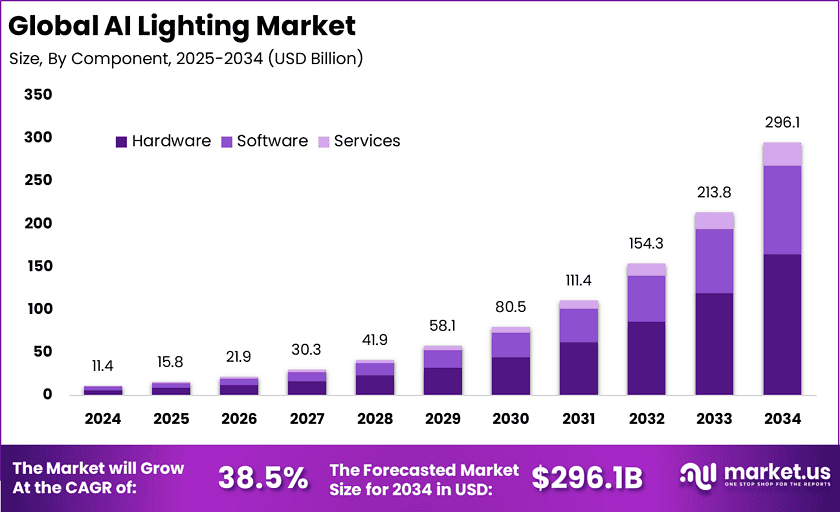
The global AI lighting market was valued at USD 11.4 billion in 2024 and is projected to reach approximately USD 296.1 billion by 2034, expanding at a CAGR of 38.5% during the forecast period from 2025 to 2034. In 2024, North America held a dominant position with more than 35.3% market share, generating around USD 4.02 billion in revenue, supported by strong adoption of smart lighting systems and energy efficient technologies.
| Report Features | Description |
|---|---|
| Market Value (2024) | USD 11.4 Bn |
| Forecast Revenue (2034) | USD 296.1 Bn |
| CAGR(2025-2034) | 38.5% |
| Base Year for Estimation | 2024 |
| Historic Period | 2020-2023 |
| Forecast Period | 2025-2034 |
Market Overview
The AI lighting market refers to intelligent lighting systems that leverage artificial intelligence to optimize performance, energy use, and user experience in built environments. These systems integrate sensors, machine learning algorithms, and connectivity to adjust lighting based on occupancy, ambient conditions, and user preferences. Adoption is observed across commercial buildings, smart cities, industrial facilities, and residential applications where efficiency and automation are prioritized. Continued innovation in AI driven controls and interoperability with building management systems shapes the competitive landscape.
AI lighting solutions are positioned at the intersection of digital transformation and sustainability objectives within the built environment. These systems support adaptive lighting scenarios that respond in real time to changing conditions and usage patterns. The market is influenced by increasing emphasis on energy optimization, regulatory pressures on efficiency standards, and advancements in Internet of Things connectivity. Growth prospects remain positive as stakeholders seek intelligent infrastructure that aligns operational performance with user comfort.
Top Driving Factors
One driving factor for the AI lighting market is the global emphasis on energy efficiency and cost reduction in lighting operations. Traditional lighting systems often operate at fixed output levels regardless of actual need, leading to excess energy consumption. AI enabled systems can tailor lighting intensity and duration to occupancy patterns, delivering measurable energy savings. These benefits are important in facilities seeking to lower operating expenses and support sustainability targets.
Another driving factor is the rising demand for improved occupant comfort and productivity in indoor environments. Research indicates that appropriately tuned lighting can positively influence well being, alertness, and task performance. AI lighting platforms can adjust spectral output and brightness based on contextual data, aligning with human centric design principles. Such capabilities appeal to facility managers and end users focused on creating adaptive and responsive spaces.
Demand Analysis
Demand for AI lighting is growing in the commercial real estate sector where building owners pursue smart building initiatives. Commercial properties with intelligent lighting gain differentiation through enhanced tenant experiences and lower utility costs. Facility managers are integrating AI lighting with other building systems to harmonize overall infrastructure performance. The shift toward digital building ecosystems supports broader procurement of AI driven lighting solutions.
In the industrial sector, demand is driven by the need to maintain safety standards while managing large lighting loads. AI lighting platforms can automate lighting based on machine schedules, shift changes, and production cycles. This reduces unnecessary energy expenditure and aligns lighting operation with real time use. Industrial facilities increasingly view AI lighting as a component of broader automation and predictive maintenance strategies.
Emerging Trend Analysis
The AI Lighting Market is being shaped by the increasing integration of artificial intelligence with advanced sensor and connectivity technologies that enable adaptive lighting control. These systems automatically adjust light intensity, color temperature, and operational schedules based on real-time environmental and occupancy data. As a result, energy consumption is reduced while user comfort and productivity are improved. The trend reflects a shift from static lighting fixtures to intelligent ecosystems that respond dynamically to user needs and context.
Another emerging trend is the adoption of connected lighting platforms that integrate with smart building and Internet of Things networks. These platforms provide centralized management of lighting assets, remote monitoring, and analytics on performance and usage patterns. With growing interest in smart infrastructure, AI-enabled lighting is being deployed in commercial buildings, public spaces, and industrial facilities. This trend supports broader digital transformation initiatives in built environments.
Driver Analysis
A primary driver of market growth is the increasing demand for energy efficiency and sustainability solutions in residential, commercial, and industrial sectors. AI lighting systems optimize light usage in real time, which leads to measurable reductions in energy consumption and operational costs. This capability aligns with corporate sustainability goals and regulatory frameworks that promote efficient energy use. As energy savings become a priority, investment in intelligent lighting technologies continues to rise.
Another significant driver is the growing deployment of smart city initiatives that integrate AI-driven lighting for enhanced public safety and urban efficiency. Intelligent street lighting systems can adapt brightness based on pedestrian and vehicular activity, reducing power usage while improving visibility. These systems also support data collection for traffic flow and environmental monitoring. As cities invest in digital infrastructure, AI lighting gains prominence as a foundational smart service.
Restraint Analysis
One restraint on market expansion is the perception of high upfront costs associated with AI lighting systems compared with traditional fixtures. Initial investment in sensors, connectivity hardware, and intelligent controllers can be substantial for smaller organizations. Budget constraints may delay adoption, particularly in price-sensitive markets. Without clear demonstrations of long-term return on investment, some buyers may be hesitant to commit to full AI lighting upgrades.
Another restraint is the technical complexity of integrating AI lighting with existing building management systems. Older infrastructure may lack compatibility with modern communication protocols or network standards, which complicates deployment. This integration challenge can increase implementation time and require specialized expertise. Consequently, some facilities postpone upgrades until broader modernization projects are planned.
Opportunity Analysis
Significant opportunity exists in the development of advanced analytics and maintenance prediction capabilities within AI lighting platforms. By analyzing performance data and usage trends, systems can forecast component failures and optimize maintenance schedules. This predictive functionality reduces downtime, extends equipment lifespan, and lowers lifecycle costs. Providers that deliver comprehensive analytics suites are positioned to capture interest from operations-focused buyers.
Another opportunity lies in expanding personalized lighting experiences that support health and wellbeing. AI lighting systems can adjust based on circadian rhythms, user preferences, or task-specific requirements to create environments conducive to comfort and performance. These features are gaining traction in healthcare, education, and corporate settings where occupant wellbeing is a priority. As awareness of human-centric lighting grows, demand for advanced AI-enabled solutions is expected to expand.
Challenge Analysis
A major challenge for the market is ensuring data security and user privacy in connected lighting networks. With increased connectivity comes greater potential for unauthorized access or misuse of system data. AI lighting platforms must implement robust encryption, secure authentication, and compliance with data protection standards to maintain trust. Failure to address security concerns can hinder adoption, especially in sensitive or regulated environments.
Another challenge lies in standardizing communication protocols and interoperability among diverse lighting products and network systems. The lack of common standards can result in compatibility issues and fragmented deployments. Manufacturers, system integrators, and platform providers must collaborate to promote interoperability that supports seamless integration. Overcoming these technical hurdles is essential for scalable, future-proof AI lighting implementations.
Key Market Segments
By Component
- Hardware
- Lamp
- Luminaire
- Software
- Services
By Technology
- Deep Learning
- Machine Learning
- Natural Language Processing (NLP)
- Machine Vision
- Generative AI
By Connectivity
- Wired
- Wireless
By Application
- Indoor
- Residential
- Commercial
- Outdoor
- Highways and Roadways
- Architectural
- Others
Top Key Players in the Market
- Acuity Brands Lighting, Inc.
- Signify Holding
- Honeywell International Inc.
- Itron Inc.
- IDEAL INDUSTRIES, INC.
- Sengled Optoelectronics Co., Ltd.
- Verizon
- Schneider Electric
- Häfele America Co.
- Wipro Lighting
- YEELIGHT
- Others
Discuss your needs with our analyst
Please share your requirements with more details so our analyst can check if they can solve your problem(s)