Niche Influencer Marketing Market Size
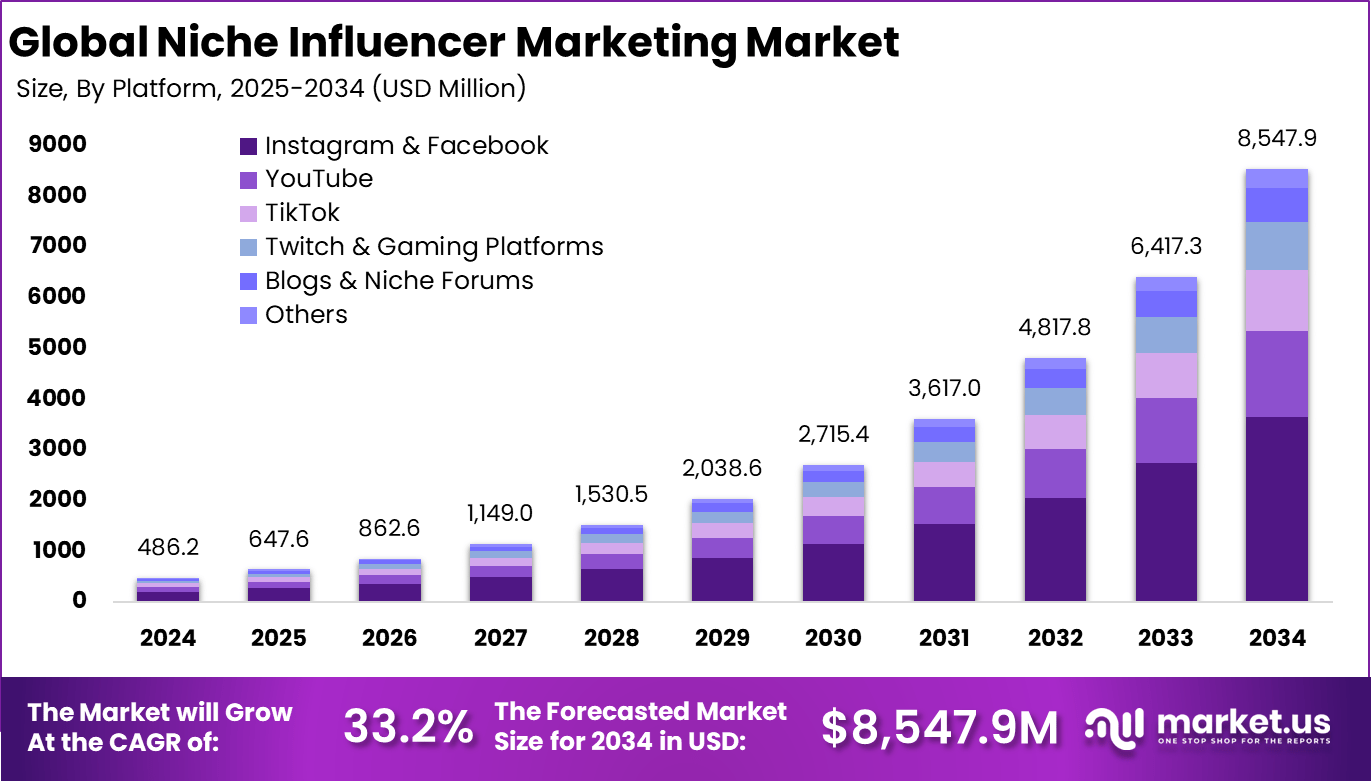
The global Niche Influencer Marketing market was valued at USD 486.2 million in 2024 and is expected to expand rapidly over the forecast period. The market is projected to reach approximately USD 8,547.9 million by 2034, growing at a strong CAGR of 33.2% from 2025 to 2034. This growth is driven by rising demand for targeted marketing strategies and higher engagement rates offered by niche creators. Brands are increasingly shifting budgets toward specialized influencers to reach well defined audience segments.
Influencer marketing continued to expand in scale and strategic importance across global brands. According to Sprout Social, about 86% of U.S. marketers planned to work with influencers in 2025, reflecting strong confidence in this channel. On a global level, 26% of marketing agencies and brands allocated more than 40% of their total marketing budgets to influencer marketing. The industry was valued at approximately USD 24 billion in 2024, highlighting its growing commercial significance.
Platform selection remains focused on a few dominant social networks, while collaboration models are evolving. Around 57% of brands identified Instagram as their preferred platform for influencer campaigns, followed by TikTok at 52% and YouTube at 37%. Facebook accounted for 28% of brand preference, while 12% chose LinkedIn. In addition, 65% of influencers expressed a strong interest in participating in the creative process, signaling a shift toward more collaborative and authentic campaign development.
Market Key Insights
- In 2024, Instagram and Facebook led platform adoption with a 42.7% share, supported by established creator ecosystems, advanced audience targeting, and consistent engagement across niche communities.
- The beauty and skincare segment dominated with a 28.9% share, reflecting strong consumer trust in creator recommendations and the effectiveness of visual, tutorial driven content formats.
- Brand awareness and content creation remained the primary campaign objective, accounting for 52.6% share. This highlighted the role of niche influencers in building authenticity, recall, and long term brand perception rather than short term conversions alone.
- Direct to consumer brands represented 47.3% of adoption in 2024, driven by the need for cost efficient customer acquisition and direct engagement with well defined audience segments.
- The United States continued to act as a major growth driver, supported by high social media penetration and early adoption of creator led marketing models.
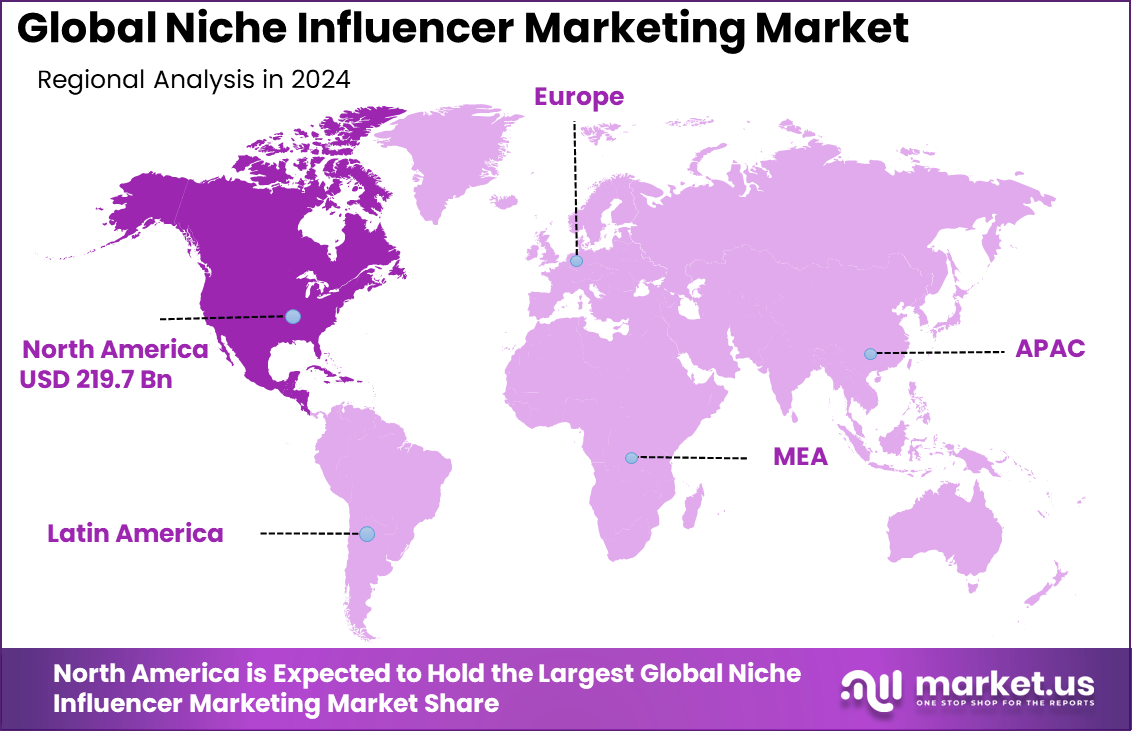
- North America maintained regional leadership with more than 45.2% share, reflecting strong brand spending on niche creators and a mature digital marketing infrastructure.
Key Statistics and Market Trends
- Engagement performance remained stronger in smaller creator segments. TikTok nano influencers recorded engagement rates of about 18%, compared with roughly 5% on Instagram. Micro influencer campaigns delivered nearly 60% higher engagement, reinforcing the value of trust based communities.
- Purchase influence was significant, as 86% of consumers made at least one influencer driven purchase each year. Short form video proved highly effective, with 79% of Instagram Reels viewers reporting product purchases after exposure.
- Platform preferences shifted in 2024, with TikTok becoming the most widely used channel for influencer campaigns at 69% brand adoption, surpassing Instagram at 47%. This shift reflected growing focus on video first discovery.
- Category performance varied by niche. Fashion recorded 81.4% adoption, making it the most developed influencer category, while sports and fitness content continued to deliver high engagement levels, particularly on Instagram.
- Trust and effectiveness remained central, as 36% of marketers reported influencer content outperforming branded content. Consumer confidence was also strong, with 69% of audiences stating they rely on influencer recommendations when evaluating products.
Market Overview
The niche influencer marketing market refers to marketing activities that focus on influencers with highly specific audience segments based on interests, professions, lifestyles, or communities. These influencers typically have smaller but more engaged followings compared to mass-market creators. Brands use niche influencers to communicate targeted messages with higher relevance and credibility. Adoption is seen across consumer goods, technology, healthcare, education, and specialty retail sectors.
Market development has been shaped by changes in consumer trust and content consumption behavior. Audiences increasingly value authentic opinions over broad promotional messaging. Niche influencers often build strong relationships with their followers through expertise or shared interests. This trust-based engagement supports more effective brand communication.
Top Driving Factors
One major driving factor of the niche influencer marketing market is declining effectiveness of traditional digital advertising. Consumers are exposed to high volumes of online ads, leading to reduced attention and lower engagement rates. Niche influencers offer a more personal and trusted communication channel. Their content feels more relevant and less intrusive.
Another key driver is brand demand for precise audience targeting. Companies seek marketing approaches that reach specific consumer segments without unnecessary spend. Niche influencers provide access to focused communities with clear interests or needs. This targeted reach improves campaign efficiency and message relevance.
Demand Analysis
Demand for niche influencer marketing is influenced by the shift toward performance-based marketing strategies. Brands increasingly measure success through engagement quality, conversion rates, and audience interaction rather than follower count. Niche influencers often deliver higher engagement within their communities. This performance advantage increases demand.
Demand is also shaped by growth in specialized consumer markets. Industries such as fitness, finance, education, sustainability, and professional services rely on informed audiences. Niche influencers act as subject-focused communicators in these areas. Their role in educating and influencing purchasing decisions supports steady market demand.
Increasing Adoption Technologies
Social media analytics platforms support adoption by providing detailed insights into audience behavior and content performance. These tools help brands identify suitable niche influencers and evaluate campaign outcomes. Data-driven selection reduces risk and improves alignment with marketing goals. Improved measurement supports wider adoption.
Content management and collaboration tools also contribute to market growth. Brands and influencers use shared platforms to manage campaigns, approvals, and performance tracking. These systems improve coordination and transparency. Technology support makes niche influencer campaigns easier to scale.
One key reason brands adopt niche influencer marketing is higher audience trust and credibility. Niche influencers are often seen as knowledgeable voices within their communities. Their recommendations carry greater weight compared to generic advertising. This trust supports stronger influence on purchasing decisions.
Another reason is improved return on marketing investment. Niche campaigns typically require lower budgets than celebrity influencer partnerships. At the same time, higher engagement levels improve campaign efficiency. This balance makes niche influencer marketing attractive for both large and small brands.
Investment Opportunities
Investment opportunities in the niche influencer marketing market exist in platforms that specialize in micro and niche influencer discovery. Tools that focus on audience quality, engagement depth, and content relevance attract brand interest. These platforms help reduce manual effort in influencer selection. Investors focus on solutions with strong data accuracy.
Another opportunity lies in sector-specific influencer networks. Platforms dedicated to industries such as healthcare, education, or finance offer curated influencer access. These networks simplify compliance and content alignment. Industry-focused models support long-term growth potential.
Business Benefits
Niche influencer marketing improves brand authenticity and message clarity. Brands communicate through voices that audiences already trust. This approach supports consistent brand perception and credibility. Authentic messaging improves long-term customer relationships.
These campaigns also support better audience insight. Brands gain direct feedback from engaged communities through comments and interactions. This information helps refine products and messaging. Improved insight supports strategic decision making.
Regulatory Environment
The regulatory environment for niche influencer marketing includes advertising disclosure and consumer protection rules. Influencers are required to clearly disclose paid partnerships and sponsorships. Compliance ensures transparency and protects consumer trust. Brands must monitor adherence to these requirements.
Data privacy regulations also affect influencer marketing activities. Campaigns often involve audience data analysis and tracking. Brands and platforms must follow applicable data protection laws. Regulatory compliance reduces legal risk and supports ethical marketing practices.
Regional Analysis
North America held a dominant position in the global market, accounting for more than 45.2% of total revenue. The region generated around USD 219.7 million, supported by advanced digital marketing ecosystems and high brand spending on influencer campaigns. Strong presence of social media platforms and data driven marketing practices strengthened regional leadership. As a result, North America continues to influence adoption and growth trends in niche influencer marketing.
Driver Analysis
The niche influencer marketing market is being propelled by the heightened demand for personalized and authentic engagement with defined audience segments. Niche influencers are recognized for their specialized expertise or interest areas, enabling them to cultivate highly engaged communities that value relevance and trust.
This depth of connection allows brands to communicate targeted messages that resonate more effectively than broad audience campaigns, especially in sectors where consumer preference is shaped by specific interests or lifestyles. As digital platforms continue to fragment into distinct communities of interest, brands increasingly leverage niche influencers to strengthen credibility and audience alignment, driving strategic investment in these specialized marketing partnerships.
Restraint Analysis
A primary restraint affecting niche influencer marketing is the challenge of maintaining authenticity and alignment between a brand’s values and the influencer’s established reputation. In niche segments, audiences place a substantial emphasis on trust and perceived expertise, which makes misaligned collaborations detrimental to both brand perception and influencer credibility.
When influencer messaging appears inconsistent with their typical content or fails to authentically reflect the interests of their audience, it can diminish engagement and erode long-term trust. Ensuring that partnerships are genuinely relevant to both the audience and the influencer’s persona requires careful selection and collaborative strategy development, which can limit rapid scalability of niche campaigns.
Opportunity Analysis
Opportunities in the niche influencer marketing market arise from its capacity to foster deeper audience engagement and more meaningful brand-community relationships. Niche influencers often maintain dedicated followings that exhibit higher interaction rates and stronger brand loyalty due to the relevance and authenticity of content.
These characteristics support more effective communication of tailored messaging and can enhance resonance with prospective customers who share specific interests. Brands that optimize collaborations with niche creators can benefit from elevated engagement, more precise audience targeting, and an enhanced ability to build community-centric brand affinity, which is particularly valuable in categories where trust is a key driver of purchase behaviour.
Challenge Analysis
A significant challenge within the niche influencer marketing market is the measurement and demonstration of campaign effectiveness across specific, tightly defined segments. Standard marketing metrics may not capture the nuanced value derived from niche partnerships, especially when audience size is smaller yet engagement is deeper.
Assessing the impact of niche influencer campaigns requires robust analytics frameworks that can evaluate not only short-term metrics such as clicks or impressions but also longer-term indicators like brand affinity, community growth, and sentiment. Without clear measurement methods tailored to niche environments, brands may struggle to justify investment or refine strategies, slowing broader adoption and optimization.
Key Market Segments
By Platform
- Instagram & Facebook
- YouTube
- TikTok
- Twitch & Gaming Platforms
- Blogs & Niche Forums
- Others
By Niche Category
- Gaming & Esports
- Beauty & Skincare
- Health, Fitness & Wellness
- Sustainable Living & Eco-products
- DIY, Crafts & Specific Hobbies
- Others
By Campaign Type
- Brand Awareness & Content Creation
- Affiliate Marketing & Performance
- Product Launches & Reviews
- Community Building & Engagement
- Others
By End-User Industry
- Direct-to-Consumer (DTC) Brands
- Specialty Retail & E-commerce
- Lifestyle & Consumer Packaged Goods
- Gaming & Technology
- Others
By Region
- North America
- Europe
- Asia Pacific
- Latin America
- Middle East & Africa
Top Key Players in the Market
- AspireIQ
- Upfluence
- Traackr
- Klear
- Patreon
- Ko-fi
- Obviously (by Mavrck)
- The Influencer Marketing Factory
- TikTok Creator Marketplace
- YouTube BrandConnect
- HypeAuditor
- Influencity
- Heepsy
- CreatorIQ
- GRIN
- Others
Report Scope
| Report Features | Description |
|---|---|
| Market Value (2024) | USD 486.2 Mn |
| Forecast Revenue (2034) | USD 8,547.9 Mn |
| CAGR(2025-2034) | 33.2% |
| Base Year for Estimation | 2024 |
| Historic Period | 2020-2023 |
| Forecast Period | 2025-2034 |
| Report Coverage | Revenue forecast, AI impact on Market trends, Share Insights, Company ranking, competitive landscape, Recent Developments, Market Dynamics and Emerging Trends |
Discuss your needs with our analyst
Please share your requirements with more details so our analyst can check if they can solve your problem(s)