HPC Data Management Market Size
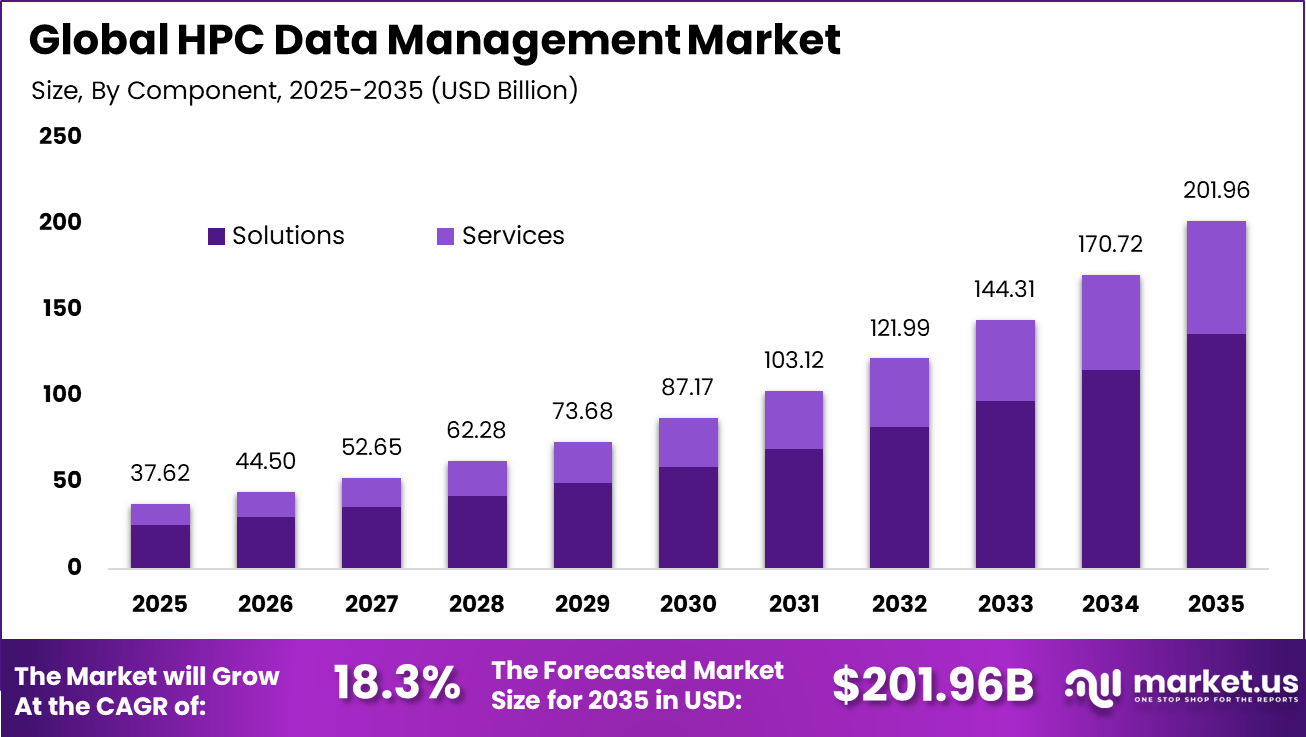
The global HPC Data Management market was valued at USD 37.62 billion in 2025 and is expected to expand strongly over the forecast period. The market is projected to reach approximately USD 201.96 billion by 2035, growing at a CAGR of 18.3% from 2025 to 2035. This growth is driven by increasing volumes of high performance computing workloads and rising demand for efficient data storage, movement, and analytics. Greater use of AI, scientific simulations, and large scale research computing is further supporting market expansion.
The HPC data management market refers to software and systems used to store, move, organize, and protect data generated by high performance computing environments. These solutions manage large volumes of structured and unstructured data produced by simulations, modeling, and analytics workloads. HPC data management platforms support data ingestion, tiering, access control, and lifecycle management. Adoption is common across research institutions, government agencies, enterprises, and scientific computing centers.
Key Takeaways
- Solutions dominated with a 67.4% share, showing strong preference for integrated platforms that manage storage optimization, data movement, and performance monitoring across complex HPC environments.
- Unstructured data led with a 72.8% share, reflecting rapid growth in simulation outputs, sensor streams, research files, and AI generated datasets handled by HPC systems.
- On premises deployment accounted for 58.9%, driven by strict data control, security requirements, and the need for ultra low latency access in research intensive workloads.
- Large enterprises represented 83.5% of adoption, supported by scale, higher data volumes, and sustained investment in advanced computing infrastructure.
- Academic and government research held the largest end user share at 42.7%, highlighting the essential role of HPC data management in scientific discovery, national laboratories, and public sector innovation.
- North America led with a 38.2% share, supported by strong research funding, mature HPC ecosystems, and early adoption of advanced data management technologies.
- The United States remained a central contributor with activity valued at USD 12.90 billion, reflecting high concentration of large scale research institutions and enterprise HPC deployments.
Key Insight Summary
HPC Data and Operational Insights
- Global HPC workloads processed more than 2.3 zettabytes of data in 2024, underscoring rapid expansion of data intensive simulations, analytics, and AI workloads.
- Manufacturing accounted for about 40% of total HPC usage, driven by digital twin modeling, advanced simulations, and supply chain optimization requiring continuous high throughput computing.
- Government and defense represented 31.8% of usage, reflecting sustained investment in national security applications and large scale research programs.
- Life sciences continued to scale demand, as genomic sequencing workloads processed nearly 12 billion reads per week, requiring tight coordination between compute and storage systems.
Deployment and Architecture Trends
- Cloud based HPC led new deployments in 2024 with a 59% share due to faster provisioning and elastic capacity, while on premises systems retained 52.7% of total market value because of security, compliance, and latency priorities.
- Hybrid and multi cloud architectures became standard, with more than 90% of large enterprises adopting these models by early 2026 to balance control and scalability.
Infrastructure and Efficiency Metrics
- Hardware investment remained central at 58.4% of total spending, as organizations prioritized advanced processors and accelerators such as GPUs.
- Leading supercomputing facilities averaged about 23 MW in energy use, while liquid cooling adoption improved thermal efficiency by up to 31% by late 2025.
- Storage utilization stayed exceptionally high, with research intensive HPC systems operating above 95% utilization, reflecting continuous workload demand and optimized resource management.
Top Driving Factors
One major driving factor of the HPC data management market is the increasing size and complexity of HPC datasets. Scientific simulations, artificial intelligence training, and engineering models generate petabyte-scale data volumes. Efficient data movement and storage are essential to maintain system performance. This requirement drives demand for advanced data management solutions. Another key driver is the need to reduce data bottlenecks in HPC workflows. Poor data handling can slow computation and reduce system utilization. HPC data management tools optimize data placement and access. Improved data flow enhances overall computing efficiency.
Demand for HPC data management solutions is influenced by expansion of research and innovation programs. Universities, laboratories, and enterprises rely on HPC to support discovery and product development. These activities require reliable access to historical and real-time data. Data management becomes a critical operational requirement. Demand is also shaped by enterprise adoption of AI and analytics within HPC environments. Training and inference workloads depend on fast and consistent data access. As AI workloads scale, data handling complexity increases. This strengthens demand for robust data management platforms.
Increasing Adoption Technologies
Parallel file systems play a central role in HPC data management adoption. These systems support simultaneous access to data by multiple computing nodes. High throughput and low latency improve application performance. Parallel storage is essential for large-scale HPC environments. Data tiering and automation technologies also support adoption. These tools move data between high-performance storage and cost-effective archives based on usage patterns. Automated tiering reduces manual intervention and storage costs. Intelligent data placement improves efficiency.
One key reason organizations adopt HPC data management solutions is improved system performance. Efficient data access reduces wait times for computing jobs. Faster data handling improves throughput and productivity. Performance gains support better use of HPC investments. Another reason is improved data reliability and protection. HPC workloads often involve valuable research and proprietary information. Data management tools support backup, replication, and recovery. Strong data protection reduces risk of loss or corruption.
Investment Opportunities
Investment opportunities in the HPC data management market exist in software-defined storage solutions. These platforms offer flexibility and scalability across different hardware environments. Software-based approaches reduce vendor dependency. Investors focus on adaptable and scalable solutions. Another opportunity lies in cloud-integrated HPC data management platforms. Hybrid environments require seamless data movement between on-premise and cloud systems. Solutions that support unified data control gain attention. Hybrid capability expands addressable markets.
HPC data management solutions improve operational efficiency by reducing manual data handling. Automated workflows streamline data ingestion and archiving. Teams spend less time managing storage issues. Efficiency improvements lower operational costs. These solutions also improve collaboration and data reuse. Centralized data management enables shared access across teams and projects. Reusable datasets improve research continuity. Better data access supports faster innovation.
Regulatory Environment
The regulatory environment for HPC data management includes data security and privacy requirements. Research and enterprise data may contain sensitive or regulated information. Secure access control and encryption are essential. Compliance with data protection laws is mandatory. Data retention and governance regulations also influence deployment. Organizations must manage how long data is stored and who can access it. HPC data management tools support audit trails and policy enforcement. Regulatory alignment ensures responsible data handling.
Regional Analysis
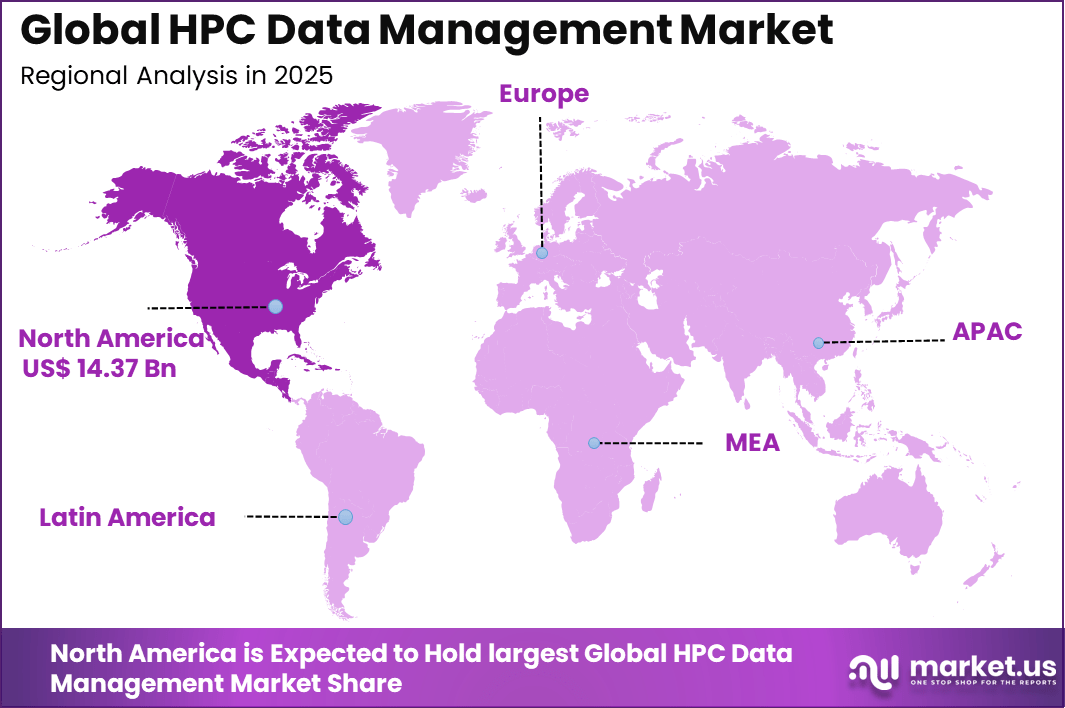
North America held a dominant position in the global market, accounting for more than 38.2% of total revenue. The region generated around USD 14.37 billion, supported by advanced research infrastructure and strong adoption of HPC technologies. High investment in data intensive applications across government, academia, and enterprises strengthened regional leadership. As a result, North America continues to shape innovation and adoption trends in the HPC data management market.
Driver Analysis
The HPC data management market is being driven by the exponential growth of data generated from high-performance computing activities, where large simulations, advanced analytics, and scientific research produce petabyte-scale datasets that require specialised handling. High-performance computing environments are increasingly data-intensive, necessitating efficient data movement, storage optimisation, accessibility, and robust retrieval mechanisms to maintain performance and throughput.
Organisations engaged in climate modelling, genomics, engineering simulations, and other compute-intensive domains depend on advanced data management frameworks to organise and process these vast data volumes without creating bottlenecks. The rising complexity of workloads combined with increasing demand for rapid analytical insights continues to reinforce the need for scalable and reliable HPC data management solutions.
Restraint Analysis
A notable restraint in the HPC data management market stems from the technical and operational challenges associated with integrating and maintaining complex data management systems within existing high-performance computing environments. Data management for HPC must support high throughput and low latency while handling distributed storage systems, which often involves substantial architectural planning and specialised expertise.
Legacy HPC infrastructure that lacks modern data orchestration tools can create integration bottlenecks and increase total cost of ownership due to the need for custom solutions and additional support resources. These integration complexities and resource requirements can slow the pace of adoption, especially among organisations with constrained technical capabilities.
Opportunity Analysis
Emerging opportunities in the HPC data management market are associated with the convergence of artificial intelligence, machine learning, and edge-to-cloud computing paradigms that demand advanced data orchestration. Integrating AI-powered data management capabilities enhances the ability to classify, index, and retrieve data intelligently, enabling faster insights and automated lifecycle management.
Hybrid and cloud-enabled HPC data platforms present further opportunities by offering scalable storage architectures that support distributed access and flexible resource provisioning. These developments extend the applicability of HPC data management beyond traditional research and high-performance computing centres to enterprise and cloud-native environments where data volume and velocity continue to rise.
Challenge Analysis
A central challenge confronting the HPC data management market is the ability to maintain performance and reliability while managing increasingly diverse, large-scale data workflows. HPC systems often operate with stringent performance requirements, where any inefficiency in data movement or storage access can significantly impact overall computational throughput.
Addressing these challenges necessitates sophisticated coordination between storage, network, and compute resources to avoid latency and bandwidth limitations, particularly as data workflows grow more complex. Ensuring data integrity, consistency, and security across distributed architectures adds further complexity to operational management, requiring continuous investment in advanced tools and processes.
Emerging Trends
Emerging trends in the HPC data management landscape include the integration of edge-to-cloud strategies and AI-enhanced data orchestration to support more responsive and adaptive data workflows. Platforms are increasingly designed to handle hybrid environments where data may originate from remote edge devices, cloud storage, and on-premise HPC clusters, necessitating seamless data interoperability.
There is also growing focus on augmented security protocols and support for exascale computing, which enable data management systems to operate efficiently at very large scales. These trends reflect broader industry movements toward distributed computing ecosystems and intelligent automation for data lifecycle management.
Growth Factors
Growth in the HPC data management market is anchored in the continued proliferation of data-intensive applications and high-performance computing use cases that require advanced data storage and analytics support. As organisations increasingly deploy HPC clusters for AI training, scientific modelling, and real-time analytics, the demand for solutions that can efficiently manage, retrieve, and protect data at scale rises.
The ongoing expansion of HPC infrastructure globally, paired with investments in research, engineering, and complex simulation environments, further elevates the need for specialised data management tools capable of meeting performance and reliability expectations. These drivers collectively contribute to the momentum behind adoption of HPC data management technologies.
Key Market Segments
By Component
- Solutions
- File & Object Storage Systems
- Hierarchical Storage Management
- Data Integration & Movement Tools
- Metadata & Catalog Management
- Others
- Services
- Professional Services
- Managed Services
- Support & Maintenance
- Others
By Data Type
- Structured Data
- Unstructured Data
- Semi-structured Data
By Deployment Model
- On-premises
- Cloud-based
- Hybrid
By Organization Size
- Large Enterprises
- Small and Medium-sized Enterprises
By End-User Industry
- Academic & Government Research
- Manufacturing & Engineering
- Banking, Financial Services, and Insurance
- Healthcare & Life Sciences
- Media & Entertainment
- Energy & Utilities
- Others
Top Key Players in the Market
- Hewlett Packard Enterprise Company
- Dell Technologies, Inc.
- International Business Machines Corporation
- NetApp, Inc.
- Hitachi, Ltd.
- Fujitsu Limited
- DDN Storage
- Panasas, Inc.
- Datalight, Inc.
- Seagate Technology plc
- Western Digital Corporation
- Pure Storage, Inc.
- Qumulo, Inc.
- Axiado Corporation
- Microsoft Corporation
- Others
Report Scope
| Report Features | Description |
|---|---|
| Market Value (2025) | USD 37.6 Bn |
| Forecast Revenue (2035) | USD 201.9 Bn |
| CAGR(2025-2035) | 18.3% |
| Base Year for Estimation | 2025 |
| Historic Period | 2020-2024 |
| Forecast Period | 2025-2035 |
| Report Coverage | Revenue forecast, AI impact on Market trends, Share Insights, Company ranking, competitive landscape, Recent Developments, Market Dynamics and Emerging Trends |
Discuss your needs with our analyst
Please share your requirements with more details so our analyst can check if they can solve your problem(s)