EdTech Gamification Market Size
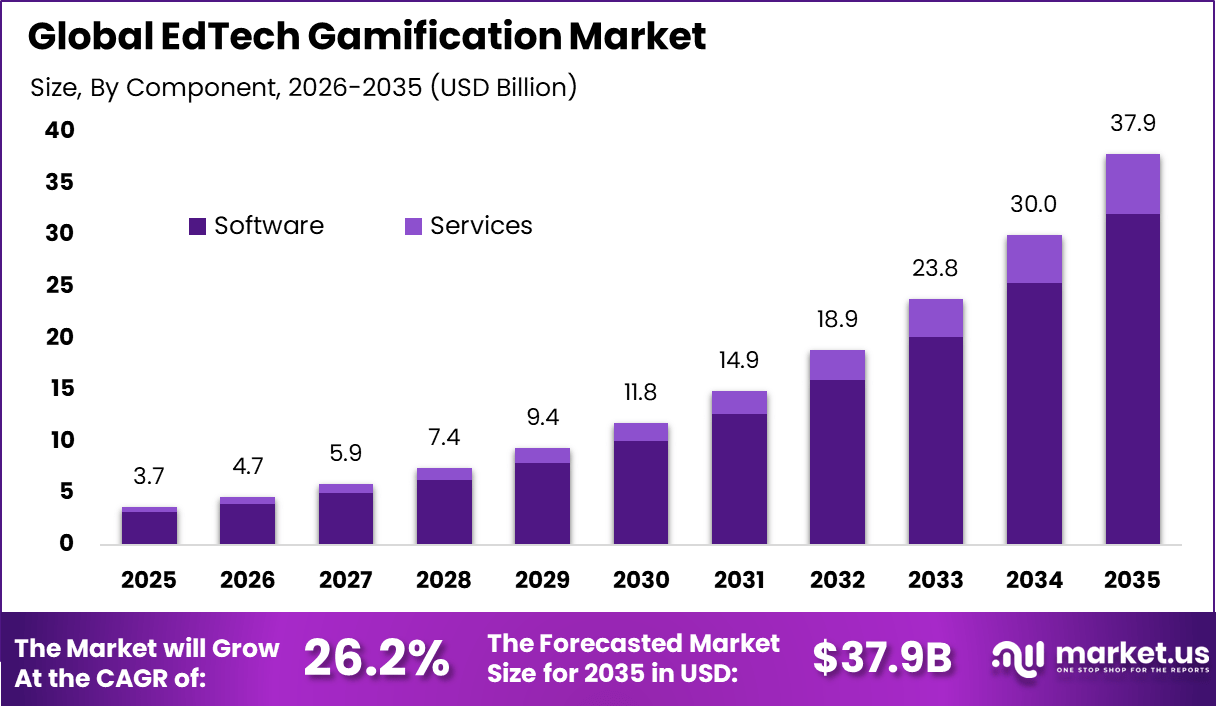
The global EdTech Gamification market was valued at USD 3.7 billion in 2025 and is expected to expand rapidly over the forecast period. The market is projected to reach approximately USD 37.9 billion by 2035, growing at a strong CAGR of 26.2% from 2026 to 2035. This growth is driven by increasing adoption of interactive learning models and rising demand for student engagement tools in digital education. Gamified platforms are being widely used to improve knowledge retention and learning outcomes.
The EdTech gamification market refers to the use of game-based elements within digital education platforms to improve learner engagement and motivation. These elements include points, badges, leaderboards, challenges, and progress tracking integrated into learning systems. Gamification is applied across K–12 education, higher education, corporate training, and skill development programs. It transforms traditional learning into interactive experiences. Adoption supports improved participation and learning outcomes.
Market development has been influenced by changing learner expectations and digital learning adoption. Traditional instructional methods often struggle to maintain learner attention in online environments. Gamification introduces interactive and goal-oriented learning structures. These features improve focus and consistency. As digital education expands, gamification becomes an important engagement tool.
One major driving factor of the EdTech gamification market is the need to improve learner engagement. Online learning environments face high dropout and low participation rates. Gamified elements encourage active involvement and sustained interest. Progress rewards motivate learners to continue. Engagement challenges strongly drive adoption.
Another key driver is the growing use of digital learning platforms in education and training. Schools and organizations increasingly rely on online learning systems. Gamification enhances the effectiveness of these platforms. Interactive features improve knowledge retention. Digital learning growth supports market expansion.
Top Market Takeaways
- Software led the EdTech gamification market with an 84.6% share, as platforms embed gamification engines, analytics, and content tools directly into digital learning systems.
- Cloud-based deployment dominated with 92.8%, reflecting demand for scalable access, remote learning enablement, and continuous updates.
- K–12 education accounted for 47.3% of adoption, driven by early exposure to digital learning and need for engagement-focused instruction.
- Points, badges, and leaderboards captured 58.4%, showing their effectiveness as simple and widely accepted motivation tools.
- Courseware and subject learning represented 52.7%, indicating gamification is increasingly applied to core curriculum delivery.
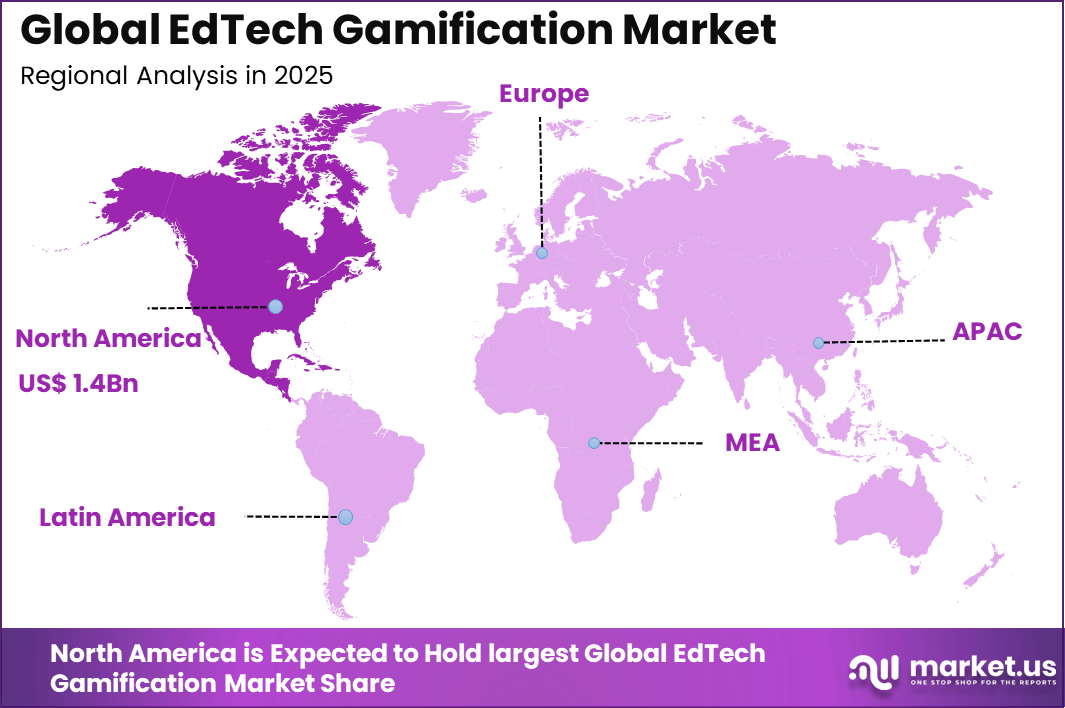
- North America held 38.6%, supported by strong EdTech investment and high digital classroom penetration.
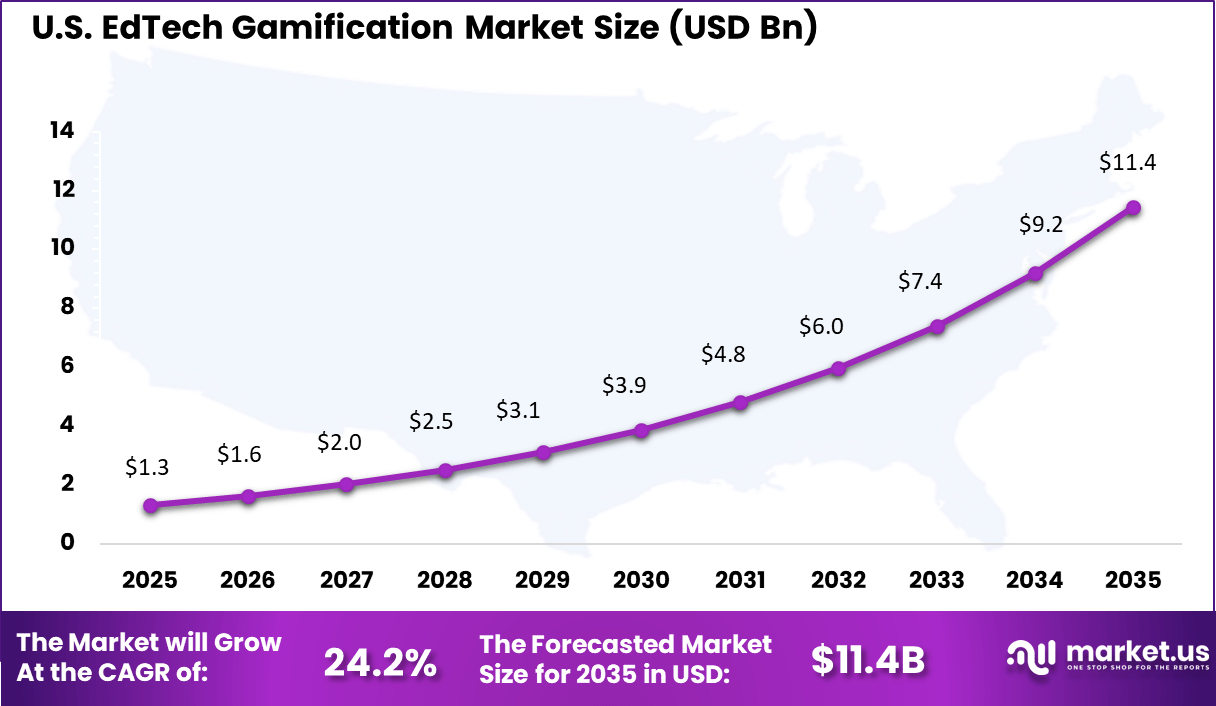
- The U.S. market reached USD 1.31 billion in 2024, expanding at a 24.22% CAGR, driven by rapid uptake of gamified learning models.
Quick Market Facts
- More than 500 million K–12 students globally use gamified learning tools, with over 60% of North American classrooms adopting game-based elements.
- Around 200 million higher-education students access gamified platforms, with 88.9% utilization in e-learning settings.
- Over 100 million employees use gamified corporate training annually, and about 70% of Fortune 500 firms apply gamification.
Usage and Engagement Insights
- About 60% of teachers view gamification as the most effective method for improving engagement.
- Badges are used by 80.5% of educators, followed by points at 57.3% and leaderboards at 43.9%.
- Gamification is most common in mathematics (91.5%) and English (57.3%) instruction.
Learning Outcomes
- 89% of educators report higher engagement with gamified learning tools.
- Over 70% of students feel more motivated through game-based learning.
- Student performance improves by around 14% in skill-based assessments.
- Test score gains average 34%, while knowledge retention improves by up to 40%.
Regional Analysis
North America held a dominant position in the global market, accounting for more than 38.6% of total revenue. The region generated around USD 1.4 billion, supported by advanced digital education infrastructure and high adoption of EdTech solutions. Strong investment in online learning platforms and technology enabled classrooms strengthened regional leadership. As a result, North America continues to shape innovation and adoption trends in the EdTech gamification market.
The United States reached USD 1.31 Billion with a CAGR of 24.22%, reflecting rapid market growth. Expansion is driven by EdTech investment and digital curriculum adoption. Gamified learning tools gain popularity among educators. Institutions focus on student engagement. Market momentum remains strong.
Driver Analysis
The EdTech gamification market is being driven by the increasing demand for engaging and interactive learning experiences that improve learner motivation and retention. Traditional learning models often struggle to maintain sustained attention and participation, especially in remote and hybrid education settings.
Gamification integrates game-like elements such as points, badges, leaderboards, and challenges into educational content, encouraging active learning and enhancing knowledge retention. These mechanisms turn routine learning tasks into rewarding experiences, which supports deeper engagement among students and adult learners alike. The alignment of gamification with digital learning platforms also enables real-time feedback and performance tracking, strengthening instructional effectiveness and learner outcomes.
Restraint Analysis
A key restraint in the EdTech gamification market arises from the complexity of designing experiences that balance entertainment value with meaningful pedagogy. While game elements may increase motivation, poorly designed gamified content can distract from core learning objectives or oversimplify complex subjects.
Educators and instructional designers must carefully align gamification mechanics with educational goals to ensure that engagement translates into measurable learning outcomes. Additionally, integrating gamification features into existing learning management systems and digital platforms often requires technical expertise and investment, which can slow adoption among resource-constrained institutions.
Opportunity Analysis
Emerging opportunities in the EdTech gamification market are linked to the expansion of personalised learning pathways and adaptive feedback systems that tailor content to individual learner progress. Advanced platforms can analyse performance data, assess learner strengths and weaknesses, and adjust challenges in real time to maintain optimal engagement levels.
This personalised approach supports mastery-based learning and helps reduce dropout rates by tailoring difficulty and rewards to learner readiness. Moreover, gamification can be extended beyond academic environments into corporate training and professional skills development, where interactive challenges and simulated scenarios enhance learner readiness and skill acquisition.
Challenge Analysis
A central challenge confronting the EdTech gamification market relates to measuring the impact of gamified elements on long-term learning outcomes and behavioural change. Engagement metrics such as time spent or points earned do not always equate to deep comprehension or practical skill development, making it difficult to validate the pedagogical effectiveness of gamification initiatives.
Educators and administrators must implement rigorous assessment frameworks that distinguish between surface-level engagement and substantive learning achievements. Ensuring that gamification enhances rather than obscures instructional quality demands ongoing evaluation, alignment with curriculum standards, and evidence-based design practices.
Emerging Trends
Emerging trends in the EdTech gamification landscape include the integration of artificial intelligence and data analytics to drive adaptive learning experiences that respond to real-time learner behaviour. AI enables systems to personalise rewards, recommend targeted challenges, and identify patterns that inform tailored instructional pathways.
Another trend is the use of immersive technologies such as augmented reality (AR) and virtual reality (VR) that combine gamification with experiential learning for subjects requiring complex conceptual understanding. Collaborative gamification, where learners engage in team-based challenges and social learning contests, is also gaining momentum as educators emphasise skills such as communication, problem-solving, and teamwork.
Growth Factors
Growth in the EdTech gamification market is anchored in rising digital adoption across education and professional training sectors, coupled with a greater focus on learner engagement and outcome-oriented instruction. Remote and hybrid learning models have accelerated the need for tools that can sustain learner attention, support self-paced study, and enhance interactive participation.
Technological advancements in mobile platforms, cloud-based learning systems, and analytics further strengthen the capabilities of gamification solutions. As educators and organisations prioritise personalised, data-informed learning pathways, gamification remains a strategic component in designing engaging and effective digital learning environments.
Key Market Segments
By Component
- Software
- Services
By Deployment Mode
- Cloud-based
- On-premises
By End-User
- K-12 Education
- Higher Education
- Corporate Training
- Language Learning
- Others
By Element
- Points, Badges & Leaderboards (PBLs)
- Storytelling & Narrative
- Challenges & Quests
- Social & Collaborative Features
- Others
By Application
- Courseware & Subject Learning
- Assessment & Testing
- Student Engagement & Behavior Management
- Professional Skill Development
- Others
Top Key Players in the Market
- Kahoot! ASA
- Duolingo, Inc.
- Classcraft Studios, Inc.
- Minecraft: Education Edition (Microsoft)
- Quizlet, Inc.
- Nearpod, Inc.
- GoGuardian
- Blooket, LLC
- Gimkit, Inc.
- Breakout EDU
- Legends of Learning
- SplashLearn
- Prodigy Education, Inc.
- Mango, LLC
- EdApp, Ltd.
- Others
Report Scope
| Report Features | Description |
|---|---|
| Market Value (2025) | USD 3.7 Bn |
| Forecast Revenue (2035) | USD 37.9 Bn |
| CAGR(2026-2035) | 26.2% |
| Base Year for Estimation | 2025 |
| Historic Period | 2020-2024 |
| Forecast Period | 2026-2035 |
| Report Coverage | Revenue forecast, AI impact on Market trends, Share Insights, Company ranking, competitive landscape, Recent Developments, Market Dynamics and Emerging Trends |
Discuss your needs with our analyst
Please share your requirements with more details so our analyst can check if they can solve your problem(s)