Introduction
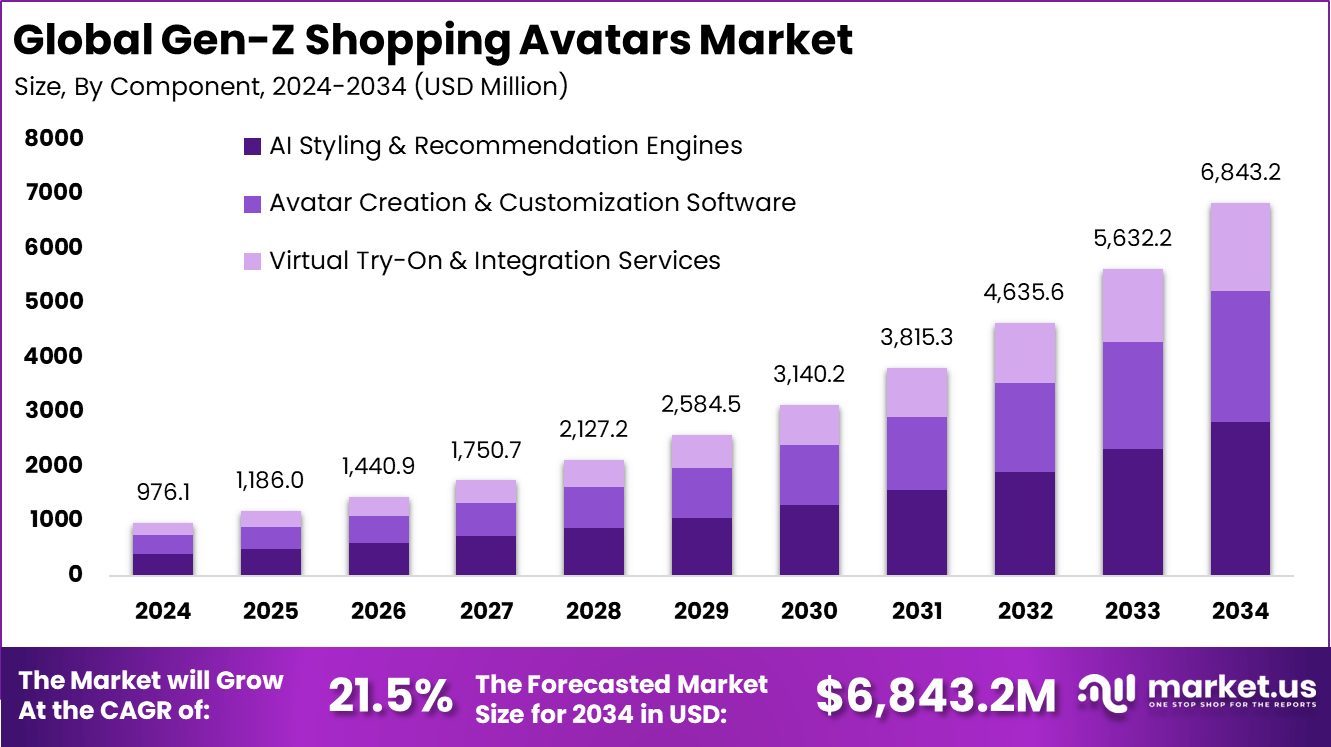
The global Gen Z Shopping Avatars market was valued at USD 1,186 million in 2025 and is expected to expand rapidly over the forecast period. The market is projected to reach approximately USD 6,843.2 million by 2034, growing at a CAGR of 21.5% from 2025 to 2034. This growth is driven by rising adoption of virtual shopping experiences and increasing use of avatars in social commerce and immersive retail platforms. Brands are leveraging shopping avatars to improve personalization and engagement among Gen Z consumers.
The Gen Z shopping avatars market refers to digital avatars designed to represent shoppers within online retail and virtual commerce environments. These avatars use artificial intelligence and personalization features to reflect user preferences, style choices, and behavior. They are used across e-commerce platforms, virtual stores, gaming-inspired marketplaces, and social commerce channels. Shopping avatars support interactive browsing, virtual try-ons, and guided purchasing experiences. Adoption is closely aligned with Gen Z digital habits and immersive online engagement.
Market development has been influenced by Gen Z preference for visual, interactive, and personalized shopping journeys. Traditional static product pages often fail to maintain attention for this demographic. Shopping avatars introduce identity-driven and gamified experiences that feel more engaging. Integration with social media and virtual environments increases relevance. As experiential commerce grows, avatars become a key interface.
Key Takeaway
- AI styling and recommendation engines led components with a 41.3% share, driven by demand for personalized fashion discovery and automated outfit suggestions.
- 2D stylized avatars dominated with 52.7%, favored for simple creation, lower computing needs, and strong appeal on mobile and social platforms.
- Virtual fashion and apparel try-on accounted for 48.6%, reflecting Gen Z interest in interactive and confidence-building shopping.
- Social media and messaging apps captured 58.4% of platform usage, reinforcing the role of social commerce and conversational shopping.
- Individual Gen Z consumers represented 76.5% of end users, highlighting direct-to-consumer adoption among digital natives.
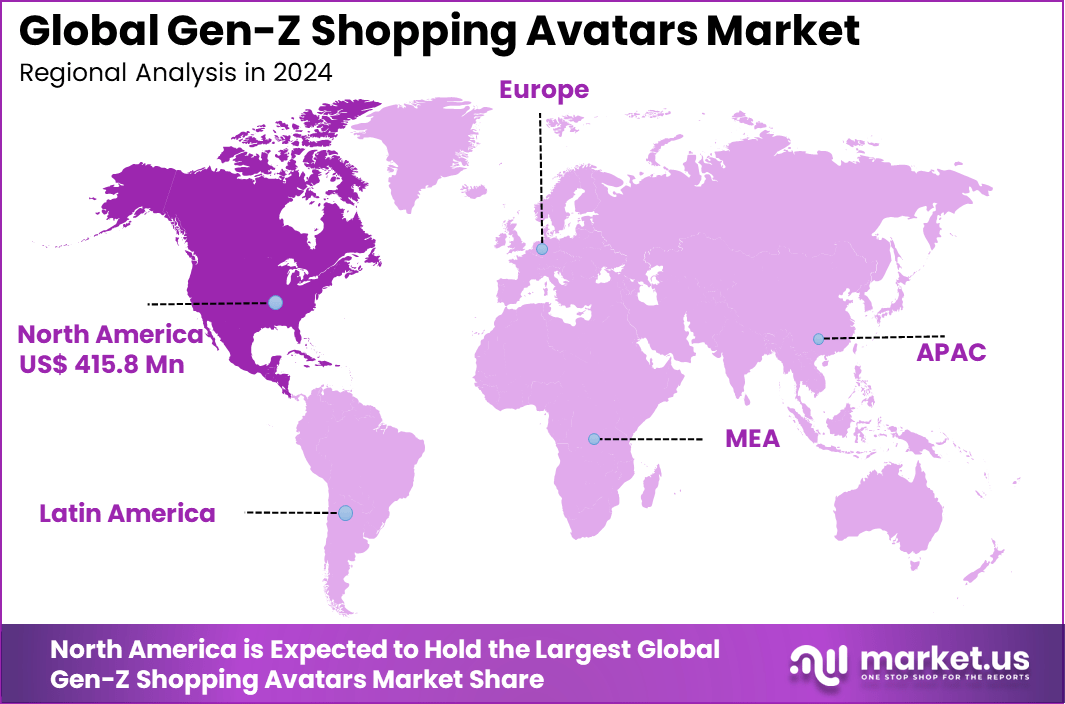
- North America held 42.6%, supported by advanced digital retail systems and high social media usage.
- The U.S. market reached USD 375.1 million in 2024, expanding at a 19.22% CAGR due to growth in virtual fashion and AI personalization.
Key Insights Summary
Avatar Creation and Usage Trends
- More than 52% of Gen Z users have created a virtual avatar.
- In the U.S., 85% of Gen Z users have created a Bitmoji avatar.
- Around 250 million users engage with Bitmoji daily.
- About 56% of Gen Z prioritize styling avatars over physical appearance.
- Avatars are treated as tools of personal expression, not only gaming assets.
Digital Fashion Influence
- About 84% of Gen Z and Gen Alpha say avatar styling influences real-world fashion choices.
- More than 60% of young consumers buy digital outfits for avatars.
- In 2023, users purchased 1.65 billion digital fashion items on Roblox.
- Around 52% of Gen Z users are willing to spend up to USD 10 per month on avatar styling.
Brand Perception and Loyalty
- About 84% of Gen Z consumers tried a physical brand after first engaging with it virtually.
- Brands focused on sustainability, inclusivity, and technology build stronger loyalty.
- Gen Z males show higher likelihood of buying digital clothing and seeking the same designs offline.
Top Driving Factors
One major driving factor of the Gen Z shopping avatars market is the demand for personalization and self-expression. Gen Z consumers value individuality and digital identity representation. Avatars allow users to customize appearance and style preferences. This creates a sense of ownership and engagement. Personal expression strongly drives adoption.
Another key driver is the influence of gaming and virtual worlds on Gen Z behavior. Many users are familiar with avatars through games and social platforms. Shopping avatars extend this familiarity into commerce. Familiar interaction models reduce learning barriers. Cultural alignment supports market growth.
Demand Analysis
Demand for Gen Z shopping avatars is influenced by the growth of social commerce and interactive retail. Consumers increasingly discover products through social and digital communities. Avatars enhance interaction within these environments. Engaging experiences increase time spent on platforms. This behavior supports rising demand.
Demand is also shaped by fashion, beauty, and lifestyle brands targeting Gen Z audiences. These categories benefit from visual representation and virtual try-on features. Avatars improve confidence in purchase decisions. Reduced uncertainty supports higher conversion. Brand-led adoption strengthens demand.
Regional Analysis
In 2024, North America held a dominant position in the global market, accounting for more than 42.6% of total revenue. The region generated around USD 415.8 million, supported by strong penetration of digital commerce platforms and early adoption of virtual and augmented reality technologies. High engagement of Gen Z users with interactive digital environments strengthened regional leadership. As a result, North America continues to influence innovation and adoption trends in the Gen Z shopping avatars market.
Driver Analysis
The Gen-Z shopping avatars market is being driven by the increasing demand among younger consumers for personalised, immersive, and socially engaging online shopping experiences. Generation Z shoppers, who have grown up with digital environments and social media, seek interactive ways to express identity, explore products, and influence purchase decisions.
Shopping avatars powered by artificial intelligence and real-time animation technologies enable users to customise digital representations of themselves, interact with virtual storefronts, and preview apparel or accessories in engaging environments. This fusion of gamification and commerce supports deeper engagement, stronger brand connection, and higher conversion potential compared with traditional online browsing. As digital identity and experiential retail continue to evolve, shopping avatars provide a differentiated way for brands to connect with digitally native audiences.
Restraint Analysis
A primary restraint in the Gen-Z shopping avatars market arises from technical barriers related to integration, standardisation, and device compatibility. High-quality avatar experiences often depend on advanced rendering, motion tracking, and real-time interaction capabilities that may not be supported uniformly across consumer devices.
Ensuring seamless performance across mobile phones, tablets, and desktop systems requires significant development resources and optimisation efforts. Additionally, concerns about digital privacy, data collection, and user control over avatar-generated data can limit uptake among privacy-conscious Gen-Z consumers. These technical and ethical factors can slow adoption, especially among smaller brands or platforms without dedicated digital experience teams.
Opportunity Analysis
Emerging opportunities in the Gen-Z shopping avatars market are linked to the expansion of social shopping, virtual events, and cross-platform identity economies. Avatars that integrate with social media platforms, livestreamed shopping events, and virtual communities can amplify peer influence and social proof, which are key drivers of Gen-Z purchasing behaviour.
There is also potential for interoperable avatars that carry style preferences, loyalty status, or digital fashion assets across retail and entertainment ecosystems. As brands explore deeper engagement strategies, avatar-led experiences can support personalised recommendations, reward-based interactions, and collaborative shopping journeys that resonate with socially connected, digitally fluent audiences.
Challenge Analysis
A central challenge confronting this market relates to balancing immersive experiences with practical commerce value and clear purchasing pathways. While avatars can enhance engagement and exploration, translating virtual interaction into actual purchase behaviour requires intuitive interfaces, transparent pricing, and frictionless checkout flows.
If users perceive avatar environments as entertaining but disconnected from tangible shopping value, interest may diminish over time. Ensuring that avatar interactions drive measurable business outcomes, such as sales lift or repeat engagement, demands intentional design, real-time analytics, and seamless integration with e-commerce infrastructures.
Emerging Trends
Emerging trends in the Gen-Z shopping avatars landscape include the use of artificial intelligence to deliver adaptive personalisation based on behavioural cues, style preferences, and past purchase data. Avatars are increasingly capable of dynamic wardrobe mixing, predictive styling suggestions, and real-time reaction to social interactions within virtual spaces.
Another trend is the blending of augmented reality experiences, where avatars and users can visualise products in physical contexts or during livestreamed shopping events. Interoperability initiatives are also gaining traction, enabling avatars to move across gaming worlds, fashion metaverses, and brand-owned environments while maintaining a consistent identity and asset repository.
Growth Factors
Growth in the Gen-Z shopping avatars market is supported by Gen-Z’s strong preference for digital engagement, self-expression, and community influence in purchase decisions. As retail continues to shift toward experiential and social commerce formats, immersive shopping interfaces that include avatars resonate with this demographic’s expectations for interactivity and creativity.
Advancements in artificial intelligence, real-time graphics, and cross-platform connectivity enhance the feasibility and appeal of avatar-driven retail experiences. Continued expansion of mobile commerce, virtual events, and social shopping trends further reinforces the relevance of shopping avatars as part of future-oriented retail engagement strategies.
Key Market Segments
By Component
- Avatar Creation & Customization Software
- AI Styling & Recommendation Engines
- Virtual Try-On & Integration Services
By Avatar Type
- 2D Stylized Avatars
- 3D Hyper-realistic Avatars
- Anime/Game-inspired Avatars
By Application
- Virtual Fashion & Apparel Try-On
- Cosmetics & Beauty Product Testing
- Virtual Social Shopping & Hauls
- Gaming & Metaverse Fashion
- Others
By Platform
- Social Media & Messaging Apps
- Gaming & Metaverse Platforms
- Branded Retail Apps & Websites
- Standalone Avatar Apps
- Others
By End-User
- Individual Gen-Z Consumers
- Fashion & Beauty Brands
- Retail & E-commerce Platforms
- Others
Top Key Players in the Market
- Zepeto
- Genies, Inc.
- Ready Player Me
- Daz 3D, Inc.
- Bitmoji
- Loom.ai
- Replica Studios
- Soul Machines, Ltd.
- The Fabricant
- Obsess, Inc.
- Zeekit
- Vue.ai
- Perfect Corp.
- Memomi
- Vertebrae, Inc.
- Others
Report Scope
| Report Features | Description |
|---|---|
| Market Value (2025) | USD 976.1 Mn |
| Forecast Revenue (2035) | USD 6,843.2 Mn |
| CAGR(2025-2035) | 21.5% |
| Base Year for Estimation | 2025 |
| Historic Period | 2020-2024 |
| Forecast Period | 2026-2035 |
Discuss your needs with our analyst
Please share your requirements with more details so our analyst can check if they can solve your problem(s)