Report Overview
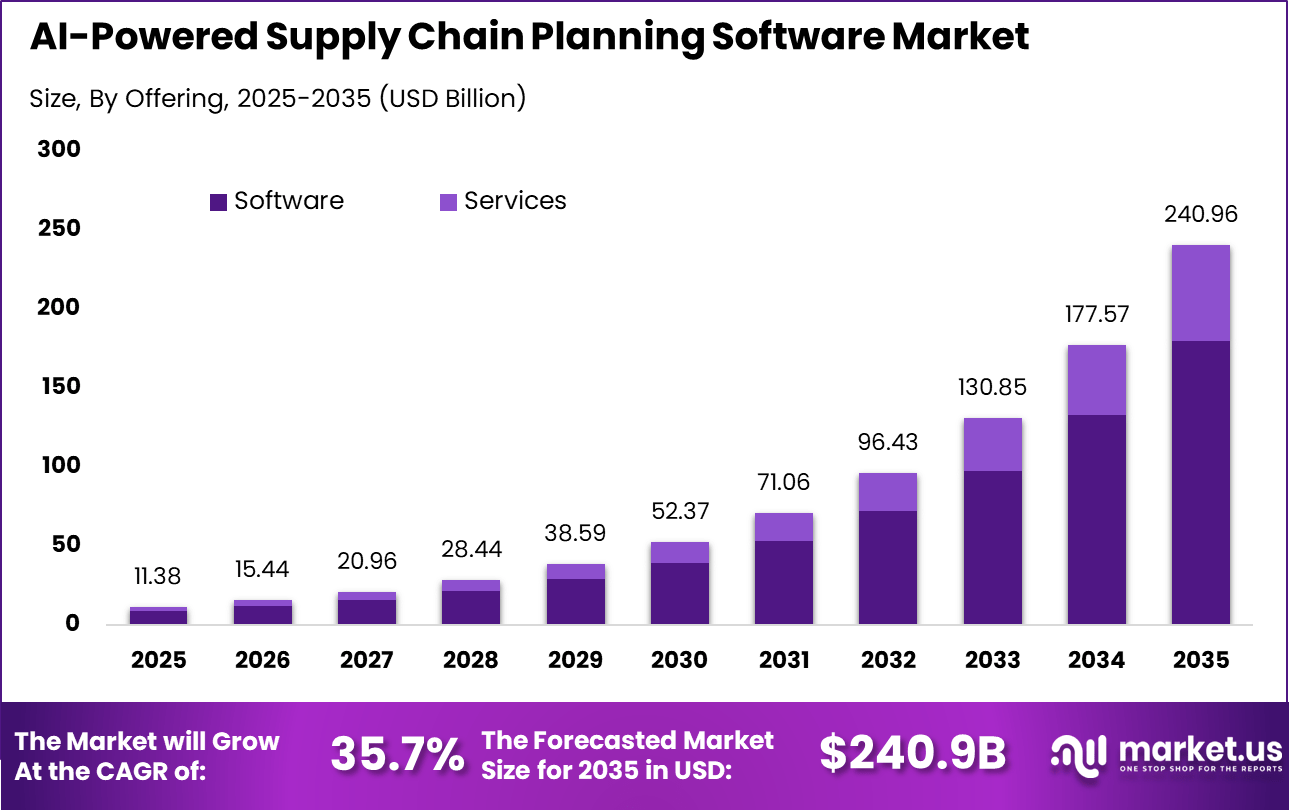
The global AI Powered Supply Chain Planning Software market was valued at USD 11.38 billion in 2025 and is expected to expand rapidly over the forecast period. The market is projected to reach approximately USD 240.96 billion by 2035, growing at a strong CAGR of 35.7% from 2025 to 2035. This growth is driven by increasing supply chain complexity and rising demand for real time forecasting, demand sensing, and inventory optimization. Organizations are adopting AI driven planning tools to improve resilience, reduce costs, and enhance operational visibility.
The AI powered supply chain planning software market refers to digital platforms that use artificial intelligence to plan, forecast, and optimize supply chain activities. These solutions support demand forecasting, inventory planning, production scheduling, and distribution coordination within a unified system. AI models analyze historical data, real-time signals, and external factors to improve planning accuracy. Adoption spans manufacturing, retail, logistics, healthcare, and consumer goods industries. These platforms help organizations manage complex and dynamic supply chains more effectively.
Market development has been influenced by increasing volatility and complexity across global supply chains. Traditional planning systems rely on static rules and manual inputs, which limit responsiveness. AI powered planning software introduces adaptive and predictive capabilities. These systems adjust plans based on changing demand and supply conditions. As resilience becomes a priority, intelligent planning tools gain importance.
Regional Analysis
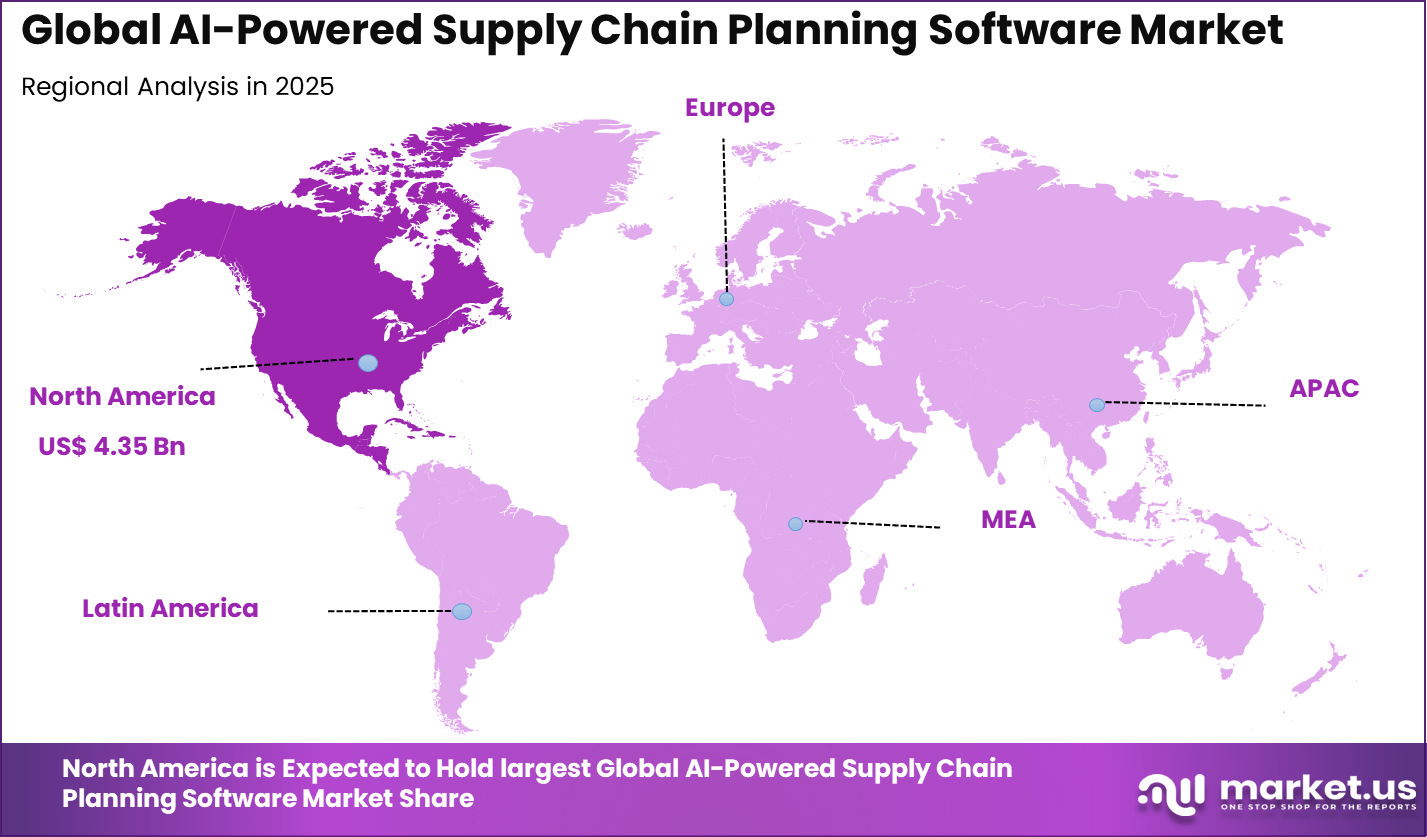
North America held a dominant position in the global market, accounting for more than 38.3% of total revenue. The region generated around USD 4.35 billion, supported by early adoption of advanced analytics and strong investment in digital supply chain transformation. High penetration of cloud platforms and AI technologies strengthened regional leadership. As a result, North America continues to shape adoption and innovation trends in AI powered supply chain planning software.
Driver Analysis
The AI-powered supply chain planning software market is being driven by the increasing complexity of global supply chains and the need for intelligent solutions that can respond to dynamic demand, disrupted supply routes, and fluctuating inventory levels. Traditional planning methods are often unable to process real-time data from suppliers, logistics networks, and customer demand signals, leading to inefficiencies and stock imbalances.
AI-enabled planning software integrates machine learning, predictive analytics, and real-time data ingestion to improve demand forecasting, optimise inventory, and orchestrate production schedules more accurately. These capabilities enable organisations to respond rapidly to market changes, reduce waste, and enhance visibility across extended supply networks.
Restraint Analysis
A significant restraint in the AI-powered supply chain planning software market relates to data quality and integration challenges within complex enterprise environments. Supply chain planning solutions depend on comprehensive, consistent, and accurate data from multiple internal systems and external partners, and many organisations struggle with fragmented data sources and legacy platforms.
Inconsistent data can lead to unreliable AI predictions, eroding trust in software outputs. Integrating AI planning tools with existing enterprise resource planning systems, supplier networks, and logistics platforms requires technical expertise and change management, which can slow adoption and increase implementation costs.
Opportunity Analysis
Emerging opportunities in the AI-powered supply chain planning software market are linked to the expansion of real-time optimisation and adaptive model capabilities that align planning with live operational conditions. Advanced solutions can continuously learn from new data, identify emerging trends, and adjust forecasts and planning decisions autonomously, supporting greater agility and resilience.
There is also opportunity in industry-specific solutions that tailor AI planning features for sectors with unique demand patterns or regulatory requirements. As organisations prioritise risk mitigation and continuity planning, AI-driven software that enhances visibility, collaboration, and scenario modelling can deliver strategic value across manufacturing, retail, healthcare, and logistics sectors.
Challenge Analysis
A central challenge confronting this market relates to aligning AI planning outputs with organisational decision-making processes and operational practices. While AI models can uncover complex patterns and suggest optimal plans, stakeholders must trust and interpret these recommendations within business-specific contexts.
Resistance to algorithmic insights, lack of internal skills to evaluate AI suggestions, and the need for explainability in highly regulated industries can hinder practical adoption. Ensuring that AI planning tools provide transparent reasoning and integrate smoothly with human planning cycles is essential to achieving value from intelligent supply chain solutions.
Emerging Trends
Emerging trends in the AI-powered supply chain planning software landscape include the integration of continual learning models that adapt to new patterns without manual retraining, supporting resilience in volatile markets. Another trend is the convergence of AI planning with digital twin technologies that simulate supply chain dynamics under varying scenarios, enabling planners to test strategies before execution. There is also growing adoption of collaborative planning platforms that connect suppliers, manufacturers, and distributors in shared environments, promoting alignment and real-time responsiveness across supply networks.
Growth Factors
Growth in the AI-powered supply chain planning software market is supported by the increasing demand for end-to-end supply chain visibility, real-time analytics, and predictive responsiveness to external disruptions. Organisations face pressure to reduce costs, optimise inventory, and improve service levels in competitive markets, which reinforces investment in intelligent planning tools.
Advances in artificial intelligence, data integration technologies, and cloud-based platforms enhance scalability and accessibility of AI planning solutions for enterprises of varied sizes. As digital transformation initiatives mature, AI-driven supply chain planning is expected to become a strategic differentiator for organisations seeking operational agility and risk resilience.
Key Market Segments
By Offering
- Software
- Services
- Managed Services
- Professional Services
By Deployment
- Cloud
- On-Premises
- Hybrid
By Organization Size
- Large Organization
- SME’s
By Application
- Demand Planning & Forecasting
- Procurement & Sourcing
- Inventory Management
- Production Planning & Scheduling
- Warehouse & Transportation Management
- Supply Chain Risk Management
- Others
By End-Use Industry
- Retail
- Healthcare & Pharmaceuticals
- Automotive
- Logistics & Transportation
- Aerospace & Defense
- Chemicals
- Electronics & Semiconductor
- Energy & Utilities
- Others
Top Key Players in the Market
- SAP SE
- Oracle
- Blue Yonder Group, Inc.
- Kinaxis Inc.
- Manhattan Associates
- NVIDIA Corporation
- Advanced Micro Devices, Inc.
- Intel Corporation
- Micron Technology, Inc.
- Qualcomm Technologies, Inc.
- Others
Report Scope
| Report Features | Description |
|---|---|
| Market Value (2025) | USD 11.3 Bn |
| Forecast Revenue (2035) | USD 240.9 Bn |
| CAGR(2026-2035) | 35.7% |
| Base Year for Estimation | 2025 |
| Historic Period | 2020-2024 |
| Forecast Period | 2026-2035 |
Discuss your needs with our analyst
Please share your requirements with more details so our analyst can check if they can solve your problem(s)