Market Overview
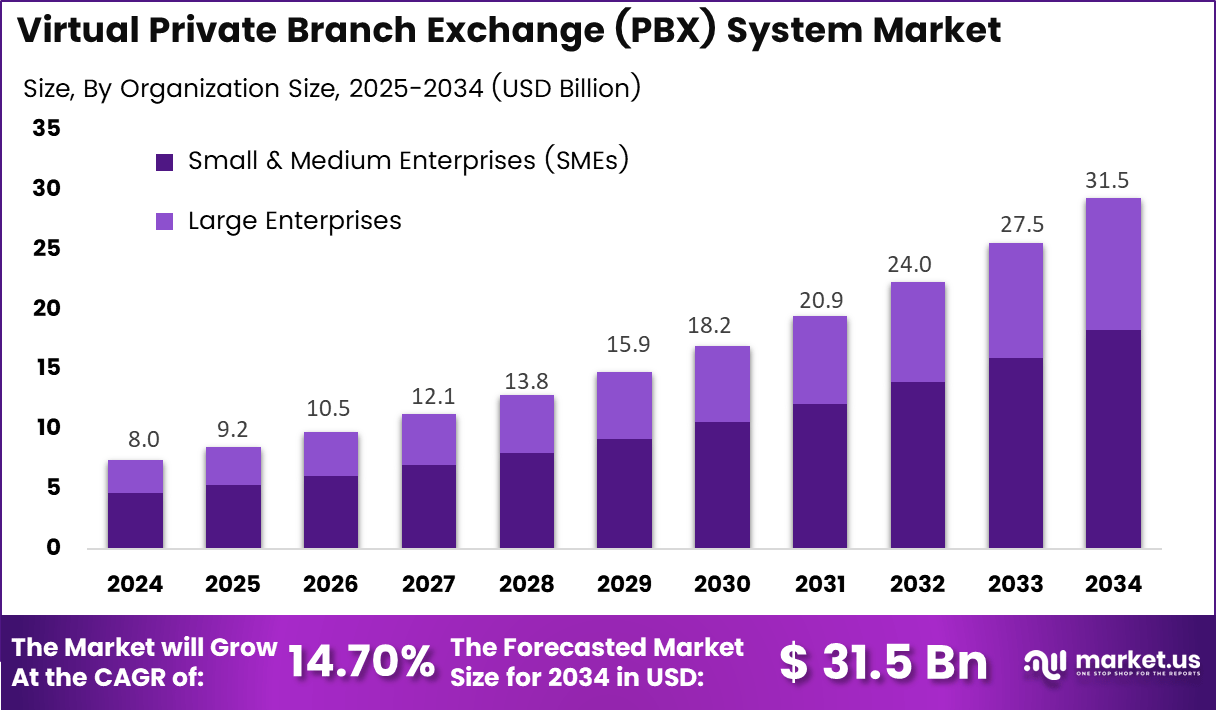
The global Virtual Private Branch Exchange system market was valued at USD 8.0 billion in 2024 and is expected to grow strongly over the forecast period. The market is projected to reach approximately USD 31.5 billion by 2034, expanding at a CAGR of 14.70% from 2025 to 2034. This growth is driven by rising demand for flexible communication systems and increasing shift toward digital and remote work environments. Businesses are adopting virtual PBX solutions to improve scalability, reduce infrastructure costs, and enhance communication efficiency.
The virtual private branch exchange system market refers to software-based telephony platforms that manage internal and external voice communications over digital networks. Virtual PBX systems replace traditional hardware-based PBX by operating through cloud or hosted environments. These systems support call routing, voicemail, conferencing, and integration with business applications. Adoption spans enterprises, small businesses, contact centers, and remote teams. Virtual PBX systems improve flexibility and reduce infrastructure dependence.
Market development has been influenced by the shift toward cloud communication and remote work models. Traditional PBX systems require significant on-site hardware and maintenance. Virtual PBX solutions reduce capital expenditure and simplify deployment. Centralized management supports distributed workforces. As communication becomes more digital, virtual PBX adoption increases.
Key Insights Summary
- Solutions led the market with a 70% share, driven by strong adoption of unified communication and collaboration platforms.
- Small and Medium Enterprises accounted for 58%, supported by demand for cost-effective and flexible communication systems.
- Cloud-based deployment dominated with 76%, enabled by scalability, remote access, and lower infrastructure maintenance.
- The IT and Telecom sector contributed 21%, reflecting heavy reliance on virtual PBX systems for internal and external communication.
- North America captured 37% of the global market, backed by advanced cloud adoption and enterprise digital transformation.
- The U.S. market reached USD 2.8 billion in 2024, growing at a 12.4% CAGR due to rising demand for hosted communication services.
Top Driving Factors
One major driving factor of the virtual PBX system market is the demand for flexible and scalable communication infrastructure. Organizations adjust workforce size and locations frequently. Virtual PBX systems scale users and features without hardware changes. Flexibility improves responsiveness to business needs. Scalability requirements drive adoption. Another key driver is cost efficiency and operational simplicity. Virtual PBX reduces upfront investment in physical equipment. Maintenance and upgrades are managed centrally. Predictable subscription costs improve budgeting. Cost optimization supports market growth.
Demand for virtual PBX systems is influenced by the rise of remote and hybrid work environments. Employees require reliable communication tools across locations. Virtual PBX supports seamless connectivity from any device. Consistent communication improves collaboration. Remote work trends increase demand. Demand is also shaped by growth in small and mid-sized enterprises. These organizations seek professional communication systems without complex infrastructure. Virtual PBX offers enterprise-grade features at lower cost. Easy deployment supports adoption. SME demand strengthens the market.
Increasing Adoption Technologies
Cloud computing technologies play a central role in virtual PBX adoption. Cloud infrastructure enables high availability and reliability. Centralized hosting simplifies system management. Cloud deployment reduces IT burden. Technology maturity supports widespread use. Voice over internet protocol technologies also support market growth.
VoIP enables voice communication over data networks. Improved voice quality and reliability enhance user experience. Integration with data services adds value. VoIP advancement strengthens adoption. One key reason organizations adopt virtual PBX systems is improved communication efficiency. Advanced call handling features improve response times.
Unified communication improves internal coordination. Consistent connectivity enhances productivity. Efficiency benefits justify adoption. Another reason is ease of integration with business tools. Virtual PBX systems connect with customer management and collaboration platforms. Integrated workflows improve service quality. Reduced switching between systems saves time. Integration capability supports adoption.
Investment and Business Benefits
Investment opportunities in the virtual PBX system market exist in cloud-native communication platforms. Providers offering scalable and secure solutions attract enterprise interest. Subscription-based models support recurring revenue. Platform expansion improves market reach. Cloud focus presents strong potential. Another opportunity lies in industry-specific virtual PBX solutions. Healthcare, retail, and customer service sectors require tailored communication features.
Specialized offerings improve relevance. Vertical alignment increases adoption. Custom solutions support expansion. Virtual PBX systems improve operational efficiency by centralizing communication management. Automated routing reduces missed calls. Remote accessibility supports continuous operations. Efficiency improvements lower communication costs. Business performance improves through reliability. These systems also enhance customer experience and responsiveness. Faster call handling improves satisfaction. Professional communication supports brand credibility. Consistent service strengthens relationships. Long-term customer value increases.
Regional Analysis
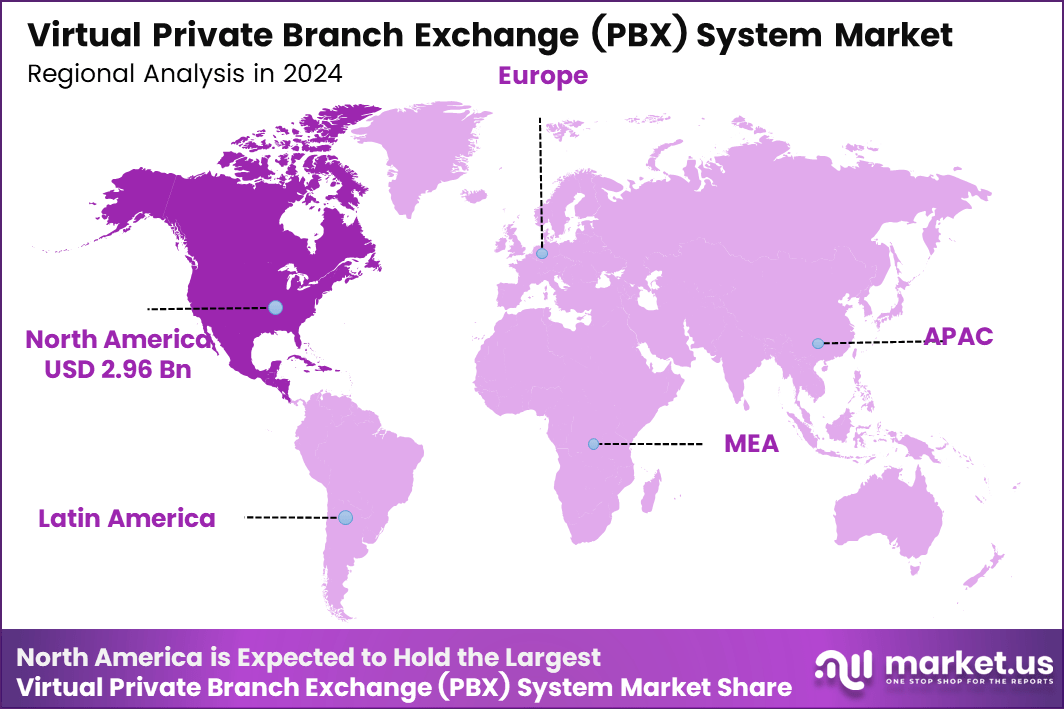
North America is expected to retain the largest share of the global market, generating around USD 2.96 billion in revenue in 2024. The region benefits from high adoption of advanced communication technologies across enterprises of all sizes. Cloud based deployments dominate the market, accounting for 76% of total adoption, supported by ease of deployment and centralized management. As a result, cloud based virtual PBX systems continue to shape market growth and technology adoption trends.
Driver Analysis
The Virtual Private Branch Exchange (PBX) system market is being driven by the growing transition from traditional on-premise telephony to cloud-based communication platforms that support flexibility, scalability, and remote collaboration. Organisations are increasingly seeking unified communication solutions that integrate voice, video, messaging, and conferencing within a single managed platform, which simplifies infrastructure and reduces operational complexity.
Virtual PBX systems enable remote and hybrid work models by providing scalable extensions, centralised call routing, and seamless connectivity across dispersed locations. As businesses prioritise agile, cost-effective communication tools that align with digital transformation initiatives, demand for virtual PBX solutions continues to strengthen.
Restraint Analysis
A significant restraint in the virtual PBX system market relates to concerns about network reliability and quality of service, which can impact real-time voice communications. Virtual PBX platforms depend on stable internet connectivity and robust network infrastructure to deliver clear, uninterrupted voice and collaboration services.
In regions or environments where bandwidth is limited, latency is variable, or service level guarantees are weak, organisations may experience degraded call quality or service disruptions. These technical limitations can slow adoption, particularly among enterprises that require high-availability communication systems for mission-critical operations.
Opportunity Analysis
Emerging opportunities in the virtual PBX system market are linked to the integration of advanced communication features and value-added services that enrich user experience and operational efficiency. Cloud-native PBX platforms can incorporate artificial intelligence-powered capabilities such as automated call transcription, smart routing based on usage patterns, sentiment analysis, and virtual assistants that handle routine queries.
There is also opportunity in tailored industry solutions that address specific compliance or workflow requirements, such as healthcare HIPAA-aligned messaging, legal practice call tracking, and retail-focused customer engagement flows. These specialised offerings can differentiate virtual PBX solutions and expand addressable use cases across varied sectors.
Challenge Analysis
A central challenge confronting this market involves balancing feature richness with ease of use and administrative control. As virtual PBX platforms evolve to offer integrated omnichannel communication, analytics, and collaboration tools, organisations must ensure that complexity does not overwhelm users or IT teams.
Ensuring intuitive interfaces, seamless integration with existing business applications, and manageable administration tools is critical to achieving effective user adoption. Technical support and training resources must also be aligned with organisational needs to avoid operational friction during deployment and ongoing use.
Emerging Trends
Emerging trends in the virtual PBX system landscape include greater emphasis on AI-enabled call analytics and intelligent automation that provide insights into communication patterns and customer sentiment. Platforms are increasingly supporting integration with customer relationship management, helpdesk, and workflow automation systems to drive contextualised interactions and streamline organisational processes.
Another trend involves enhanced security and identity management features that protect voice and data communications against evolving cyber threats, particularly for remote and distributed workforces. There is also growing interest in hybrid voice architectures that combine public internet and private network connectivity to optimise performance and resilience.
Growth Factors
Growth in the virtual PBX system market is supported by the proliferation of remote and hybrid work models, increasing adoption of cloud computing, and the need for cost-effective, scalable communication infrastructure. Organisations across enterprises of varied sizes are prioritising unified communication strategies that support collaboration, productivity, and customer engagement without the traditional overhead of on-premise systems.
Advances in software-defined networking, voice over IP technologies, and platform interoperability strengthen the business case for virtual PBX adoption. As digital communication becomes central to business continuity and competitive differentiation, investment in intelligent, cloud-ready PBX solutions remains robust.
Key Market Segment
By Component
- Solutions
- Hosted PBX
- Cloud PBX
- IP PBX
- Services
- Professional Services
- Managed Services
- Integration & Support Services
By Organization Size
- Small & Medium Enterprises (SMEs)
- Large Enterprises
By Deployment Mode
- CloudBased
- OnPremise
By EndUser Industry
- IT & Telecom
- BFSI
- Retail & Ecommerce
- Healthcare
- Education
- Government & Public Sector
- Manufacturing
- Others (Media, Travel, Logistics, etc.)
Key Regions and Countries
- North America
- US
- Canada
- Europe
- Germany
- France
- The UK
- Spain
- Italy
- Rest of Europe
- Asia Pacific
- China
- Japan
- South Korea
- India
- Australia
- Rest of APAC
- Latin America
- Brazil
- Mexico
- Rest of Latin America
- Middle East & Africa
- GCC
- South Africa
- Rest of MEA
Top Key Player
- RingCentral, Inc.
- 8×8, Inc.
- Nextiva
- Vonage (Ericsson)
- Dialpad
- Ooma, Inc.
- Mitel Networks Corp.
- Zoom Video Communications, Inc.
- GoTo
- 3CX
- Cisco (Webex Calling)
- Others
Report Scope
| Report Features | Description |
|---|---|
| Market Value (2024) | USD 8.0 Bn |
| Forecast Revenue (2034) | USD 31.5 Bn |
| CAGR(2025-2034) | 14.70% |
| Base Year for Estimation | 2024 |
| Historic Period | 2020-2023 |
| Forecast Period | 2025-2034 |
| Report Coverage | Revenue forecast, AI impact on Market trends, Share Insights, Company ranking, competitive landscape, Recent Developments, Market Dynamics, and Emerging Trends |
| Segments Covered | By Component (Solution [Hosted PBX, Cloud PBX, IP PBX], Services [Professional Services, Managed Services, Integration & Support Services]), By Organization Size (Small & Medium Enterprises (SMEs), Large Enterprises), By Deployment Mode (CloudBased, OnPremise), By EndUser Industry (IT & Telecom, BFSI, Retail & Ecommerce, Healthcare, Education, Government & Public Sector, Manufacturing, Others (Media, Travel, Logistics, etc.)) |
Discuss your needs with our analyst
Please share your requirements with more details so our analyst can check if they can solve your problem(s)