Power Over Ethernet Market Size
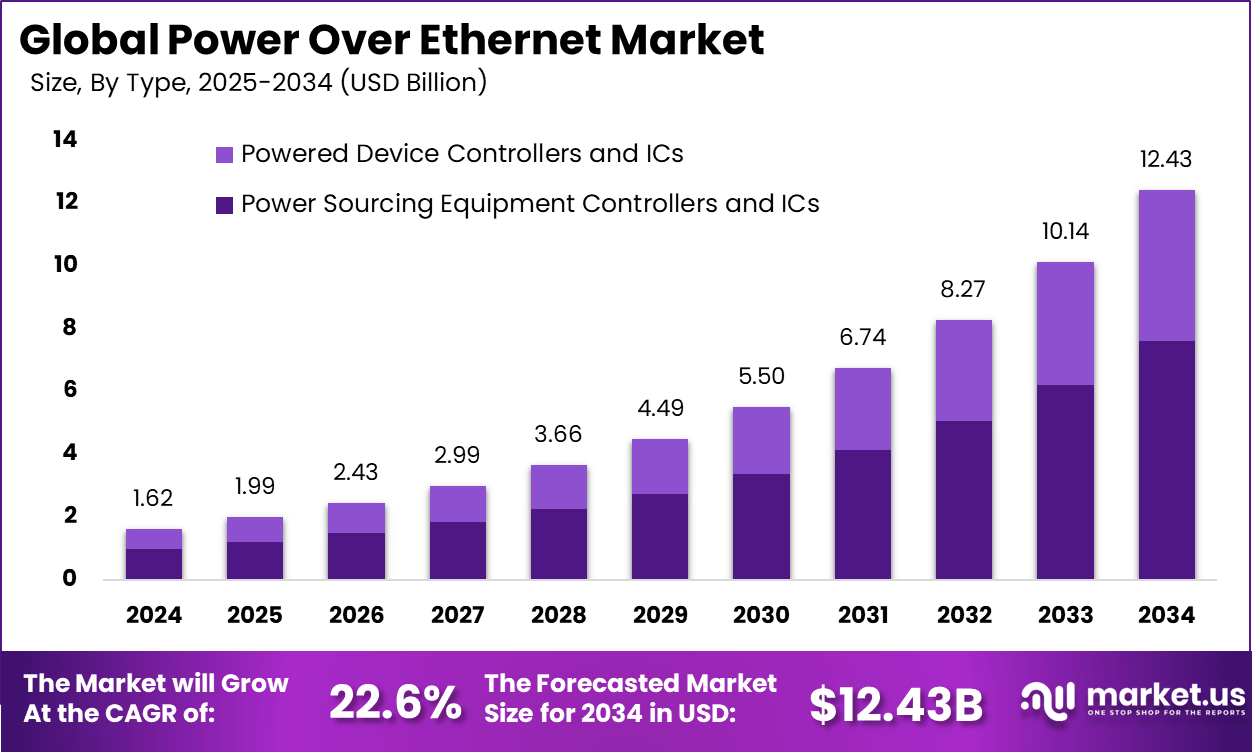
The global Power over Ethernet market was valued at USD 1.62 billion in 2024 and is expected to expand rapidly over the forecast period. The market is projected to reach approximately USD 12.43 billion by 2034, growing at a strong CAGR of 22.6% from 2025 to 2034. This growth is driven by increasing deployment of IP based devices, smart lighting systems, and networked security solutions. Adoption of PoE technology is enabling simplified cabling and improved energy efficiency across commercial and industrial environments.
The power over ethernet market refers to technologies that deliver electrical power and data through a single ethernet cable. This approach allows network devices such as cameras, access points, phones, and sensors to operate without separate power connections. Power over ethernet simplifies installation and reduces cabling complexity. It is widely used in commercial buildings, industrial facilities, and smart infrastructure projects. Adoption supports efficient and flexible network deployment.
Market development has been influenced by the growing need for connected and intelligent devices. Traditional power delivery methods increase installation cost and time. Power over ethernet enables centralized power management and easier device placement. Network-based power delivery improves scalability and reliability. As connected environments expand, demand for power over ethernet solutions increases.
Key Takeaway
- Power Sourcing Equipment (PSE) controllers and ICs led the market with a 61.2% share, driven by higher integration of PoE controllers in switches and routers for efficient power delivery.
- The connectivity segment accounted for 39.4%, reflecting rising demand for combined power and data transmission across enterprise and smart building networks.
- The commercial segment dominated with a 68.5% share, supported by strong use of PoE in office automation, IP telephony, and intelligent lighting systems.
- The U.S. market reached USD 0.5 billion in 2024, growing at a 20.3% CAGR, driven by rapid digital infrastructure expansion and smart workplace adoption.
- North America held a 34% global share, supported by advanced IT infrastructure, early PoE standard adoption, and ongoing enterprise network modernization investments.
Top Driving Factors
One major driving factor of the power over ethernet market is the rapid adoption of network-connected devices. Devices such as security cameras and wireless access points require both power and data connectivity. Power over ethernet provides a unified solution. Simplified installation reduces deployment barriers. Device proliferation strongly drives adoption.
Another key driver is the focus on energy efficiency and centralized power control. Power over ethernet systems allow monitoring and management of energy usage. Centralized control improves efficiency and fault detection. Reduced power waste supports sustainability goals. Energy management priorities support market growth.
Demand Analysis
Demand for power over ethernet solutions is influenced by expansion of smart buildings and intelligent infrastructure. Commercial buildings deploy connected lighting, security, and automation systems. Power over ethernet supports flexible and scalable installation. Reduced wiring complexity improves project feasibility. Smart infrastructure growth strengthens demand.
Demand is also shaped by industrial and enterprise network upgrades. Organizations modernize networks to support digital operations. Power over ethernet enables rapid device deployment without electrical rework. Faster rollout improves operational agility. Enterprise transformation increases demand.
Increasing Adoption Technologies
Advanced ethernet standards play a key role in power over ethernet adoption. Higher power delivery capabilities support more device types. Improved standards enable stable performance over longer distances. Compatibility improvements support broader use. Technology evolution increases confidence. Network management and monitoring technologies also support market growth. Software tools track power usage and device status. Real-time visibility improves maintenance and planning. Integrated management enhances reliability. Technology integration strengthens adoption.
One key reason organizations adopt power over ethernet is reduced installation cost and complexity. Fewer cables lower material and labor expenses. Simplified layouts reduce deployment time. Cost savings improve return on investment. Financial efficiency supports adoption. Another reason is improved operational flexibility. Devices can be relocated easily without new power outlets. Network-based power supports dynamic environments. Flexibility improves scalability. Adaptability benefits encourage adoption.
Investment and Business Benefits
Investment opportunities in the power over ethernet market exist in smart building and automation applications. Lighting, access control, and sensing systems show strong demand. Integrated solutions attract commercial investment. Infrastructure modernization supports growth. This segment offers stable opportunity. Another opportunity lies in industrial and outdoor power over ethernet solutions. Rugged devices support harsh environments. Industrial digitalization increases deployment. Specialized solutions improve differentiation.
Industrial adoption supports expansion. Power over ethernet improves operational efficiency by simplifying device deployment and maintenance. Centralized power management reduces downtime. Faster troubleshooting improves reliability. Efficiency gains support productivity. Network operations become more predictable. These solutions also enhance system reliability and safety. Centralized power sources support backup systems. Reduced electrical wiring lowers risk. Improved control strengthens resilience. Business continuity improves through reliable infrastructure.
Regional Analysis
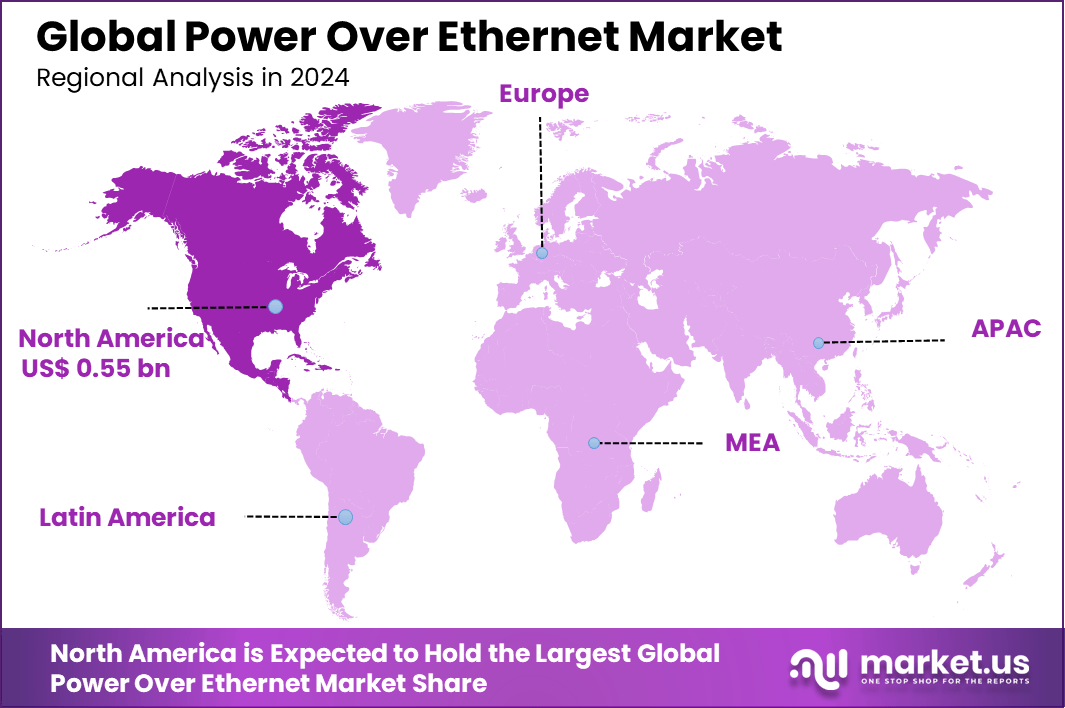
In 2024, North America held a dominant position in the global market, accounting for more than 34% of total revenue. The region generated around USD 0.55 billion, supported by early adoption of advanced networking infrastructure and smart building technologies. Strong investment in enterprise IT and connected systems strengthened regional leadership. As a result, North America continues to influence growth and technology adoption trends in the Power over Ethernet market.
Key Market Segments
By Type
- Power Sourcing Equipment Controllers and ICs
- Powered Device Controllers and ICs
By Application
- Connectivity
- Security and Access Control
- Infotainment
- LED Lighting and Control
- Others
By End Use
- Commercial
- Industrial
- Residential
Top Key Players in the Market
- STMicroelectronics
- Broadcom
- Microchip Technology Inc.
- Axis Communications AB
- Texas Instruments Incorporated
- Semiconductor Components Industries, LLC
- Silicon Laboratories
- Monolithic Power Systems, Inc.
- MSTronic Co., Ltd
- Cisco Systems, Inc.
- Others
Driver Analysis
The power over Ethernet (PoE) market is being driven by the growing need for integrated data and power delivery over a single network cable, which simplifies infrastructure and reduces installation costs. PoE technology enables devices such as wireless access points, IP cameras, VoIP phones, sensors, and lighting systems to receive both power and network connectivity through a single Ethernet cable.
This convergence reduces the need for additional electrical wiring, supports rapid deployment, and improves flexibility for networked devices across commercial, industrial, and residential environments. The increasing adoption of smart building technologies, Internet of Things (IoT) deployments, and connected devices reinforces demand for PoE solutions that support scalable and energy-efficient network architectures.
Restraint Analysis
A significant restraint in the PoE market relates to power limitations and compatibility challenges with high-power devices. Traditional PoE standards deliver limited wattage per port, which can restrict support for devices that require greater power, such as pan-tilt-zoom cameras, high-performance wireless access points, or advanced digital signage.
While newer high-power PoE standards address some of these needs, they require corresponding upgrades in network switches, cabling quality, and power budget planning. Organisations may face increased upfront costs and deployment complexity when migrating to higher-wattage PoE infrastructures, particularly in existing facilities with legacy cabling or constrained electrical capacity.
Opportunity Analysis
Emerging opportunities in the PoE market are linked to the expansion of smart IoT and edge device ecosystems that benefit from unified power and data delivery. As organisations implement IoT sensors, environmental controls, occupancy detectors, and advanced security devices, PoE provides reliable network power with predictable performance.
There is also opportunity in integrated PoE-driven lighting systems that combine illumination with sensor networks and data analytics, enabling energy savings and enhanced building automation. Service providers and system integrators that can offer PoE-centric solutions bundled with analytics, remote management, and scalability planning can address the evolving needs of enterprises seeking seamless connectivity and operational efficiency.
Challenge Analysis
A central challenge confronting the PoE market relates to ensuring power budget management and thermal performance within dense network deployments. As the number and power requirements of PoE devices increase, network planners must account for total power allocation across switches, uplinks, and distribution infrastructure.
Inadequate power provisioning can lead to brownouts, reduced device performance, or network instability. Additionally, high-power PoE implementations can generate greater heat within cabling and switch equipment, which requires careful thermal design and monitoring to maintain reliability. Addressing these technical considerations while preserving network uptime and performance demands precise planning and ongoing management.
Emerging Trends
Emerging trends in the PoE landscape include increased adoption of higher-power PoE standards that extend support for devices requiring greater wattage while maintaining delivery over conventional Ethernet cabling. Another trend is the integration of PoE with smart building and automation platforms to power and connect diverse systems including lighting, access control, environmental sensors, and analytics endpoints.
PoE over multi-gigabit Ethernet infrastructure and support for link-aggregation in high-traffic environments are also gaining traction to accommodate bandwidth-intensive applications alongside power delivery. Software-defined power management features that enable remote monitoring, power budgeting, and dynamic allocation are further enhancing PoE value propositions.
Growth Factors
Growth in the PoE market is supported by expanding deployments of connected devices, the rise of smart building initiatives, and broader digital transformation strategies that prioritise unified infrastructure for power and data. Advances in Ethernet standards, energy-efficient hardware design, and greater awareness of total cost of ownership benefits strengthen the appeal of PoE solutions for enterprises of varied sizes. As organisations seek to simplify installation, reduce cabling complexity, and support scalable networked devices, PoE remains a practical and cost-effective approach to powering and connecting the next wave of IoT and smart infrastructure applications.
Report Scope
| Report Features | Description |
|---|---|
| Market Value (2024) | USD 1.62 Bn |
| Forecast Revenue (2034) | USD 12.4 Bn |
| CAGR(2025-2034) | 22.6% |
| Base Year for Estimation | 2024 |
| Historic Period | 2020-2023 |
| Forecast Period | 2025-2034 |
| Report Coverage | Revenue forecast, AI impact on Market trends, Share Insights, Company ranking, competitive landscape, Recent Developments, Market Dynamics and Emerging Trends |
Discuss your needs with our analyst
Please share your requirements with more details so our analyst can check if they can solve your problem(s)