Report Scope
| Report Features | Description |
|---|---|
| Market Value (2025) | USD 3.6 Bn |
| Forecast Revenue (2035) | USD 16.3 Bn |
| CAGR(2025-2035) | 16.3% |
| Base Year for Estimation | 2025 |
| Historic Period | 2020-2024 |
| Forecast Period | 2026-2035 |
| Report Coverage | Revenue forecast, AI impact on Market trends, Share Insights, Company ranking, competitive landscape, Recent Developments, Market Dynamics and Emerging Trends |
| Segments Covered | By Component (Software, Hardware, Services), By Application (Training & Simulation, Gaming & Entertainment, Retail & E-commerce, Healthcare, Industrial Maintenance & Design, Others), By End-User (Enterprises, Consumers, Healthcare Providers, Educational Institutions) |
| Regional Analysis | North America – US, Canada; Europe – Germany, France, The UK, Spain, Italy, Russia, Netherlands, Rest of Europe; Asia Pacific – China, Japan, South Korea, India, New Zealand, Singapore, Thailand, Vietnam, Rest of Latin America; Latin America – Brazil, Mexico, Rest of Latin America; Middle East & Africa – South Africa, Saudi Arabia, UAE, Rest of MEA |
| Competitive Landscape | Meta Platforms, Inc., Microsoft Corporation, Google LLC, NVIDIA Corporation, Unity Software, Inc., Epic Games, Inc., Qualcomm Technologies, Inc., Magic Leap, Inc., Varjo Technologies Oy, PTC, Inc., Apple, Inc., Ultraleap, Ltd., Niantic, Inc., Scope AR, Talespin Reality, Inc., Others |
AI in VR and AR Market Overview
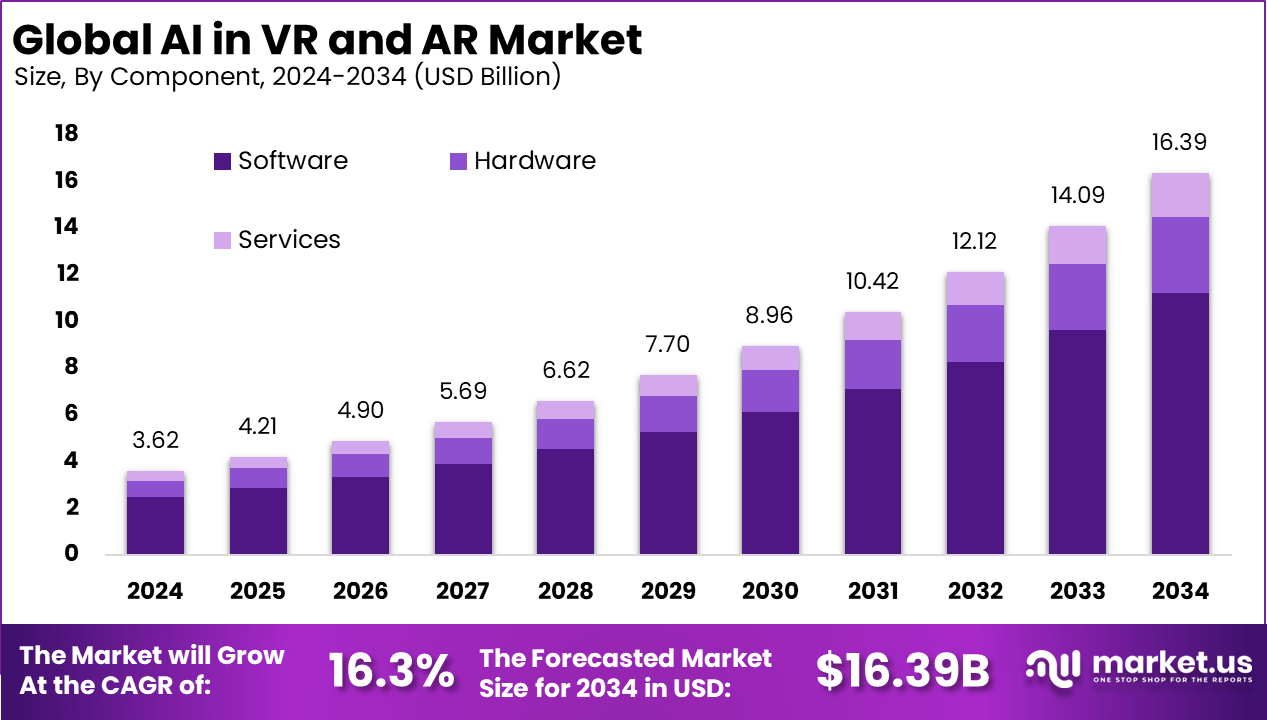
According to Market.us, The global AI in VR and AR market was valued at USD 3.62 billion in 2024 and is expected to grow steadily over the forecast period. The market is projected to reach approximately USD 16.39 billion by 2034, expanding at a CAGR of 16.3% from 2025 to 2034. This growth is driven by rising adoption of immersive technologies across gaming, training, healthcare, and industrial applications. Integration of AI is enhancing realism, interactivity, and real time data processing within virtual and augmented environments.
The AI in VR and AR market refers to the integration of artificial intelligence technologies with virtual reality and augmented reality systems. AI enhances immersive experiences by enabling real-time interaction, environment understanding, and adaptive content generation. These solutions are used across gaming, training, healthcare, retail, education, and industrial applications. AI improves realism and responsiveness within virtual and augmented environments. Adoption supports more intelligent and personalized immersive experiences.
Market development has been influenced by advancements in immersive hardware and digital interaction demands. Traditional VR and AR experiences rely on predefined content and limited interaction. AI introduces dynamic behavior, natural movement, and contextual awareness. Improved immersion increases user engagement. As immersive applications expand, AI integration becomes essential.
One major driving factor of the AI in VR and AR market is the demand for realistic and interactive experiences. Users expect environments that respond naturally to actions and inputs. AI enables object recognition, gesture tracking, and adaptive scenarios. Real-time intelligence improves immersion quality. Experience expectations strongly drive adoption. Another key driver is the growing use of VR and AR in training and simulation. Industries require safe and effective training environments. AI-driven simulations adapt to user performance. Personalized training improves learning outcomes. Enterprise training needs support market growth.
Demand for AI-enabled VR and AR solutions is influenced by enterprise adoption of immersive technologies. Organizations use VR and AR for training, design, and remote assistance. AI enhances efficiency and effectiveness in these applications. Improved results justify investment. Enterprise demand continues to increase. Demand is also shaped by consumer entertainment and gaming applications. Players seek intelligent non-player characters and adaptive gameplay. AI-driven interactions improve engagement and replay value. Enhanced realism attracts users. Consumer demand strengthens market growth.
Key Insights Summary
- Software led the AI in VR and AR market in 2024 with 68.4%, driven by demand for AI-powered content creation, analytics, and real-time interaction engines.
- Training and simulation accounted for 38.7%, reflecting strong use of immersive environments for workforce training, education, and risk-free skill development.
- Enterprises represented 58.9% of total demand, supported by adoption for training, design, collaboration, and operational efficiency.
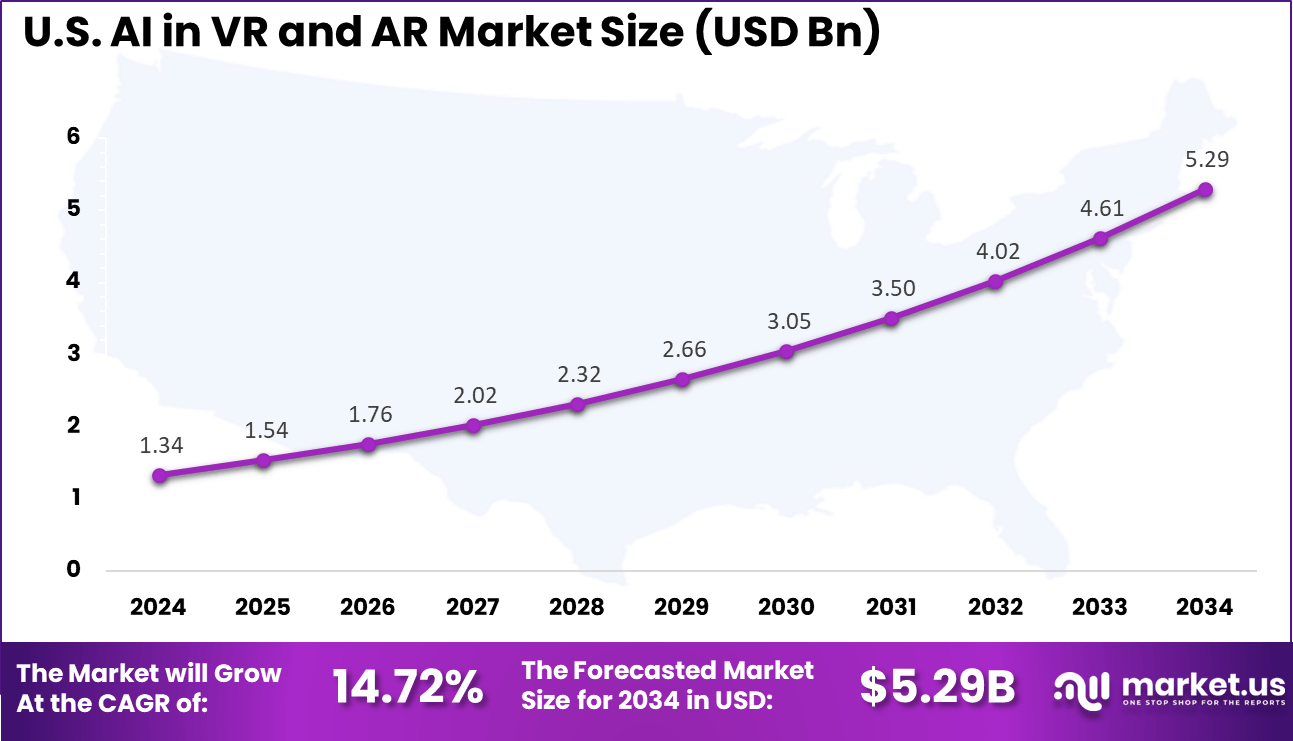
- The U.S. market reached USD 1.34 billion in 2024 and is growing at a 14.72% CAGR, driven by enterprise investment and immersive innovation.
- North America held over 41.62% share, supported by advanced digital infrastructure and early AI adoption.
- The U.S. AR user base is projected to reach 103.9 million by 2026, up from 100.1 million in 2025.
- Globally, about 75% of the population is expected to be active AR users by early 2026.
- Monthly active mobile AR users worldwide are expected to exceed 2 billion, driven by social media and retail use cases.
- Global VR hardware penetration is estimated at 1.7% in 2026 and is expected to remain stable through 2027.
- Headset shipments are forecast to grow by around 87% in 2026 as new product cycles resume.
- More than 75% of Fortune 500 companies already use XR for training, education, or production activities.
- About 22% of large enterprises actively use VR for training, compared with 7% across organizations overall.
- Nearly 75% of global brands are expected to adopt AR or VR for marketing by 2026.
- AR-assisted workflows deliver productivity gains of 25% to 40% in maintenance and training.
- Around 71% of consumers say AR tools would encourage more frequent shopping.
- AI-enabled AR try-ons are expected to reduce product return rates by up to 25% by 2026.
- About 78% of consumers prefer AR experiences enhanced with AI-driven personalization.
- Among VR users, 70% use it for gaming, 42% for entertainment, 35% for fitness, and 22% for creative activities.
Increasing Adoption Technologies
Machine learning technologies play a central role in AI-driven VR and AR adoption. These models analyze user behavior and environmental data. Continuous learning improves interaction accuracy. Adaptive systems personalize experiences. Intelligent processing increases value. Computer vision technologies also support adoption. Visual recognition enables spatial mapping and object tracking.
Accurate environment understanding improves AR overlays. Improved tracking reduces latency and errors. Technology advancements support scalability. One key reason organizations adopt AI in VR and AR is improved user engagement. Intelligent environments respond to user actions effectively. Personalized interactions increase immersion. Higher engagement improves satisfaction. Experience quality drives adoption.
Investment and Business Benefits
Investment opportunities in the AI in VR and AR market exist in enterprise training and simulation platforms. Industries such as manufacturing and healthcare show strong demand. AI-driven immersive training improves safety and outcomes. Enterprise focus attracts investment. Professional applications offer growth potential. Another opportunity lies in consumer entertainment and social VR platforms.
AI-powered avatars and environments increase user retention. Social interaction enhances platform value. Scalable ecosystems attract investors. Consumer engagement supports expansion. AI-enabled VR and AR solutions improve learning and performance outcomes. Immersive training enhances retention and understanding. Reduced errors improve operational results.
Performance improvements support business goals. Value creation strengthens adoption. These solutions also support innovation and product development. VR and AR enable rapid prototyping and visualization. AI improves simulation accuracy. Faster iteration reduces development costs. Innovation efficiency improves competitiveness.
Regulatory Environment
The regulatory environment for AI in VR and AR includes data privacy and digital interaction guidelines. Immersive systems collect user behavior and biometric data. Secure data handling is required. Compliance with privacy laws builds trust. Responsible data use is essential. Health and safety regulations also influence adoption. Prolonged VR use raises ergonomic and safety concerns. AI systems help monitor user comfort and exposure. Compliance with safety guidelines supports acceptance. Regulatory alignment ensures sustainable deployment.
Driver Analysis
The AI in VR and AR market is being driven by the increasing demand for immersive, intelligent experiences that improve user engagement, interaction fidelity, and contextual responsiveness in virtual and augmented environments. Artificial intelligence technologies such as machine learning, computer vision, and natural language processing are being integrated into VR and AR systems to support realistic object recognition, adaptive environments, gesture and voice interaction, and predictive user behaviour modelling.
These enhanced capabilities help developers create more intuitive, personalised, and interactive applications in gaming, education, healthcare, industrial training, and retail engagement, supporting a shift from static experiences to dynamic, user-centric immersion.
Restraint Analysis
A significant restraint in the AI in VR and AR market relates to the technical complexity and cost associated with developing and deploying AI-enhanced immersive systems. VR and AR solutions typically require high-performance hardware, advanced software frameworks, and detailed content design, which can raise development and adoption costs.
Ensuring seamless integration of AI models with real-time rendering, tracking sensors, and user interfaces demands specialised skills and comprehensive testing to maintain responsive performance and low latency. In addition, concerns regarding data privacy and secure handling of personal and biometric input within immersive environments create additional compliance and governance challenges for developers and enterprises.
Opportunity Analysis
Emerging opportunities in the AI in VR and AR market are linked to expanding use cases beyond entertainment into sectors where intelligent immersion enhances operational outcomes and experiential value. In industrial training and simulation, AI-augmented VR can replicate realistic work scenarios and adapt difficulty based on learner performance.
In healthcare, intelligent AR overlays can assist clinicians with contextual guidance, diagnostics, and procedural support in real time. AI also enables more natural interaction models that reduce cognitive load and improve accessibility for users across demographic segments. These diversified applications support broader adoption and integration of intelligent immersive technologies across enterprise and consumer domains.
Challenge Analysis
A central challenge confronting this market involves balancing the pursuit of higher immersion and AI sophistication with user comfort and system usability. Immersive experiences that are highly realistic can induce physical discomfort, motion sickness, or sensory fatigue in users, which may limit prolonged use in applications such as extended training or workplace collaboration.
Designing AI systems that adapt experiences without overwhelming users or disrupting interaction flows requires careful tuning of interface dynamics, feedback mechanisms, and content pacing. Maintaining interoperability between AI components and diverse VR/AR hardware ecosystems further complicates development and deployment for global audiences.
Emerging Trends
Emerging trends in the AI in VR and AR market include the integration of predictive analytics, adaptive environments, and multimodal interaction that respond to user behaviour and intent in real time. AI-enhanced gesture and speech recognition improve natural interaction with digital objects, reducing reliance on traditional control methods.
There is also growth in AI-powered content generation that assists designers in producing realistic assets, scene dynamics, and narrative variations efficiently. The convergence of AI with wearable AR devices and lightweight headsets expands potential for everyday use cases, including navigation assistance, remote collaboration, and contextual productivity support.
Growth Factors
Growth in the AI in VR and AR market is supported by rapid advancements in hardware performance, improved sensor accuracy, and greater availability of development tools that simplify the creation of intelligent immersive experiences. Increasing demand for engaging remote learning and collaboration tools continues to push enterprises and institutions to adopt AI-enabled immersive solutions.
Expansion of mobile-based AR and VR platforms further lowers barriers to entry, enabling broader user reach and more frequent interaction with intelligent virtual environments. As industries seek to differentiate customer experiences and elevate training outcomes, AI-driven VR and AR technologies are positioned as foundational elements of next-generation digital engagement strategies.
Regional Analysis
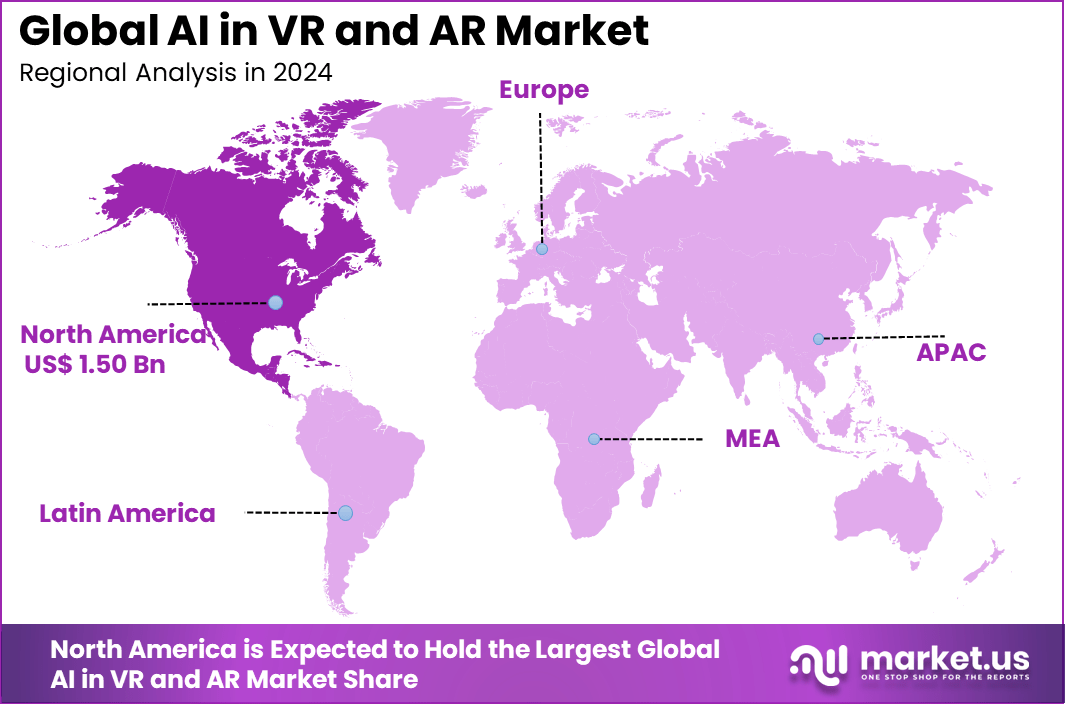
North America held a dominant position in the global market, accounting for more than 41.62% of total revenue. The region generated around USD 1.50 billion, supported by strong investment in immersive technology development and early adoption across enterprises. High concentration of technology providers and advanced digital infrastructure strengthened regional leadership. As a result, North America continues to shape innovation and adoption trends in the AI in VR and AR market.
U.S. AI in VR and AR Market Size
The market for AI in VR and AR within the U.S. is growing tremendously and is currently valued at USD 1.34 billion, the market has a projected CAGR of 14.72%.
Key Market Segments
By Component
- Software
- Hardware
- Services
By Application
- Training & Simulation
- Gaming & Entertainment
- Retail & E-commerce
- Healthcare
- Industrial Maintenance & Design
- Others
By End-User
- Enterprises
- Consumers
- Healthcare Providers
- Educational Institutions
Top Key Players in the Market
- Meta Platforms, Inc.
- Microsoft Corporation
- Google LLC
- NVIDIA Corporation
- Unity Software, Inc.
- Epic Games, Inc.
- Qualcomm Technologies, Inc.
- Magic Leap, Inc.
- Varjo Technologies Oy
- PTC, Inc.
- Apple, Inc.
- Ultraleap, Ltd.
- Niantic, Inc.
- Scope AR
- Talespin Reality, Inc.
- Others
Discuss your needs with our analyst
Please share your requirements with more details so our analyst can check if they can solve your problem(s)