Report Overview
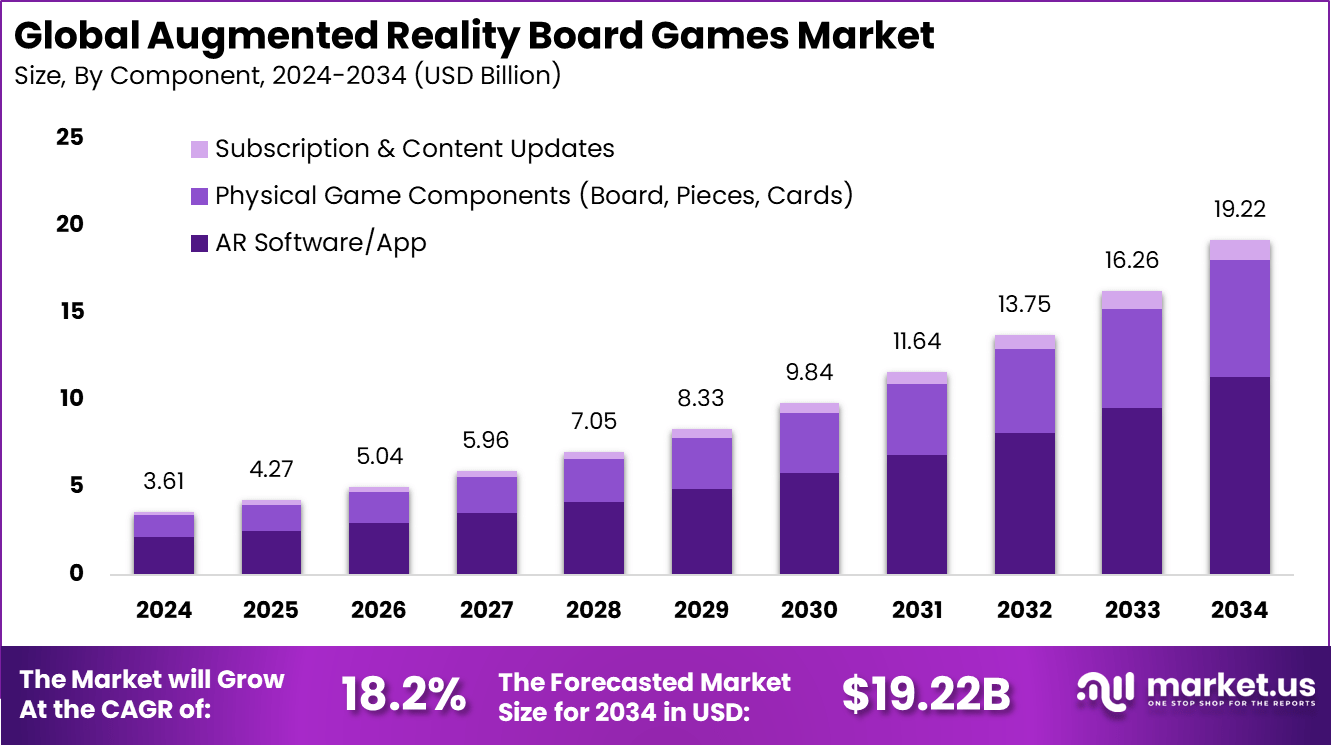
The global Augmented Reality Board Games market was valued at USD 3.61 billion in 2024 and is expected to expand rapidly over the forecast period. The market is projected to reach approximately USD 19.22 billion by 2034, growing at a CAGR of 18.2% from 2025 to 2034. This growth is driven by rising consumer interest in immersive gaming experiences and increasing integration of AR technology into traditional tabletop games. Advancements in mobile devices and AR software are further supporting market adoption.
The augmented reality board games market refers to physical board games enhanced with augmented reality features through mobile devices, tablets, or smart glasses. These games combine traditional game boards, cards, or figurines with digital overlays, animations, and interactive elements. Augmented reality adds visual effects, real-time feedback, and dynamic storytelling to physical gameplay. Adoption is seen among families, casual gamers, educational users, and hobby gaming communities. These games aim to blend physical interaction with digital immersion.
Market development has been influenced by the demand for more engaging and interactive entertainment experiences. Traditional board games rely on static rules and components. Augmented reality introduces adaptive gameplay and evolving scenarios. This hybrid format appeals to players seeking both social interaction and digital enhancement. As mixed-reality entertainment grows, AR board games gain attention.
Key Takeaway
- AR software and applications led the augmented reality board games market with 58.9%, supported by demand for immersive gameplay and continuous content updates.
- Smartphone and tablet based AR dominated device usage with 92.4%, driven by wide device availability and easy access for casual and family gamers.
- Strategy and adventure games accounted for 38.7%, as players preferred narrative depth, replayability, and interactive decision making enabled by AR.
- Online marketplaces captured 62.8%, supported by app stores, digital downloads, and global distribution reach.
- North America held 36.5% share, backed by high gaming penetration, strong AR awareness, and a mature digital entertainment ecosystem.
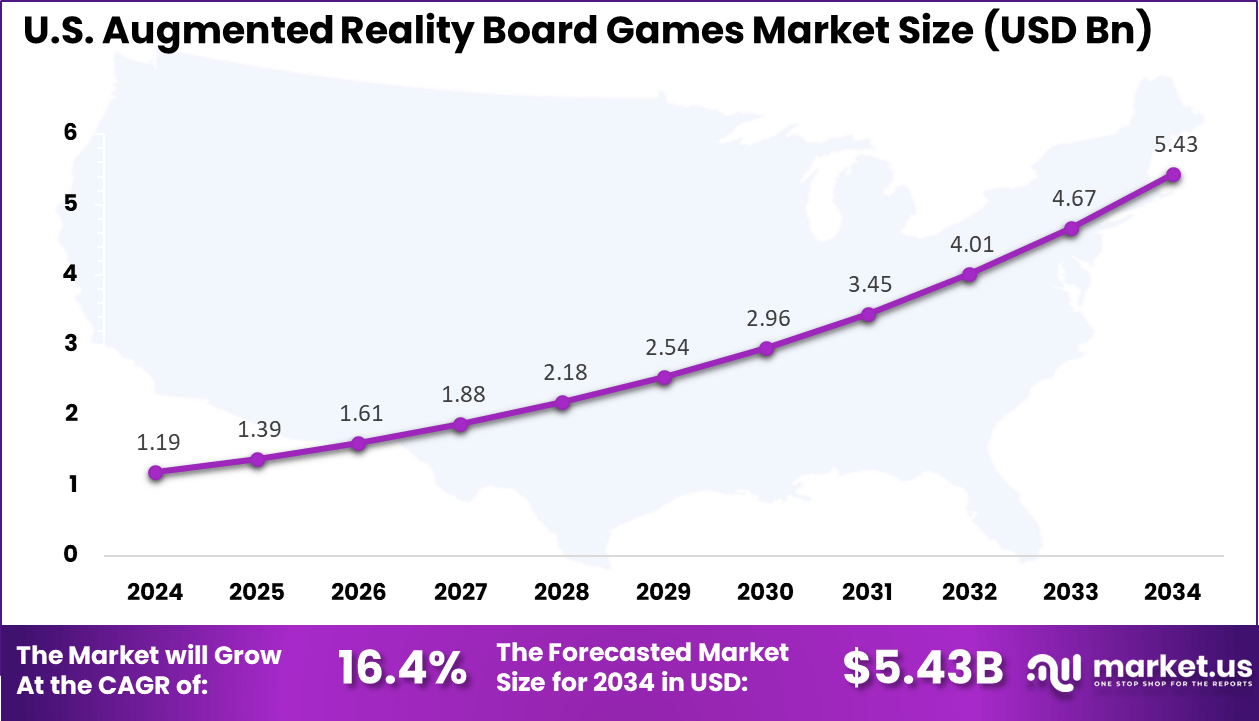
- The U.S. market reached USD 1.19 billion in 2024 and is growing at a 16.4% CAGR, driven by mobile gaming expansion and AR innovation.
Adoption and Usage Statistics
- Mobile AR users are projected to reach 1.73 billion by the end of 2024, showing strong mainstream adoption.
- Nearly 50% of mobile gamers prefer games that include AR features.
- Head mounted displays accounted for 55% of AR gaming hardware usage in 2024, reflecting demand for deeper immersion and advanced interaction.
Top Driving Factors
One major driving factor of the augmented reality board games market is the demand for immersive and interactive gaming experiences. Players seek deeper engagement beyond static boards. Augmented reality enhances storytelling and visual appeal. Dynamic elements improve replay value. Experience-driven entertainment strongly drives adoption.
Another key driver is the growing interest in family-friendly and social gaming formats. Board games encourage in-person interaction and group participation. AR features make these experiences more exciting for younger audiences. Shared digital interactions enhance group engagement. Social entertainment trends support market growth.
Demand for augmented reality board games is influenced by the expansion of casual and home-based gaming. Families and social groups look for interactive entertainment options. AR board games offer novelty without requiring advanced gaming consoles. Accessibility supports wider adoption. Home entertainment demand strengthens growth.
Demand is also shaped by educational and learning-oriented gaming use cases. AR board games support interactive learning and problem-solving. Visual overlays improve understanding and engagement. Educational institutions and parents value such features. Learning-driven demand contributes to adoption.
Increasing Adoption Technologies
Augmented reality software and mobile computing technologies play a key role in market adoption. Smartphones and tablets act as primary AR interfaces. Improved camera and processing capabilities enhance performance. Stable AR tracking improves gameplay accuracy. Technology maturity supports wider use. Game engines and interactive content platforms also support adoption. These technologies enable dynamic animations and real-time interaction.
Content updates extend game longevity. Smooth integration improves user experience. Platform development strengthens market appeal. One key reason consumers adopt augmented reality board games is enhanced engagement and replayability. AR elements introduce variability and surprise. Players experience new outcomes with each session. Extended engagement improves value perception. Entertainment quality drives adoption.
Investment and Business Benefits
Investment opportunities in the augmented reality board games market exist in family and educational game categories. Products designed for group learning and entertainment show strong potential. Educational alignment improves adoption. Scalable content platforms attract interest. Learning-focused games support growth. Another opportunity lies in licensed and themed AR board games. Popular characters and stories enhance appeal. Brand partnerships improve market visibility. Themed content increases demand. Licensing strategies support expansion.
Augmented reality board games improve consumer engagement by offering unique hybrid experiences. Enhanced gameplay increases customer satisfaction. Strong engagement supports repeat purchases. Differentiated products strengthen brand positioning. Business competitiveness improves. These games also enable digital content monetization beyond physical components. Updates and expansions extend product life cycles. Digital add-ons create additional revenue streams. Long-term value improves profitability. Business sustainability benefits.
Regional Analysis
North America held a dominant position in the global market, accounting for more than 36.5% of total revenue. The region generated around USD 1.31 billion, supported by strong gaming culture and early adoption of AR based entertainment. High presence of game developers and technology providers strengthened regional leadership. As a result, North America continues to influence innovation and growth trends in the augmented reality board games market.

The United States reached USD 1.19 Billion with a CAGR of 16.4%, reflecting steady market expansion. Growth is driven by mobile gaming adoption and AR innovation. Players seek new gaming experiences beyond traditional formats. Continued content development supports demand. Market momentum remains positive.
Driver Analysis
The augmented reality board games market is being driven by the growing consumer desire for immersive, interactive entertainment that blends physical gameplay with digital enhancements. Traditional board games have seen renewed interest through the addition of AR features that overlay dynamic visuals, animated characters, and contextual information onto physical game boards using mobile devices or AR headsets.
This hybrid experience increases engagement, extends narrative possibilities, and introduces real-time feedback that enriches tabletop interactions. As consumers seek deeper social and sensory experiences in gaming, AR board games provide differentiated value by combining tactile gameplay with immersive digital content.
Restraint Analysis
A key restraint in the augmented reality board games market relates to technology access and user readiness for AR integration. High-quality AR experiences often depend on advanced smartphones, tablets, or wearable devices that support sophisticated graphics and real-time tracking. Not all players possess compatible hardware, which can limit the addressable audience and slow mainstream adoption. Additionally, designing AR board games that balance digital innovation with intuitive gameplay without overwhelming players requires careful design expertise, which can increase development complexity and cost. These factors can present hurdles for smaller game publishers with limited resources.
Opportunity Analysis
Emerging opportunities in the augmented reality board games market are linked to expanding use cases that extend beyond entertainment to educational, strategic, and social play experiences. AR enhancements can introduce adaptive learning modules, narrative driven quests, and collaborative problem-solving elements that elevate cognitive challenge and replay value.
There is also potential for integration with online communities and multiplayer matchmaking that allows geographically dispersed players to interact within shared AR-enabled tabletop sessions. Augmented reality can support personalised content updates, seasonal expansions, and downloadable narratives that refresh engagement over time.
Challenge Analysis
A central challenge confronting this market involves ensuring seamless integration between physical components and digital overlays without disrupting player immersion. Poor calibration, tracking errors, or latency between the physical board and AR visuals can undermine user experience and reduce enjoyment.
Developers must optimise software performance, user interface design, and spatial alignment to ensure that digital enhancements feel natural and contribute meaningfully to gameplay. Balancing visual richness with accessibility and playability remains a nuanced technical and creative requirement.
Emerging Trends
Emerging trends in the augmented reality board games landscape include the use of machine learning to adapt difficulty and storytelling elements based on player behaviour and skill levels. Developers are also exploring modular game components that trigger different AR events, unlocking new game paths and dynamic challenges.
Cross-platform compatibility is gaining traction, enabling players to experience AR board games across a range of devices while maintaining consistent gameplay experiences. Another trend involves hybrid tournaments and social play events where AR elements support competitive and cooperative experiences in shared physical locations.
Growth Factors
Growth in the augmented reality board games market is supported by rising interest in interactive entertainment that bridges physical and digital realms, particularly among families, hobbyists, and tech-savvy gaming communities. Advances in AR development tools, mobile processing power, and tracking technologies improve the feasibility and affordability of creating engaging AR experiences.
As consumers increasingly value personalised and immersive gaming, AR board games offer a compelling blend of narrative, strategy, and social interaction that aligns with evolving play preferences. Continued innovation in digital content, hardware accessibility, and cross-community engagement is expected to further strengthen market momentum as the appeal of hybrid gaming experiences expands.
Key Market Segments
By Component
- Physical Game Components (Board, Pieces, Cards)
- AR Software/App
- Subscription & Content Updates
By Device Type
- Smartphone/Tablet-based AR
- Dedicated AR Headset/Goggle Games
- Hybrid (Screen + Projection)
By Game Type
- Strategy & Adventure Games
- Educational & Learning Games
- Party & Social Games
- Mystery & Puzzle Games
- Others
By Distribution Channel
- Retail Stores
- Online Marketplaces
- Direct Sales
- Others
Top Key Players in the Market
- Niantic, Inc.
- Sony Interactive Entertainment
- Microsoft Corporation
- LEGO Group
- Hasbro, Inc.
- Asmodee Group
- Spin Master Corp.
- Thames & Kosmos
- BANDAI NAMCO Entertainment, Inc.
- Prospero Hall
- Schell Games
- Trigger Global, Inc.
- Tilt Five, Inc.
- Reality Gaming Group
- ARize, Inc.
- Others
Report Scope
| Report Features | Description |
|---|---|
| Market Value (2024) | USD 3.6 Bn |
| Forecast Revenue (2034) | USD 19.2 Bn |
| CAGR(2025-2034) | 18.2% |
| Base Year for Estimation | 2024 |
| Historic Period | 2020-2023 |
| Forecast Period | 2025-2034 |
| Report Coverage | Revenue forecast, AI impact on Market trends, Share Insights, Company ranking, competitive landscape, Recent Developments, Market Dynamics and Emerging Trends |
Discuss your needs with our analyst
Please share your requirements with more details so our analyst can check if they can solve your problem(s)