Digital Railway Market Size
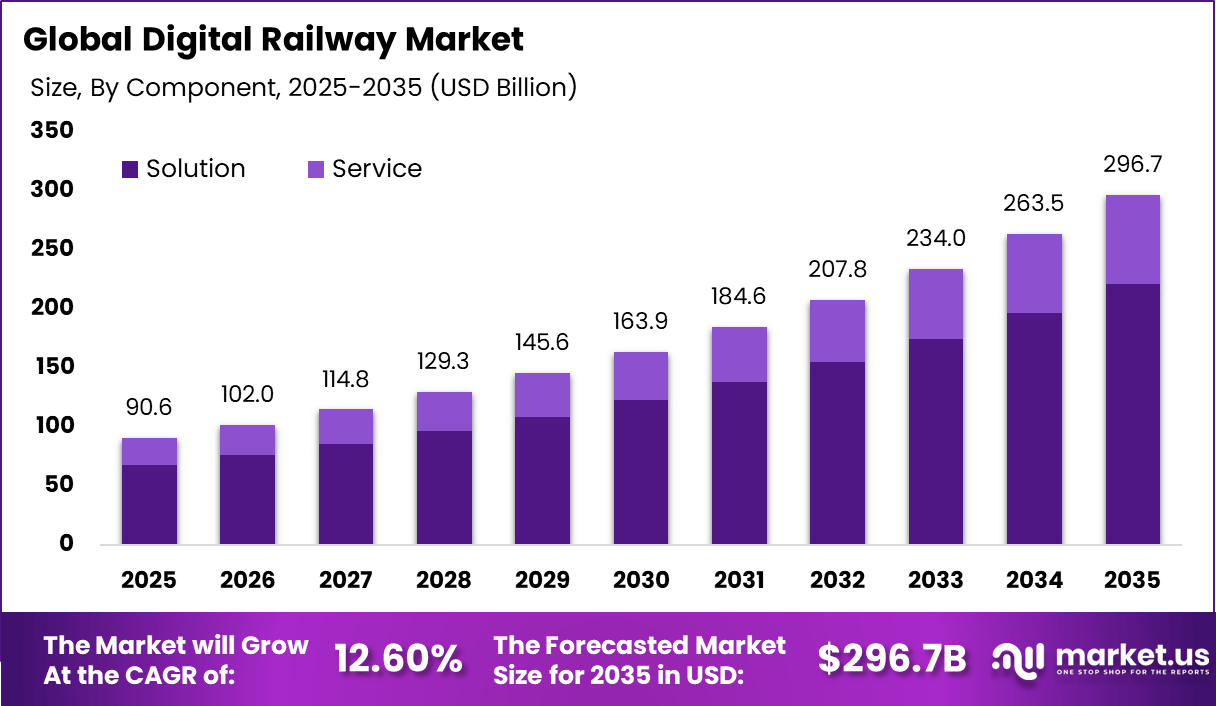
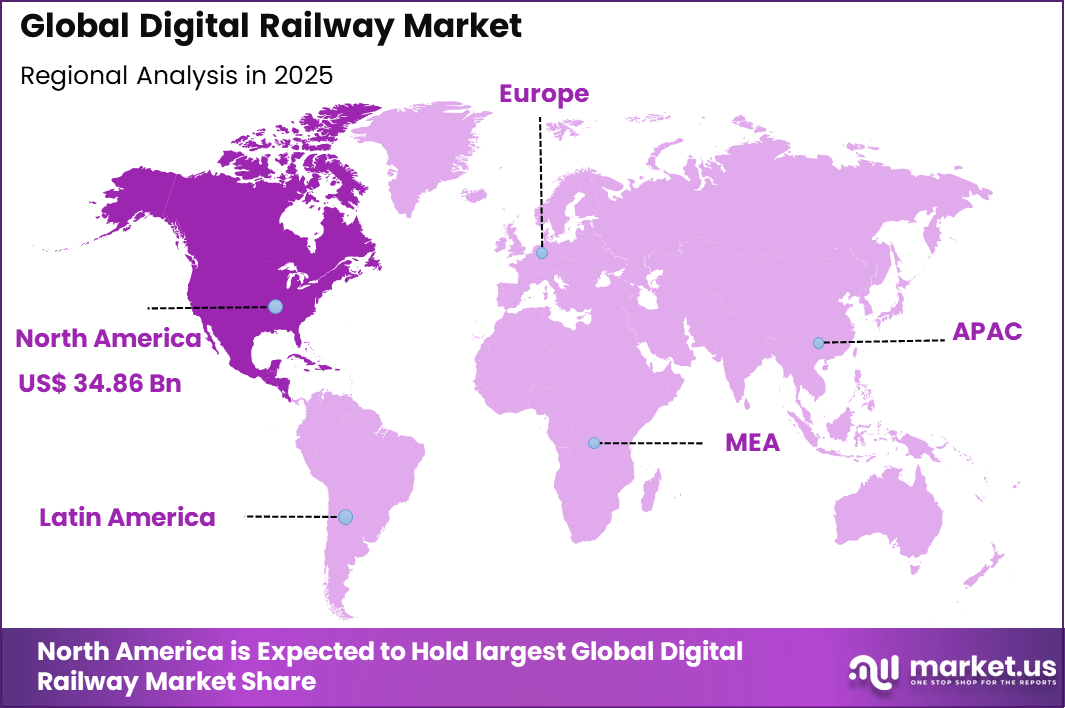
The Global Digital Railway Market offers a compelling large-scale investment opportunity, having generated USD 90.6 billion in 2025 and expected to grow from USD 102 billion in 2026 to nearly USD 296.7 billion by 2035, at a CAGR of 12.60%. North America’s dominant position, with over 38.5% market share and USD 34.86 billion in revenue in 2025, reinforces the region’s role as a key growth engine for long-term capital deployment.
The Digital Railway Market refers to the adoption of digital technologies and software systems to improve the efficiency, safety, and reliability of railway operations. These solutions cover areas such as signaling, traffic management, asset monitoring, predictive maintenance, passenger information systems, and operational analytics. The market has developed as rail operators modernize legacy infrastructure and respond to growing demand for safe, punctual, and sustainable transportation. Digital railway systems enable real time data exchange across rail networks, supporting better decision making and service delivery.
Top Market Takeaways
- Solutions account for 74.7% of the digital railway market, indicating strong reliance on software platforms for signaling, scheduling, asset monitoring, and passenger information management.
- Rail operations management represents 43.9% of application demand, supported by the need for real time traffic control, predictive maintenance, and efficient use of network capacity.
- North America contributes 38.5% of global revenue, with the US valued at USD 29.64 billion and expanding at a 9.5% CAGR, driven by continued investment in digital rail systems and smart infrastructure programs.
Key Insights Summary
Key Performance Statistics and Technology Trends
- Digital ticketing throughput increased from 1,000 to 25,000 tickets per minute, reflecting significant gains in system efficiency and transaction processing.
- Planned enhancements aim to reach 250,000 tickets per minute, showing readiness for peak travel periods and high passenger demand.
- Over 6,500 locomotives now support real time tracking, strengthening operational oversight and timetable accuracy.
- Optical fiber coverage expanded to nearly 67,233 route kilometers, improving the reliability of data transmission across rail networks.
- Free public Wi Fi services were introduced at 6,117 stations, improving passenger connectivity and digital engagement.
- Coach guidance systems were deployed at 1,064 stations, enabling better passenger movement and platform coordination.
Emerging Technologies and Operational Impact
- Digital twin technologies have reduced unplanned downtime by up to 25% through improved predictive maintenance and scenario planning.
- Rail operators are increasingly adopting Zero Trust security frameworks to protect cloud based and 5G supported rail systems.
- Digital acceleration control solutions have achieved 18% improvement in energy efficiency, supporting operational cost control and sustainability targets.
Top Driving Factors
One of the main driving factors of the Digital Railway Market is the need to improve operational efficiency and safety across rail networks. Aging infrastructure and rising traffic volumes create challenges that cannot be addressed through manual systems alone. Digital solutions allow operators to monitor assets continuously and detect potential issues before they lead to service disruptions or safety incidents.
Another important factor is the focus on reducing operational costs while maintaining service quality. Automated control systems and data driven maintenance planning help minimize unplanned downtime and extend asset life. These capabilities support cost optimization while ensuring consistent and reliable rail services.
Demand Analysis
Demand for digital railway solutions is influenced by increasing passenger expectations for punctuality, transparency, and comfort. Travelers now expect accurate real time information on schedules, delays, and connections. Digital passenger information systems and mobile platforms address this demand by providing timely updates and improving the overall travel experience.
Institutional demand is also driven by freight operators seeking greater efficiency and visibility across logistics operations. Digital traffic management and monitoring systems support better coordination of freight movements and improve network utilization. This has increased adoption across both passenger and freight rail segments.
Increasing Adoption Technologies
Advanced signaling and control technologies have seen strong adoption within digital railway systems. These technologies support automated train control, real time traffic optimization, and enhanced safety mechanisms. Their use enables higher network capacity and more precise scheduling without compromising operational reliability.
Data analytics and Internet of Things technologies are also increasingly integrated into rail operations. Sensors embedded in tracks, trains, and infrastructure generate continuous data streams that support condition monitoring and predictive maintenance. This data driven approach reduces manual inspections and improves response times to emerging issues.
Rail operators adopt digital railway technologies to enhance safety and operational visibility. Real time monitoring and automated alerts help identify risks early and support faster intervention. This proactive approach improves incident prevention and strengthens regulatory compliance. Another key reason for adoption is the need to support long term sustainability goals.
Investment and Business Benefits
Investment opportunities in the Digital Railway Market are concentrated in solutions that integrate signaling, control, and analytics into unified platforms. Systems that enable interoperability across legacy and modern infrastructure are particularly attractive as rail networks transition gradually toward full digitalization.
There is also growing opportunity in passenger focused digital services such as smart ticketing and real time journey management. As customer experience becomes a strategic priority, solutions that enhance engagement and service transparency are expected to attract continued investment. Digital railway solutions deliver measurable benefits by improving network reliability and reducing service disruptions.
Automated monitoring and predictive maintenance lower the frequency of unexpected failures and improve service continuity. This leads to higher operational stability and customer satisfaction. Another significant benefit is improved decision making through data driven insights. Access to real time operational data enables rail authorities to optimize scheduling, resource allocation, and long term planning. These benefits contribute to more resilient, efficient, and future ready rail networks.
Driver Analysis
The digital railway market is growing as railway operators seek to enhance operational efficiency, safety, and passenger experience through advanced digital technologies. Rail networks generate vast amounts of data from sensors, signalling systems, rolling stock, and infrastructure assets. Digital railway solutions enable real-time monitoring, predictive maintenance, automated traffic control, and data analytics that help operators reduce downtime, optimise asset utilisation, and minimise service disruptions. Passenger expectations for real-time journey information, mobile ticketing, and seamless connectivity further encourage investment in digital platforms that support modern travel experiences.
Restraint Analysis
A key restraint in the digital railway market is the high capital expenditure and technical complexity required to modernise legacy infrastructure. Many existing rail systems were built with mechanical or analogue technologies that are not easily compatible with digital communication and data processing solutions.
Upgrading these environments to support integrated digital platforms often requires phased implementation, extensive planning, and specialised technical expertise. Budget constraints and long project timelines can slow adoption, particularly for smaller rail authorities or networks with limited funding.
Opportunity Analysis
Emerging opportunities in the digital railway market are linked to the integration of advanced analytics, cloud computing, and Internet of Things connectivity to improve operational decision making and service reliability. Cloud-based platforms can support unified data storage, cross-system analytics, and remote monitoring of assets, enhancing scalability and responsiveness.
Digital railway solutions can also support value-added passenger services such as personalised travel notifications, digital payments, and predictive crowd management. Collaboration with smart city initiatives and multimodal transport networks presents further avenues for unified urban mobility experiences.
Challenge Analysis
A central challenge in the digital railway market involves ensuring cybersecurity and data privacy across connected systems. As rail networks become more digitised, the volume of operational and passenger data exchanged between devices and platforms increases. This expanded attack surface requires robust security frameworks, regular vulnerability assessments, and adherence to industry data protection standards to prevent unauthorised access, disruption, or data breaches. Balancing open data sharing for operational insights with strong security controls remains an essential operational requirement.
Emerging Trends
Emerging trends in the digital railway landscape include the adoption of predictive maintenance powered by real-time sensor analytics that forecast equipment failures before they occur. Automated traffic and signalling systems are also gaining traction to improve capacity utilisation, reduce delays, and support safer operations.
Passenger-centric digital services, such as mobile ticketing, digital wayfinding, and on-board connectivity, are becoming standard features of modern rail travel. Integration with urban mobility platforms that combine rail with bus, bike share, and ride-hailing services supports seamless end-to-end journeys.
Growth Factors
Growth in the digital railway market is supported by ongoing investment in rail network modernisation, urbanisation trends that increase demand for efficient mass transit, and regulatory focus on safety and service quality. The proliferation of data sources, advanced analytics, and connectivity technologies improves the feasibility and appeal of digital solutions for rail operators. As rail transport remains a critical component of sustainable mobility strategies, digital railway technologies are being recognised as essential tools for improving service reliability, operational resilience, and passenger satisfaction.
Regional Analysis
North America accounted for 38.5% share, supported by ongoing modernization of rail infrastructure and increasing adoption of digital technologies across passenger and freight rail networks. Digital railway solutions have been used to improve signaling, traffic management, predictive maintenance, and passenger information systems.
| Region | Primary Growth Driver | Regional Share (%) | Regional Value (USD Bn, 2025) | Adoption Maturity |
|---|---|---|---|---|
| North America | Large-scale rail digitization programs | 38.5% | USD 34.86 Bn | Advanced |
| Europe | Safety and signaling modernization | 29.1% | USD 26.38 Bn | Advanced |
| Asia Pacific | High-speed and metro rail expansion | 24.4% | USD 22.12 Bn | Developing to Advanced |
| Latin America | Urban transit digital upgrades | 4.5% | USD 4.08 Bn | Developing |
| Middle East and Africa | Smart rail infrastructure projects | 3.5% | USD 3.17 Bn | Early |
Key Market Segments
By Component
- Solution
- Remote Monitoring
- Route Optimization & Scheduling
- Analytics
- Network Management
- Predictive Maintenance
- Security
- Others
- Service
- Professional Services
- Managed Services
By Application
- Rail Operations Management
- Passenger Information System
- Asset Management
- Other Applications
Top Key Players in the Market
- CISCO
- HITACHI
- ABTEC
- ALSTOM
- IBM
- ABB
- HUAWEI
- FUJITSU
- DXC
- HONEYWELL
- INDRA
- NOKIA
- ATKINS
- TOSHIBA
- TELEVIC
- ADVANTECH
- Others
Report Scope
| Report Features | Description |
|---|---|
| Market Value (2025) | USD 90.6 Bn |
| Forecast Revenue (2035) | USD 296.7 Bn |
| CAGR(2025-2035) | 12.60% |
| Base Year for Estimation | 2024 |
| Historic Period | 2020-2024 |
| Forecast Period | 2025-2035 |
Discuss your needs with our analyst
Please share your requirements with more details so our analyst can check if they can solve your problem(s)