Overview
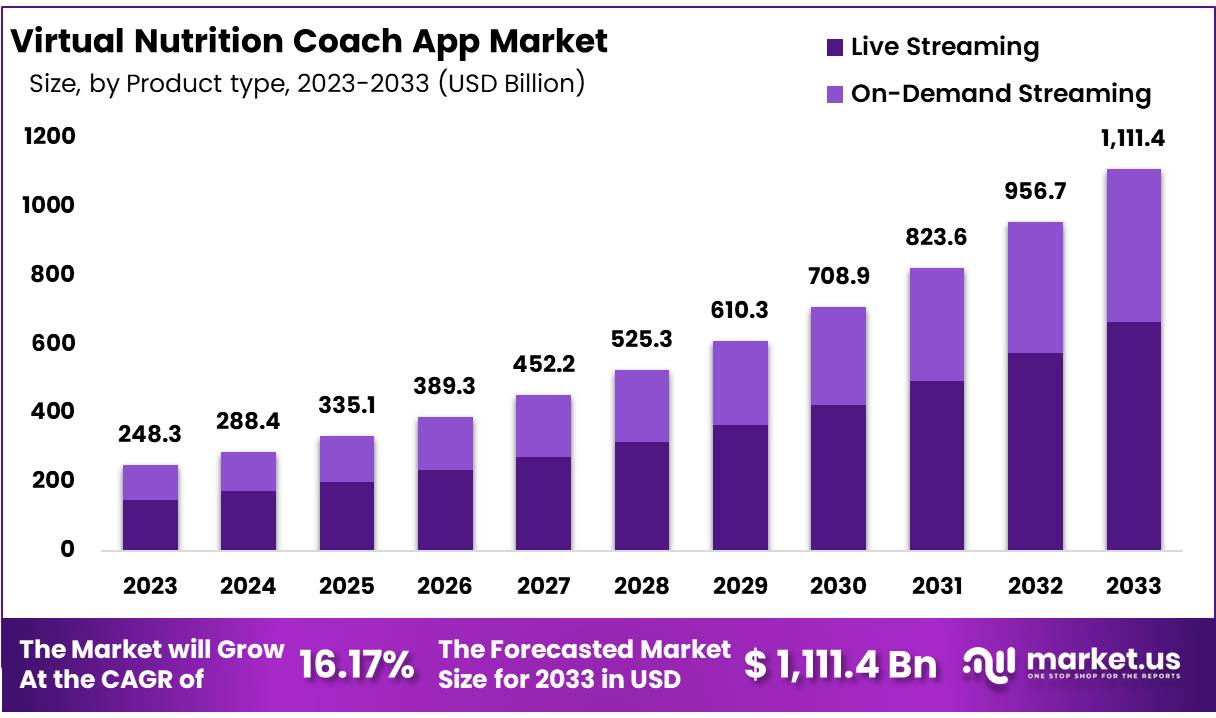
New York, NY – Jan 23, 2026 – Global Virtual Nutrition Coach App Market size is expected to be worth around USD 1,111.4 Billion by 2033 from USD 248.3 Billion in 2023, growing at a CAGR of 16.17% during the forecast period from 2024 to 2033.
A new Virtual Nutrition Coach App has been introduced to support individuals in managing their daily nutrition through personalized, technology-enabled guidance. The app has been designed to address growing demand for accessible, preventive health solutions driven by rising awareness of lifestyle-related conditions and long-term wellness management.
The Virtual Nutrition Coach App uses data inputs such as age, dietary preferences, health goals, activity levels, and medical considerations to deliver customized nutrition recommendations. Meal planning, calorie tracking, micronutrient analysis, and hydration monitoring are integrated into a single platform. Recommendations are continuously refined based on user behavior and progress, enabling adaptive and goal-oriented nutrition planning.
The app also includes features such as real-time feedback, progress dashboards, and reminders to improve adherence and consistency. Evidence-based nutrition principles are embedded into the system, ensuring that guidance aligns with recognized dietary standards. Integration with wearable devices and fitness applications allows for a more holistic view of user health data.
The launch of the Virtual Nutrition Coach App reflects broader market trends toward digital health, personalization, and preventive care. Increased smartphone penetration, growing interest in functional nutrition, and advancements in artificial intelligence have supported the development of scalable nutrition coaching solutions.
The platform is positioned to benefit health-conscious consumers, fitness enthusiasts, and individuals managing specific dietary needs. Over time, the app is expected to support improved dietary awareness, better nutrition outcomes, and more informed lifestyle choices, contributing to long-term health optimization.
Key Takeaways
- Market Size: The Virtual Nutrition Coach App market is projected to reach approximately USD 1,111.4 billion by 2033, expanding from USD 248.3 billion in 2023.
- Market Growth: The market is expected to register a compound annual growth rate (CAGR) of 16.17% during the forecast period from 2024 to 2033.
- Product Analysis: Strong market expansion is being observed, with live streaming functionalities accounting for nearly 60% of the total market share in 2023, reflecting high user engagement.
- Device Type Analysis: In 2023, the smartphones segment emerged as the leading device category, capturing approximately 39% of the overall market share.
- Revenue Model Analysis: Subscription-based revenue models dominated the market, representing about 54% of total revenue in 2023, supported by recurring user engagement.
- Regional Analysis: North America led the global market in 2023, holding around 32% of the total market share, driven by high digital adoption and health awareness.
- Innovation and Engagement: Market players are increasingly emphasizing AI-driven personalized nutrition plans, live coaching sessions, and interactive user features, with substantial investments directed toward research and development to enhance platform capabilities and user experience.
- Data Privacy: Robust data privacy and security frameworks are becoming a critical focus area, as safeguarding user information is essential for sustaining consumer trust and strengthening overall market credibility.
How Does Artificial Intelligence Help to Improve the Virtual Nutrition Coach App Market?
Artificial intelligence plays a critical role in improving the Virtual Nutrition Coach App market by enhancing personalization, accuracy, and user engagement. AI algorithms analyze user data such as age, weight, dietary preferences, health conditions, and activity levels to deliver customized meal plans and nutrition advice. This personalization improves user outcomes and increases long-term app adoption.
Machine learning enables continuous learning from user behavior, allowing recommendations to be refined over time based on progress and feedback. Natural language processing supports conversational interfaces, making virtual nutrition coaches more interactive and accessible through chatbots and voice assistants.
AI also improves data-driven insights by integrating wearable devices and health apps, enabling real-time monitoring of calories, nutrients, and physical activity. Predictive analytics help identify nutritional gaps and potential health risks early. As a result, the effectiveness and credibility of virtual nutrition coach apps are strengthened. The growing demand for preventive healthcare and digital wellness solutions continues to support AI-driven market growth.
Regional Analysis
In 2023, North America accounted for approximately 32% of the global Virtual Nutrition Coach App market, establishing itself as the leading regional market. This dominance is primarily attributed to widespread smartphone penetration, rising health awareness, and strong consumer demand for personalized nutrition and wellness solutions. The region’s well-developed technological infrastructure supports seamless application performance, enabling high user adoption and engagement.
Moreover, the growing emphasis on preventive healthcare and lifestyle-based wellness programs has further accelerated market expansion across the region. Industry assessments suggest that North America’s leading position is expected to be maintained over the forecast period, supported by ongoing technological advancements and an increasing preference for convenient, data-driven, and personalized nutrition guidance.
Emerging trends
- AI chat coaching is replacing static diet plans. MyFitnessPal reports over 250 million users across 120 countries, supporting personalization at scale through nudges, meal swaps, and habit reminders, while keeping coaching costs low per user.
- Food logging is shifting from manual entry to barcode, voice, and photo capture. Research shows adherence drops fast: consistent calorie tracking fell from 68% (week 1) to 21% (week 12), pushing automation.
- Wearables are becoming core data inputs for nutrition advice, linking sleep, steps, and heart rate to meal timing. Pew reports 21% of U.S. adults regularly wear a smartwatch or fitness tracker, supporting large-scale integration.
- Virtual nutrition is increasingly bundled with health benefits, expanding reach beyond direct subscriptions. Highmark states nearly 2 million members are eligible for Noom’s program starting January 1, 2026, indicating payer-led distribution.
- Clinical credibility is rising through outcome-focused design and evidence reviews. A meta-analysis found mobile app interventions were associated with about 1.07 kg greater weight loss versus controls, encouraging structured goal setting and monitoring.
Use cases
- Prediabetes prevention coaching can be delivered through an app with clear goals. CDC reports 5–7% weight loss plus at least 150 minutes/week activity reduced type 2 diabetes incidence by 58% in high-risk adults.
- Tele-nutrition triage can route users from AI guidance to dietitians for complex cases. CDC estimates 37.0% of U.S. adults used telemedicine in the past 12 months (2021), supporting comfort with remote care workflows.
- Obesity support programs can provide daily meal structure, protein targets, and habit coaching. WHO reports 43% of adults were overweight and 16% lived with obesity in 2022, creating broad demand for guided nutrition.
- Employer wellness programs can use nutrition coaching with dashboards, nudges, and incentives tied to engagement. Benefit rollouts can reach millions, enabling standardized reporting on weekly active users, goal completion rates, and multi-month retention.
- Long-term weight management can use relapse detection and behavior prompts. Because tracking is burdensome, the drop from 68% to 21% consistent logging by week 12 shows why apps must reduce friction and sustain routines.
Frequently Asked Questions on Virtual Nutrition Coach App
- How does a Virtual Nutrition Coach App work?
A Virtual Nutrition Coach App functions by collecting user data such as dietary habits, health goals, and activity levels. Advanced algorithms analyze this information to deliver tailored meal plans, real-time feedback, and progress monitoring. - What factors are driving the growth of the Virtual Nutrition Coach App Market?
The market growth is driven by increasing health awareness, rising smartphone penetration, demand for personalized wellness solutions, and advancements in artificial intelligence. The shift toward preventive healthcare and digital health adoption further supports market expansion. - What is the expected market size of the Virtual Nutrition Coach App Market?
The Virtual Nutrition Coach App Market is projected to reach approximately USD 1,111.4 billion by 2033. This growth is supported by strong user adoption, expanding subscription models, and continuous technological innovations across global markets. - Which revenue model dominates the Virtual Nutrition Coach App Market?
Subscription-based revenue models dominate the Virtual Nutrition Coach App Market, as they offer recurring income streams for providers. These models are preferred due to consistent user engagement, access to premium features, and long-term customer retention. - Which region leads the Virtual Nutrition Coach App Market?
North America leads the Virtual Nutrition Coach App Market due to high digital adoption, strong health awareness, and advanced technological infrastructure. The region benefits from widespread smartphone usage and increasing demand for personalized nutrition solutions. - How is artificial intelligence influencing Virtual Nutrition Coach Apps?
Artificial intelligence plays a crucial role by enabling personalized nutrition plans, real-time dietary recommendations, and predictive health insights. AI enhances user engagement, improves accuracy, and supports scalable solutions tailored to individual health goals. - Why is data privacy important in Virtual Nutrition Coach Apps?
Data privacy is critical as these apps handle sensitive health and dietary information. Strong security frameworks help build user trust, ensure regulatory compliance, and enhance the overall credibility and long-term sustainability of Virtual Nutrition Coach App platforms.
Conclusion
The Virtual Nutrition Coach App market is positioned for strong long-term growth, supported by rising health awareness, digital adoption, and demand for personalized preventive care. Artificial intelligence has strengthened platform effectiveness through adaptive nutrition planning, real-time insights, and improved user engagement.
Integration with wearables, subscription-based models, and evidence-driven design has enhanced scalability and commercial viability. North America continues to lead adoption due to advanced infrastructure and wellness-focused consumers. As data privacy frameworks mature and AI capabilities advance, virtual nutrition coaching is expected to play an increasingly important role in improving dietary outcomes, supporting lifestyle management, and enabling sustainable, technology-driven health optimization.
Discuss your needs with our analyst
Please share your requirements with more details so our analyst can check if they can solve your problem(s)