Market.us Scoop, we strive to bring you the most accurate and up-to-date information by utilizing a variety of resources, including paid and free sources, primary research, and phone interviews.Learn
more.
close
Advertiser Disclosure
At Market.us Scoop, we strive to bring you the most accurate and up-to-date information by utilizing a variety of resources, including paid and free sources, primary research, and phone interviews. Our data is available to the public free of charge, and we encourage you to use it to inform your personal or business decisions. If you choose to republish our data on your own website, we simply ask that you provide a proper citation or link back to the respective page on Market.us Scoop. We appreciate your support and look forward to continuing to provide valuable insights for our audience.
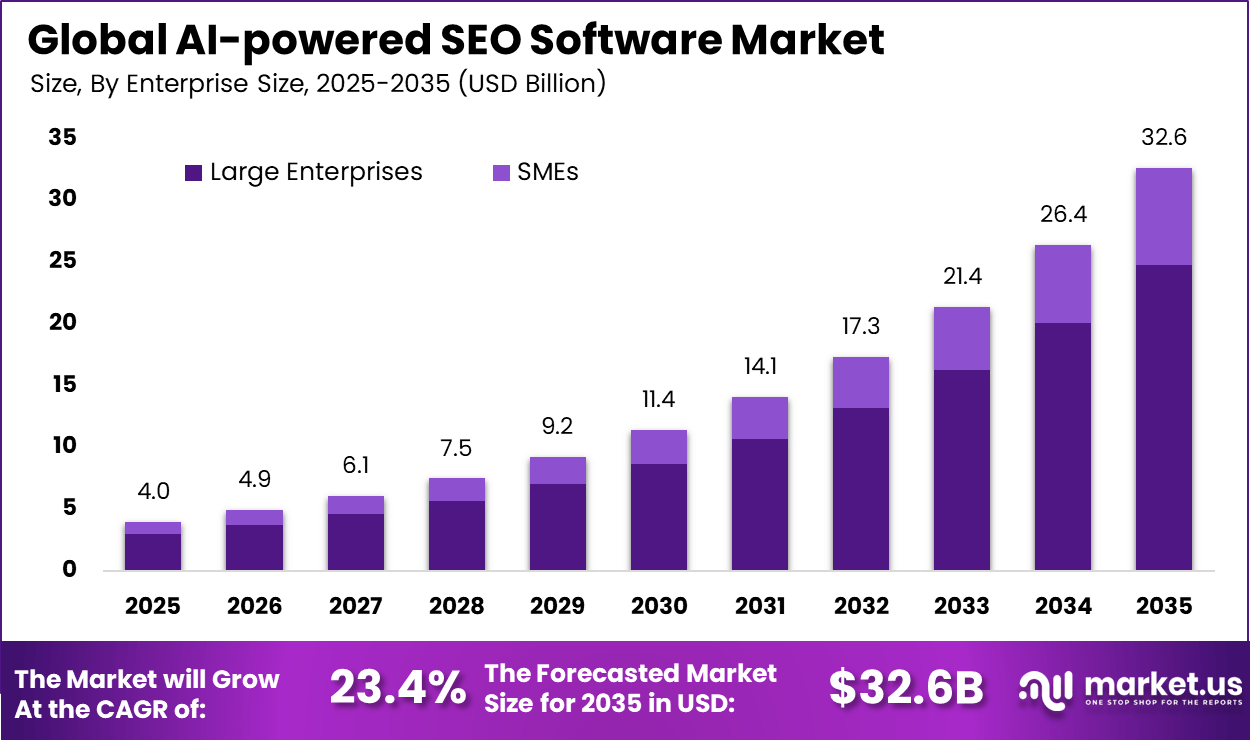
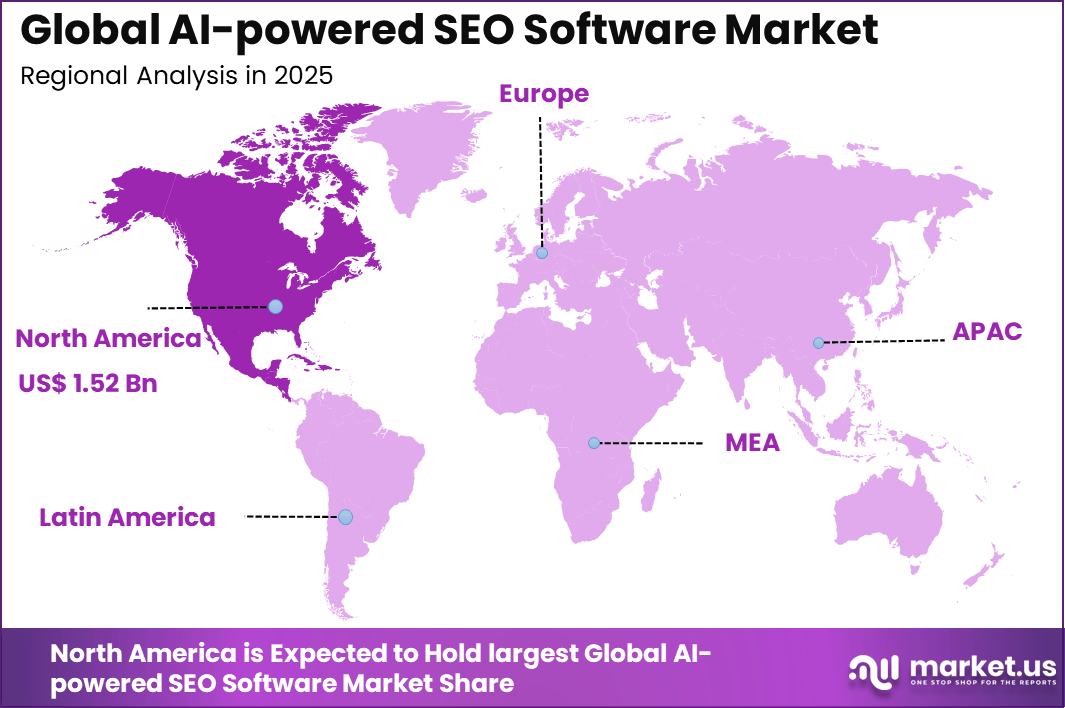
The Global AI-Powered SEO Software Market was valued at USD 3.98 billion in 2025 and is projected to expand rapidly to approximately USD 32.6 billion by 2035, registering a robust CAGR of 23.4% over the forecast period. North America dominated the market in 2025, capturing more than 38.4% share and generating USD 1.52 billion in revenue, reflecting strong enterprise adoption of AI-enabled digital marketing tools and attractive long-term upside for investors.
The AI-Powered SEO Software Market focuses on digital tools that use artificial intelligence to improve website visibility on search engines. These platforms automate tasks such as keyword analysis, content optimization, technical audits, and performance monitoring. By analyzing large volumes of search and website data, AI-driven SEO software helps users make informed optimization decisions. These tools are increasingly used by businesses, publishers, and digital teams to manage complex SEO requirements efficiently.
AI-powered SEO software automates keyword research, content optimization, and performance tracking to help businesses rank higher in search results. These tools use machine learning to analyze search intent, predict trends, and personalize strategies amid AI-driven search changes. Demand grows as 60% of searches yield no clicks due to AI summaries, pushing marketers to adapt.
One of the primary driving factors for this market is the growing complexity of search engine algorithms. Search engines now evaluate content quality, relevance, structure, and user engagement signals simultaneously. Manual SEO methods struggle to keep pace with these changes. AI-powered software helps automate analysis and adaptation, making optimization more manageable and effective.
Another key driver is the increasing volume of digital content published every day. Websites compete for limited search visibility across multiple keywords and topics. AI tools help identify opportunities, gaps, and performance issues faster than traditional approaches. This efficiency drives adoption among content-driven businesses and publishers.
Key Takeaways
In 2025, large enterprises led adoption with a 75.9% share, reflecting stronger budgets, complex SEO needs, and higher demand for advanced automation and analytics tools.
The on premises deployment model held 67.4% share in 2025, showing continued preference for tighter data control, deeper customization, and integration with internal digital systems.
Natural language processing was the leading technology with 45.3% share, driven by its use in understanding search intent, improving content relevance, and supporting semantic keyword analysis.
Social media marketing applications accounted for 27.5% share, indicating growing use of AI driven SEO tools to connect search performance with social content reach and engagement.
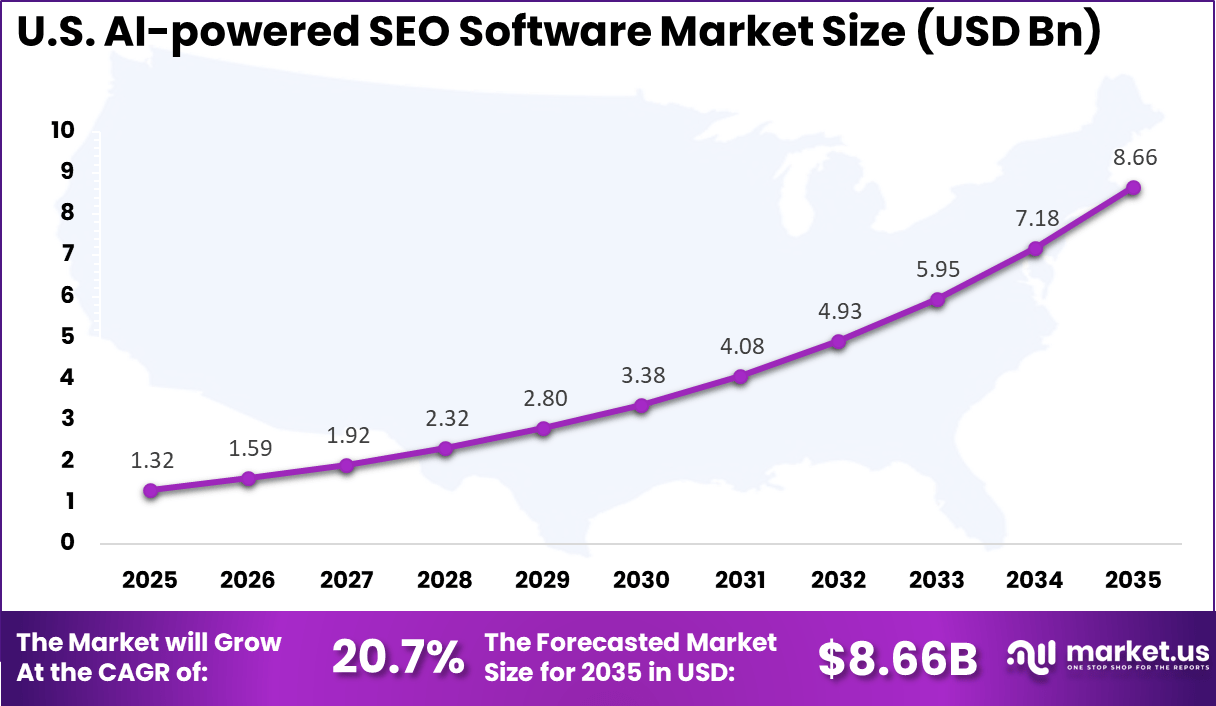
The US market was valued at USD 1.32 billion in 2025 and is growing at a 20.7% rate, supported by high digital marketing spending and early adoption of AI based optimization solutions.
North America held more than 38.4% share in 2025, supported by mature SEO practices, strong enterprise demand, and rapid integration of AI across digital marketing workflows.
Drivers Impact Analysis
Driver Category
Key Driver Description
Estimated Impact on CAGR (%)
Geographic Relevance
Impact Timeline
Complexity of search algorithms
Need for automated optimization
~6.4%
Global
Short Term
Growth of digital marketing spend
Performance focused SEO investment
~5.7%
North America, Europe
Short Term
Expansion of content driven commerce
SEO automation for scale
~4.6%
Global
Mid Term
AI adoption in marketing workflows
Data driven decision making
~3.9%
Global
Mid Term
Integration with analytics platforms
Unified marketing intelligence
~2.8%
Global
Long Term
Risk Impact Analysis
Risk Category
Risk Description
Estimated Negative Impact on CAGR (%)
Geographic Exposure
Risk Timeline
Algorithm volatility
Frequent search engine updates
~4.8%
Global
Short Term
Data privacy regulations
Limits on user data usage
~4.1%
North America, Europe
Mid Term
Over reliance on automation
Reduced manual SEO expertise
~3.3%
Global
Mid Term
Tool commoditization
Price pressure among vendors
~2.6%
Global
Long Term
Skill gaps
Shortage of AI SEO specialists
~2.1%
Global
Long Term
Restraint Impact Table
Restraint Factor
Restraint Description
Impact on Market Expansion (%)
Most Affected Regions
Duration
High subscription costs
Premium enterprise pricing
~5.3%
Emerging Markets
Short to Mid Term
Integration complexity
Linking with existing martech stacks
~4.6%
Global
Mid Term
Data quality dependence
Output accuracy tied to input data
~3.8%
Global
Mid Term
Limited SME adoption
Budget constraints
~3.0%
Global
Long Term
Regulatory uncertainty
Data and AI governance changes
~2.4%
North America, Europe
Long Term
Regional Driver Comparison
North America accounts for 38.4%, supported by advanced adoption of digital marketing technologies. Organizations across the region continue to invest heavily in AI based SEO solutions to strengthen online visibility and performance. High competitive intensity sustains demand for advanced optimization tools, while mature digital infrastructure supports large scale deployment. As a result, the region remains a key contributor to overall market development.
Region
Primary Growth Driver
Regional Share (%)
Regional Value (USD Bn)
Adoption Maturity
North America
Advanced digital marketing ecosystems
38.4%
USD 1.52 Bn
Advanced
Europe
Enterprise SEO compliance and analytics
26.9%
USD 1.07 Bn
Advanced
Asia Pacific
Rapid ecommerce and content growth
23.7%
USD 0.94 Bn
Developing
Latin America
Digital brand expansion
6.4%
USD 0.25 Bn
Developing
Middle East and Africa
Early digital marketing adoption
4.6%
USD 0.18 Bn
Early
The United States reached USD 1.32 Billion with a CAGR of 20.7%, reflecting strong market growth. Expansion is driven by enterprise digital transformation.
Revenue forecast, AI impact on Market trends, Share Insights, Company ranking, competitive landscape, Recent Developments, Market Dynamics and Emerging Trends
Discuss your needs with our analyst
Please share your requirements with more details so our analyst can check if they can solve your problem(s)
Yogesh Shinde is a passionate writer, researcher, and content creator with a keen interest in technology, innovation and industry research. With a background in computer engineering and years of experience in the tech industry. He is committed to delivering accurate and well-researched articles that resonate with readers and provide valuable insights. When not writing, I enjoy reading and can often be found exploring new teaching methods and strategies.