Market Size
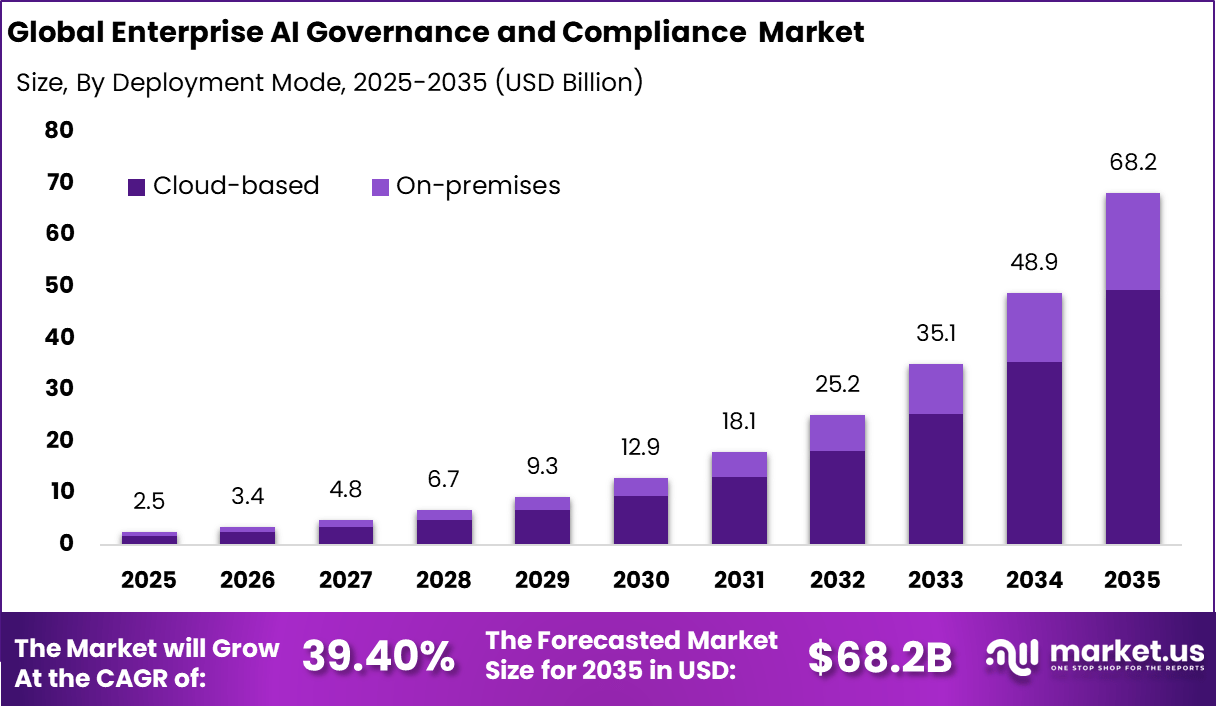
The Global Enterprise AI Governance and Compliance Market represents a high-conviction investment opportunity, expanding from USD 2.5 billion in 2025 to nearly USD 68.2 billion by 2035, growing at a CAGR of 39.4%. North America’s dominant market position, capturing more than 42.3% share and USD 1.04 billion in revenue, underscores strong regional leadership in enterprise AI oversight, risk management, and regulatory compliance solutions.
The Enterprise AI Governance and Compliance Market focuses on frameworks, tools, and practices that help organizations manage artificial intelligence systems responsibly. These solutions ensure AI models are developed, deployed, and operated in line with legal requirements, ethical principles, and internal policies. Governance typically addresses transparency, accountability, data usage, and risk management across the AI lifecycle. As AI becomes embedded in enterprise decision making, structured oversight has become essential.
The Enterprise AI Governance and Compliance Market focuses on frameworks, tools, and practices that help organizations manage artificial intelligence systems responsibly. These solutions ensure AI models are developed, deployed, and operated in line with legal requirements, ethical principles, and internal policies. Governance typically addresses transparency, accountability, data usage, and risk management across the AI lifecycle. As AI becomes embedded in enterprise decision making, structured oversight has become essential.
One of the main driving factors is the rapid expansion of AI use in enterprise decision processes. AI systems are increasingly applied to customer engagement, credit assessment, recruitment screening, and operational planning. These decisions directly affect individuals and organizations, raising accountability expectations. As a result, enterprises are prioritizing governance structures to manage responsibility and risk.
Demand for enterprise AI governance and compliance solutions is increasing as organizations scale AI deployment beyond pilot projects. As AI usage expands, manual oversight becomes inefficient and unreliable. Enterprises require automated systems to track model performance, data usage, and compliance indicators. This operational complexity is creating sustained demand for governance platforms.
Top Market Takeaways
- By component, solutions led the enterprise AI governance and compliance market with a 68.9% share, as organizations rely on software platforms to monitor AI ethics, risk, and policy adherence.
- By deployment mode, cloud based systems captured 72.4%, supported by easier integration and real time oversight across distributed AI environments.
- By organization size, large enterprises dominated with 81.6%, reflecting the need to govern complex AI portfolios under increasing regulatory pressure.
- By end user industry, banking, financial services, and insurance accounted for 47.3%, driven by strict compliance requirements and high exposure to AI related financial risks.
- By application, regulatory compliance held 58.3% share, focusing on adherence to data protection rules and emerging AI regulations.
- North America represented 42.3% of the global market, with the US valued at USD 0.94 billion and growing at a 37.20% CAGR, supported by early regulation readiness and strong enterprise AI adoption.
Segmentation Impact Table
Enterprise AI Governance and Compliance Market
| Segment Type | Dominant Segment | Segment Share (%) | Segment Value (USD Bn) | Market Influence |
|---|---|---|---|---|
| By Component | Software platforms | 62.8% | USD 1.57 Bn | Critical |
| By Deployment Mode | Cloud based | 69.4% | USD 1.74 Bn | Critical |
| By Organization Size | Large enterprises | 74.6% | USD 1.87 Bn | Critical |
| By Application | Model risk management and monitoring | 41.3% | USD 1.03 Bn | Critical |
| By End User Industry | BFSI | 28.9% | USD 0.72 Bn | High |
Drivers Impact Analysis
| Driver Category | Key Driver Description | Estimated Impact on CAGR (%) | Geographic Relevance | Impact Timeline |
|---|---|---|---|---|
| Global AI regulations | Enforcement of AI governance laws | ~10.4% | North America, Europe | Short Term |
| Enterprise scale AI adoption | Growing operational and ethical risks | ~9.1% | Global | Short Term |
| Demand for explainable AI | Transparency and accountability requirements | ~7.6% | Global | Mid Term |
| Data privacy and security mandates | Alignment with existing compliance regimes | ~6.4% | Global | Mid Term |
| Board level AI risk oversight | AI treated as enterprise risk | ~5.9% | Global | Long Term |
Risk Impact Analysis
| Risk Category | Risk Description | Estimated Negative Impact on CAGR (%) | Geographic Exposure | Risk Timeline |
|---|---|---|---|---|
| Regulatory uncertainty | Fragmented global AI regulations | ~6.8% | Global | Short Term |
| High implementation complexity | Integration with AI and data stacks | ~5.9% | Global | Mid Term |
| Skill shortages | Limited AI governance expertise | ~5.1% | Global | Mid Term |
| Vendor immaturity | Rapidly evolving solution landscape | ~4.2% | Global | Long Term |
| Cost pressure | Budget constraints in early adoption | ~3.4% | Emerging Markets | Long Term |
Restraint Impact Table
| Restraint Factor | Restraint Description | Impact on Market Expansion (%) | Most Affected Regions | Duration |
|---|---|---|---|---|
| Lack of standardized frameworks | Variability in governance models | ~7.3% | Global | Short to Mid Term |
| High deployment costs | Enterprise grade compliance tooling | ~6.1% | Emerging Markets | Mid Term |
| Data lineage complexity | Tracking AI training and inference data | ~5.4% | Global | Mid Term |
| Organizational resistance | Cultural resistance to AI oversight | ~4.6% | Global | Long Term |
| Limited SME adoption | Compliance tools focused on large firms | ~3.8% | Global | Long Term |
Opportunity Analysis
Emerging opportunities in the enterprise AI governance and compliance market are linked to platforms that automate policy enforcement, risk scoring, and reporting. Solutions that support continuous monitoring, explainability, and audit readiness enable organisations to demonstrate regulatory alignment and operational control.
There is also potential for industry-specific governance modules tailored to sectors with stringent regulatory environments such as finance and healthcare, where compliance demands are high. Hybrid solutions that integrate governance with model lifecycle tooling, data management, and risk platforms can further extend value by reducing manual effort and improving oversight.
Emerging Trends
Emerging trends in the enterprise AI governance landscape include the adoption of continuous compliance and monitoring tools that detect model drift, performance issues, and policy deviations in real time. Automated explainability and bias detection tools are also becoming integral, allowing stakeholders to understand how models reach decisions without requiring deep technical expertise.
Another trend is alignment with global regulatory frameworks and standards, which helps organisations prepare for evolving laws and demonstrate compliance to auditors and regulators. Integrated governance platforms that tie together risk, ethics, and regulatory requirements are gaining traction as holistic solutions.
Growth Factors
Growth in the enterprise AI governance and compliance market is supported by rising regulatory activity and broader adoption of AI across enterprise functions. Regulatory focus on responsible AI, including efforts such as the EU AI Act and national frameworks, reinforces the need for structured governance that aligns with compliance obligations.
Enterprises recognise that unmanaged AI can introduce legal, ethical, and operational risks, and governance solutions help mitigate these risks while supporting trust and transparency. Advances in automation, monitoring, and analytics technologies are improving the scalability and effectiveness of governance processes, enabling organisations to manage AI at scale with confidence.
Key Market Segments
By Component
- Solutions
- AI Model Governance & Lifecycle Management
- Bias Detection & Fairness Monitoring
- Explainability & Interpretability Tools
- Compliance & Regulatory Reporting
- Risk Management & Auditing
- Others
- Services
- Professional Services
- Consulting & Advisory
- Implementation & Integration
- Training & Education
- Managed Services
- Professional Services
- Others
By Deployment Mode
- On-premises
- Cloud-based
By Organization Size
- Large Enterprises
- Small and Medium-sized Enterprises
By End-User Industry
- Banking, Financial Services, and Insurance
- Healthcare & Life Sciences
- Government & Public Sector
- Retail & E-commerce
- IT & Telecommunications
- Others
By Application
- Regulatory Compliance
- Ethical AI & Risk Mitigation
- Operational Transparency
- Model Performance & Validation
- Others
Top Key Players in the Market
- IBM Corporation
- Microsoft Corporation
- Google LLC
- Salesforce, Inc.
- SAS Institute Inc.
- H2O.ai, Inc.
- DataRobot, Inc.
- Fiddler Labs, Inc.
- Arize AI, Inc.
- MetricStream, Inc.
- OneTrust, LLC
- SAP SE
- Oracle Corporation
- Accenture plc
- PwC Advisory Services LLC
- Others
Report Scope
| Report Features | Description |
|---|---|
| Market Value (2025) | USD 2.5 Bn |
| Forecast Revenue (2035) | USD 68.2 Bn |
| CAGR(2025-2035) | 39.40% |
| Base Year for Estimation | 2025 |
| Historic Period | 2020-2024 |
| Forecast Period | 2025-2035 |
Discuss your needs with our analyst
Please share your requirements with more details so our analyst can check if they can solve your problem(s)