Overview
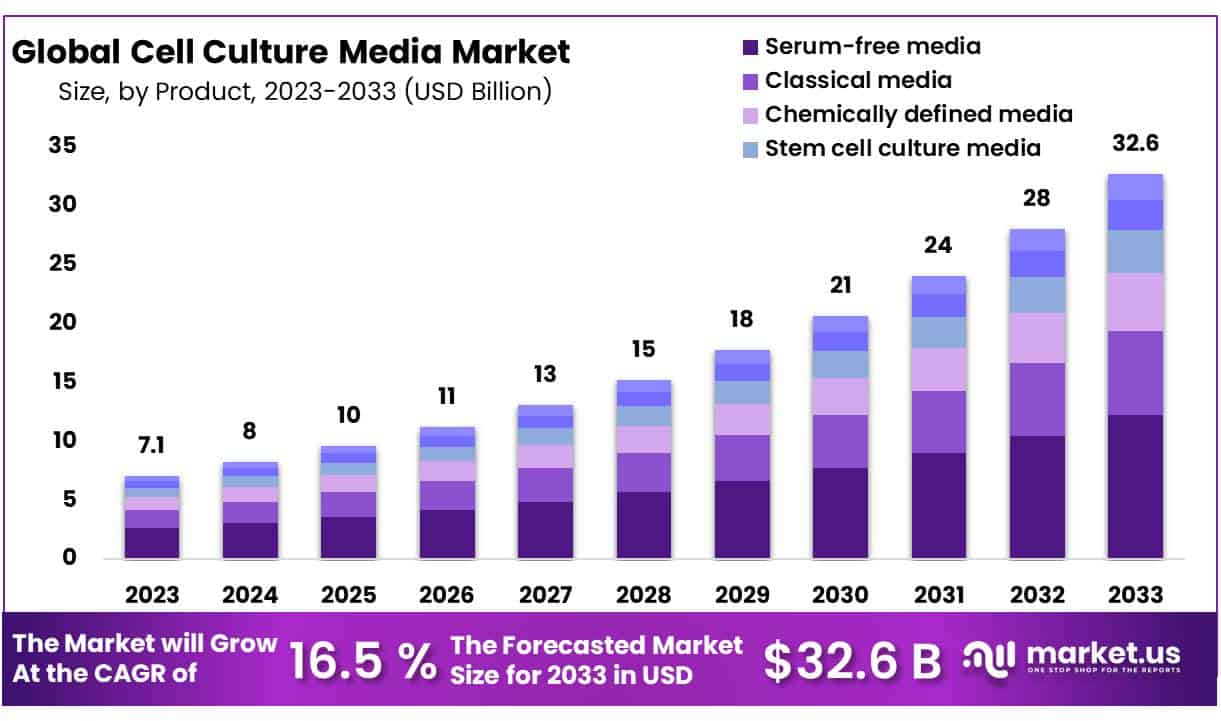
New York, NY – Jan 28, 2026 – The Global Cell Culture Media Market size is expected to be worth around USD 32.6 Billion by 2033 from USD 7.1 Billion in 2023, growing at a CAGR of 16.5% during the forecast period from 2024 to 2033.
Cell culture media represents a fundamental component in modern life science research, biopharmaceutical development, and clinical applications. The basic formation of cell culture media is designed to provide an artificial environment that supports the growth, proliferation, and maintenance of cells outside their natural biological systems.
At its core, cell culture media is composed of a balanced mixture of essential nutrients. These include inorganic salts that help maintain osmotic balance and regulate membrane potential, along with carbohydrates, primarily glucose, which serve as the main energy source for cellular metabolism. Amino acids are included to support protein synthesis and cellular repair processes, while vitamins act as co-factors in enzymatic reactions critical for cell survival.
In addition, buffering systems such as sodium bicarbonate or HEPES are incorporated to stabilize pH levels during cell growth. Depending on the application, serum or serum-free supplements may be added to supply growth factors, hormones, and attachment proteins. Antibiotics are sometimes included to reduce the risk of microbial contamination during routine laboratory handling.
The formulation of cell culture media is optimized based on cell type and intended application, ensuring consistency, reproducibility, and scalability. As demand for biologics, vaccines, and cell-based therapies continues to increase, the importance of standardized and high-quality cell culture media remains a critical factor in advancing biomedical research and industrial biotechnology.
Key Takeaways
- Market Size: The global cell culture media market is projected to reach approximately USD 32.6 billion by 2033, increasing from USD 7.1 billion in 2023.
- Market Growth: The market is anticipated to expand at a compound annual growth rate (CAGR) of 16.5% over the forecast period from 2024 to 2033.
- Product Analysis: Serum-free media accounted for the largest share of the market, representing 37.4% of total revenue in 2023.
- Application Analysis: Biopharmaceutical production emerged as the leading application segment, holding a dominant position in 2023.
- Type Analysis: The liquid media segment captured a substantial market share of 63.4% in 2023, reflecting its widespread adoption.
- End-Use Analysis: Pharmaceutical and biotechnology companies led the market, collectively accounting for 35.8% of the total share in 2023.
- Regional Analysis: North America maintained its leadership position in the global cell culture media market, securing a significant 36.4% market share in 2023.
- Technological Advancements: Ongoing innovations in media formulations, particularly serum-free and chemically defined media, are improving cell viability and productivity, thereby supporting market expansion.
Market Segmentation Analysis
- By Product: The cell culture media market is segmented into serum-free, classical, chemically defined, stem cell, specialty, and other media. Serum-free media led in 2023 with 37.4% share, driven by consistency, reduced contamination risk, physiological control, and growing emphasis on animal-free research practices.
- By Application: By application, the market includes biopharmaceutical production, diagnostics, drug screening and development, and tissue engineering. Biopharmaceutical production dominated in 2023 due to rising biologics demand and need for standardized, contamination-free media, supported by large investments from players such as Cytiva and Pall Corporation.
- By Type: Based on type, the market is categorized into liquid, semi-solid, and solid media. Liquid media accounted for 63.4% share in 2023, supported by rapid cell growth, operational flexibility, reduced processing steps, and increasing adoption by biologics manufacturers, including expansions by Sartorius.
- By End User: By end user, the market comprises pharmaceutical and biotechnology companies, hospitals and diagnostic laboratories, and research institutes. Pharmaceutical and biotechnology companies led with 35.8% share in 2023, driven by expanding biopharmaceutical manufacturing capacities and sustained investments to scale production infrastructure.
Regional Analysis
North America emerged as the leading region in the global cell culture media market, accounting for a substantial 36.4% market share in 2023. This regional leadership is primarily driven by the strong presence of major industry participants such as Thermo Fisher Scientific, Inc. and Cytiva, among others.
The continued focus of these companies on product innovation, technological advancements, and strategic initiatives aimed at strengthening their competitive positioning in the life sciences sector has significantly reinforced North America’s dominance in the global marketplace.
Emerging Trends in Cell Culture Media
- Transition from 2D to 3D Cell Culture Systems: Traditional two-dimensional cell culture methods are progressively being replaced by three-dimensional culture systems. These advanced models better replicate in vivo tissue structures and cell-to-cell interactions, improving biological accuracy. Their adoption is especially significant in oncology research and preclinical drug testing, where realistic disease modeling is essential.
- Rising Use of Physiologic Cell Culture Media: A growing shift toward physiologic cell culture media is being observed, as these formulations more closely resemble the biochemical environment of the human body. This trend enhances the translational value of research findings by providing conditions that reflect natural cellular behavior and physiological responses.
- Application of Machine Learning in Media Development: Machine learning and advanced analytics are increasingly utilized to optimize cell culture media formulations. By analyzing large biological datasets, these technologies enable precise nutrient optimization, resulting in improved cell growth efficiency, greater reproducibility, and enhanced overall product quality.
Key Use Cases of Cell Culture Media
- Vaccine Production: Cell culture–based vaccine manufacturing is gaining prominence as an effective alternative to conventional egg-based methods. These systems offer superior scalability, faster production timelines, and greater flexibility, making them particularly valuable during public health emergencies requiring rapid vaccine development.
- Drug Discovery and Pharmaceutical Research: Cell culture media are fundamental to drug discovery, supporting cell growth for screening, efficacy testing, and toxicity assessment. The increasing adoption of 3D cell culture models enhances predictive accuracy of human responses, enabling more informed decisions prior to clinical trial progression.
- Cancer Research and Oncology Studies: In oncology research, cell culture media are essential for sustaining and analyzing tumor cells under controlled conditions. Advancements in 3D culture technologies allow for the recreation of tumor microenvironments, supporting targeted drug evaluation and the study of cancer-specific signaling mechanisms.
Conclusion
The global cell culture media market is experiencing strong and sustained growth, driven by expanding biopharmaceutical production, rising demand for biologics and vaccines, and continuous advancements in cell-based research.
The increasing adoption of serum-free and liquid media reflects the industry’s focus on consistency, scalability, and contamination control. North America remains a dominant region due to robust R&D infrastructure and strong presence of leading manufacturers.
Moreover, emerging trends such as 3D cell culture systems, physiologic media, and data-driven formulation optimization are enhancing research accuracy and productivity. Collectively, these factors position cell culture media as a critical enabler of future progress in biomedical research, industrial biotechnology, and advanced therapeutic development.
Discuss your needs with our analyst
Please share your requirements with more details so our analyst can check if they can solve your problem(s)