Introduction
Market.us has released a comprehensive analysis of the Global Traffic Simulation Systems Market, projecting steady expansion from USD 2.7 Billion in 2024 to USD 6.3 Billion by 2034. The market is forecast to grow at a CAGR of 8.9% over the 2025–2034 period, reflecting accelerating global demand for advanced urban mobility planning and smart infrastructure solutions.
Consequently, rapid urbanization is intensifying traffic congestion challenges across major metropolitan regions worldwide. Governments and city planners are turning to traffic simulation systems to design better road networks, optimize signal timing, and test infrastructure changes virtually before committing significant financial resources to physical implementation.
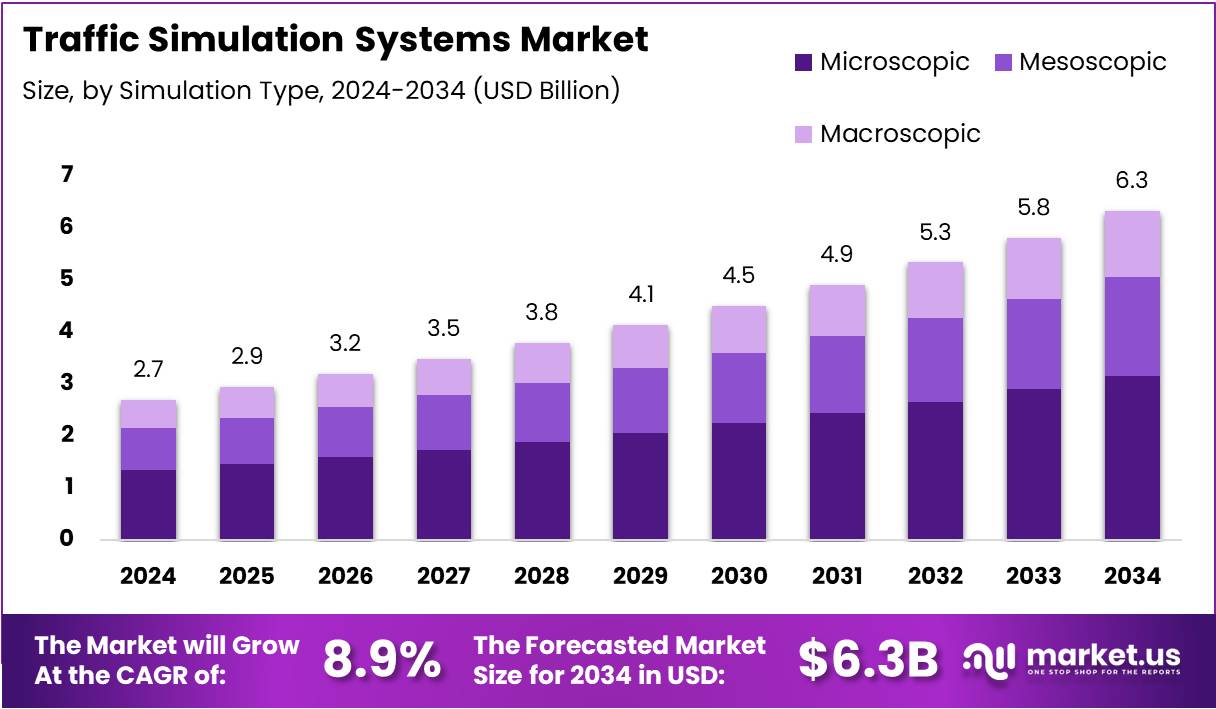
Furthermore, government investment in Intelligent Transportation Systems is playing a critical role in market acceleration. Policies promoting sustainable mobility, public transit integration, and mandatory traffic impact assessments are compelling authorities to adopt precise simulation tools that support evidence-based infrastructure planning and traffic management strategies.
Additionally, technological innovation is fundamentally expanding simulation capabilities. Real-time platforms powered by cloud computing, GPU acceleration, and machine learning now enable large-scale modeling of up to 1,500 vehicles at 60 FPS, allowing planners to evaluate complex urban networks dynamically and extract actionable insights for both immediate management and long-term investment decisions.
Finally, the shift toward autonomous vehicle development and smart city ecosystems is creating new high-value application areas for traffic simulation. From self-driving vehicle algorithm testing to emergency evacuation planning, these platforms are becoming indispensable tools across government agencies, engineering consultancies, and private mobility operators globally.
Key Takeaways
- The Global Traffic Simulation Systems Market is projected to grow from USD 2.7 Billion in 2024 to USD 6.3 Billion by 2034 at a CAGR of 8.9%.
- Software dominates the component segment with a 74.6% market share.
- Microscopic simulation leads the simulation type segment with a 49.9% share.
- Urban Mobility Planning holds the largest application share at 39.8%.
- Government Agencies represent the largest end-user segment with a 44.1% share.
- North America leads the regional market with a 43.8% share, valued at USD 1.1 Billion.
Market Segmentation Overview
By component, Software dominates with a 74.6% share, driven by demand for sophisticated modeling tools, cloud-based deployment flexibility, and machine learning integration that enables real-time data analysis and predictive traffic management. Hardware complements software by providing essential sensor networks, edge computing units, and IoT devices that feed accurate data into simulation platforms.
By simulation type, Microscopic leads with 49.9%, preferred for its granular vehicle-level modeling suited to urban intersection analysis and signal optimization. By application, Urban Mobility Planning commands 39.8% of demand, supported by smart city initiatives and rapid urbanization. By end user, Government Agencies hold a dominant 44.1% share, reflecting their primary responsibility for public infrastructure planning and traffic management across jurisdictions.
Drivers
Rising urbanization and smart infrastructure development are primary growth drivers. As populations concentrate in cities, traffic congestion intensifies and the cost of poor infrastructure planning escalates. Municipal authorities are increasingly mandating simulation-based assessments before approving major road projects, creating consistent and policy-backed demand for advanced modeling platforms across both developed and emerging economies.
The shift toward data-driven decision-making is equally influential. Transportation authorities now leverage real-time traffic data, predictive analytics, and scenario testing to optimize signal timing, lane configurations, and routing strategies. Modern simulation platforms that analyze vast traffic datasets and translate outputs into clear planning recommendations are becoming essential operational tools rather than optional planning supplements.
Use Cases
Autonomous vehicle testing represents one of the fastest-growing application areas. Simulation systems provide safe, cost-effective environments for testing self-driving algorithms and sensor fusion capabilities across diverse traffic conditions. Automotive manufacturers use these platforms to accelerate development cycles and validate safety performance under scenarios that are impractical or dangerous to replicate in real-world testing environments.
Urban freight logistics optimization is another high-value use case. Research indicates that replacing 10% of conventional delivery vans with cargo-cycles can significantly reduce travel distances and traffic delays. Simulation systems enable logistics providers to model such transitions, anticipate bottlenecks, optimize fleet routing, and assess e-commerce growth impacts on urban delivery patterns before operational deployment.
Major Challenges
Limited availability of skilled professionals presents a significant adoption barrier. Traffic simulation systems generate vast amounts of complex data requiring specialized expertise in traffic engineering, data analytics, and software interpretation. Smaller municipalities and developing regions particularly struggle to recruit and retain qualified personnel, creating bottlenecks in project implementation and reducing return on investment for organizations that have committed to these platforms.
Integration difficulties with legacy infrastructure compound the challenge. Many cities operate aging traffic management systems incompatible with modern simulation platforms, requiring substantial time and financial resources to bridge technology generations. Incomplete data transfer and compatibility issues between older hardware and new software frequently reduce system effectiveness, discouraging adoption among budget-constrained public agencies seeking reliable, immediately deployable solutions.
Business Opportunities
AI-based predictive analytics integration represents a compelling commercial opportunity. Intelligent systems capable of analyzing sensor, camera, and GPS data to forecast congestion before it occurs allow authorities to intervene proactively. Vendors offering simulation platforms with embedded AI that translates predictions directly into actionable traffic management recommendations are positioned to capture premium government and consultancy contracts globally.
Cloud-based simulation platforms present a parallel democratization opportunity. Scalable cloud solutions eliminate the need for expensive on-premise hardware investments, enabling smaller cities and developing-region agencies to access sophisticated simulation capabilities previously available only to well-funded metropolitan authorities. This expanding addressable market significantly broadens revenue potential for software providers offering flexible, subscription-based deployment models.
Regional Analysis
North America leads the global market with a 43.8% share valued at USD 1.1 Billion, supported by well-established transportation infrastructure, early adoption of intelligent transportation systems, and substantial government investment in data-driven traffic management. Growing urban congestion across major U.S. and Canadian cities continues to strengthen demand for advanced simulation tools across both public planning and private mobility operator segments.
Europe demonstrates consistent growth driven by proactive smart city programs, stringent sustainability regulations, and rising autonomous vehicle development activity. Asia Pacific is emerging as the fastest-expanding regional market, fueled by rapid urbanization, surging vehicle ownership, and large-scale government investment in intelligent transportation infrastructure across China, India, Japan, and Southeast Asia. Latin America and Middle East & Africa are advancing steadily as urban infrastructure modernization programs gain momentum.
Recent Developments
- In April 2025, Chaos launched Chaos Anima 6, the first traffic simulation specifically designed for architectural visualization, enabling realistic traffic and pedestrian flow animations in architectural presentations.
- In June 2024, OPAL-RT announced the acquisition of 4D-Virtualiz, strengthening its real-time simulation capabilities across automotive and aerospace sectors.
- In July 2024, PTV Planung Transport Verkehr GmbH launched PTV Vissim Automotive, an upgraded traffic simulation platform offering advanced features for autonomous vehicle testing and connected vehicle scenarios.
- In April 2024, the 7bridges acquisition expanded IFS’s logistics and transportation optimization capabilities, integrating advanced AI simulation and analytics for sophisticated supply chain planning solutions.
Conclusion
The Global Traffic Simulation Systems Market is entering a sustained growth phase driven by accelerating urbanization, government smart city investment, and the rapid expansion of autonomous vehicle development programs. With the market forecast to grow from USD 2.7 Billion in 2024 to USD 6.3 Billion by 2034 at a CAGR of 8.9%, stakeholders across government, engineering, and private mobility sectors face significant opportunities to capture value in the evolving transportation intelligence landscape.
As digital twin technology, AI-powered analytics, and cloud-based deployment continue to mature, traffic simulation systems will become foundational infrastructure for every major city planning and mobility optimization program worldwide. Vendors and integrators that invest in scalable, interoperable, and AI-enhanced platforms today will be best positioned to lead this fast-expanding market through the decade ahead.
Discuss your needs with our analyst
Please share your requirements with more details so our analyst can check if they can solve your problem(s)