Introduction
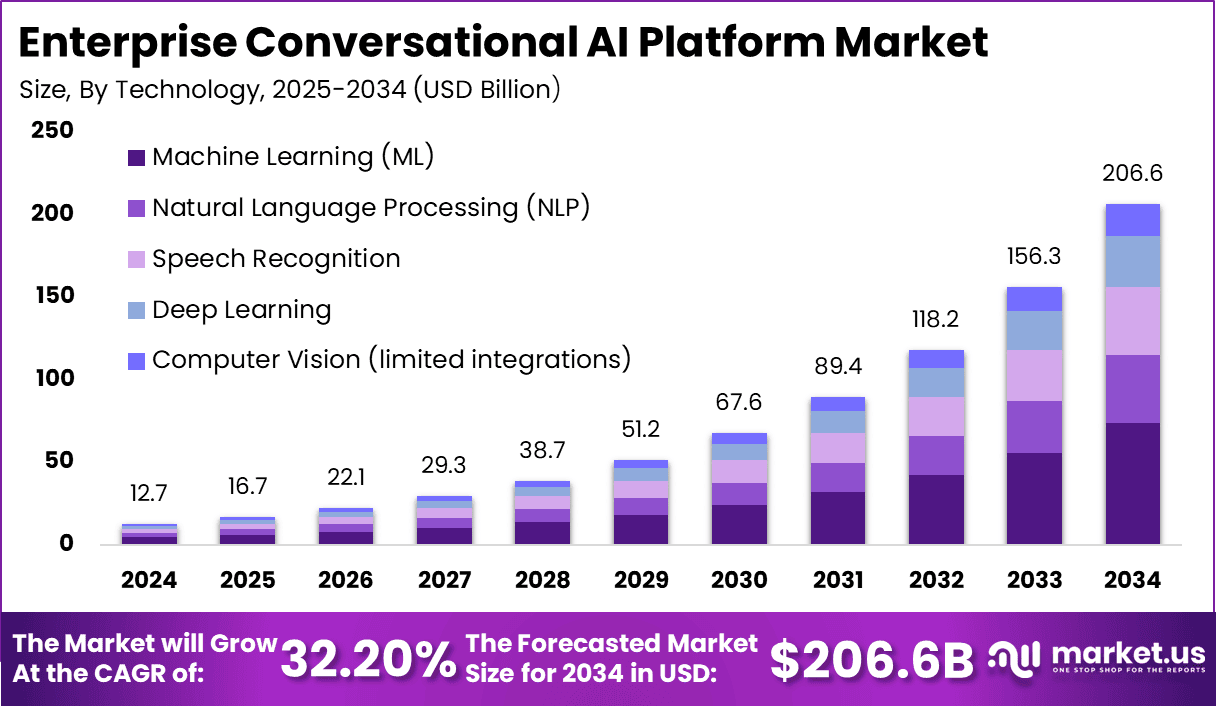
The global Enterprise Conversational AI Platform Market is valued at USD 12.67 billion in 2024 and is projected to reach USD 206.6 billion by 2034, expanding at a CAGR of 32.2%. North America holds a leading share of 33.8%, valued at USD 4.28 billion, while the US market alone stands at USD 3.68 billion in 2024 and is expected to reach USD 43.45 billion by 2034.
Solutions or platforms dominate with 67.7%, and on-premises deployment leads at 70.2%. Machine learning accounts for 35.6%, while customer support applications contribute 40.4%. BFSI leads end use with 30.2%, and text-based interactions hold 48.5%, reflecting strong enterprise demand.
How Growth is Impacting the Economy
The rapid expansion of enterprise conversational AI platforms is reshaping economic structures by enhancing productivity and reducing operational inefficiencies. Businesses are increasingly automating customer interactions, which is optimizing workforce utilization and lowering service delivery costs. This shift is allowing organizations to reallocate resources toward innovation and strategic initiatives rather than routine support functions.
At a macro level, the market growth is contributing to increased investments in digital infrastructure, cloud ecosystems, and AI research. Governments and enterprises are supporting AI adoption through funding and policy frameworks, which are strengthening the digital economy. The demand for skilled professionals in AI, data science, and natural language processing is also rising, leading to job transformation rather than displacement.
Additionally, conversational AI is improving customer accessibility and service availability across industries, which is supporting economic inclusivity. Small and medium enterprises are benefiting from scalable AI tools, enabling them to compete with larger firms. Overall, the market is expected to drive efficiency-led economic growth while fostering technological advancement across sectors.
Impact on Global Businesses
Global businesses are experiencing a transition in cost structures due to the adoption of conversational AI platforms. While initial implementation costs, integration complexities, and data management investments are rising, long-term operational expenses are declining due to automation and reduced dependency on human support teams.
Supply chains are also evolving as companies integrate AI into customer communication, order processing, and logistics coordination. Real-time conversational interfaces are improving demand forecasting and inventory management, which is reducing delays and enhancing transparency.
Sector-specific impacts are prominent across industries. In BFSI, conversational AI is strengthening fraud detection and customer engagement. In retail, it is enhancing personalized shopping experiences and order tracking. Healthcare providers are using AI assistants for patient interaction and appointment management. Telecom companies are leveraging AI to handle high-volume customer queries efficiently. These transformations are expected to redefine competitive dynamics across global markets.
Strategies for Businesses
Businesses are prioritizing AI integration with existing systems to ensure seamless deployment and scalability. Organizations are focusing on data security frameworks to address privacy concerns associated with conversational AI. Continuous model training and optimization are becoming essential to improve accuracy and contextual understanding.
Enterprises are also investing in omnichannel communication strategies, enabling consistent customer experiences across platforms such as web, mobile, and messaging applications. Partnerships with AI technology providers and cloud platforms are helping accelerate adoption. Additionally, companies are emphasizing user experience design to ensure natural and intuitive interactions.
Key Takeaways
- Rapid market expansion driven by enterprise automation demand
- Strong dominance of the solutions or platforms segment due to integrated capabilities
- On-premises deployment preferred for security and compliance needs
- Machine learning remains a core technology enabling adaptive interactions
- BFSI sector leads due to the high demand for secure and efficient customer engagement
- Text-based communication dominates due to ease of integration and scalability
Analyst Viewpoint
The present market reflects strong enterprise alignment toward automation and intelligent communication systems. Organizations are increasingly recognizing conversational AI as a strategic asset rather than a support tool. This shift is strengthening investment flows and accelerating adoption across industries.
Looking ahead, the market is anticipated to witness deeper integration with advanced technologies such as generative AI, voice recognition, and predictive analytics. Enterprises are expected to focus on hyper-personalized interactions and real time decision making capabilities. As AI models become more sophisticated, conversational platforms are likely to evolve into comprehensive business intelligence interfaces. The future outlook remains highly positive, supported by continuous innovation and expanding enterprise use cases.
Use Case and Growth Factors
| Use Case | Growth Factor |
|---|---|
| Customer Support Automation | Rising demand for 24 by 7 service and cost reduction |
| Virtual Assistants in BFSI | Increased focus on fraud prevention and digital banking |
| Healthcare Interaction Systems | Need for efficient patient engagement and scheduling |
| Retail Chatbots | Growth in personalized shopping and e-commerce adoption |
| IT Helpdesk Automation | Demand for faster issue resolution and productivity improvement |
Regional Analysis
North America dominates the market with a 33.8% share, driven by early adoption of AI technologies and strong digital infrastructure. The US leads regional growth due to high enterprise investment in AI-driven customer engagement solutions and innovation in machine learning applications.
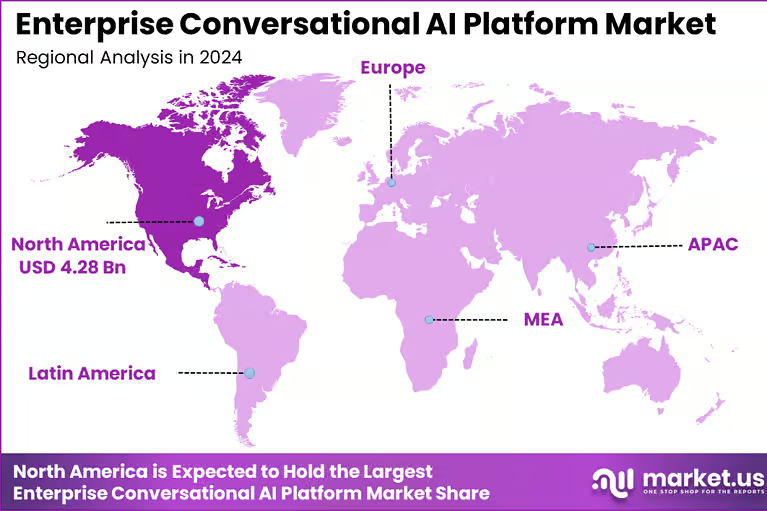
Europe is expected to witness steady growth supported by regulatory compliance requirements and increasing enterprise digitization. Asia Pacific is emerging as a high growth region due to expanding digital economies, rising adoption of cloud technologies, and increasing demand for automation in customer service. Countries such as India and China are contributing significantly due to large consumer bases and rapid technological advancements. Overall, regional growth patterns reflect varying levels of AI maturity and enterprise readiness.
Business Opportunities
The market presents significant opportunities for businesses focusing on AI-driven communication platforms. Enterprises can leverage conversational AI to enhance customer experience, reduce operational costs, and improve decision-making processes. There is strong potential in developing industry-specific AI solutions tailored to sectors such as healthcare, finance, and retail.
Opportunities also exist in integrating conversational AI with emerging technologies such as IoT and analytics platforms. Companies can explore multilingual and voice-enabled AI systems to expand their reach in global markets. Additionally, small and medium enterprises are increasingly adopting cost effective AI tools, creating a new growth avenue. Continuous innovation and customization are expected to unlock long term business value.
Key Segmentation
The market is segmented by component, deployment mode, technology, application, end use industry, and interaction type. By component, solutions or platforms dominate due to their comprehensive capabilities in managing AI interactions. By deployment mode, on-premises leads as enterprises prioritize data security and regulatory compliance.
In terms of technology, machine learning holds the largest share as it enables adaptive and context aware responses. By application, customer support and service automation leads due to increasing demand for efficient communication systems. BFSI dominates end use industry as financial institutions adopt AI for customer engagement and fraud prevention. By interaction type, text based communication leads due to widespread usage across digital platforms.
Key Player Analysis
Market participants are focusing on enhancing platform capabilities through continuous innovation in natural language processing and machine learning. Companies are investing in research and development to improve conversational accuracy and scalability. Strategic collaborations with cloud providers and technology firms are helping expand service offerings and global reach.
Top Key Players in the Market
- Microsoft
- Amazon Web Services
- IBM Watson Assistant
- Rasa
- LivePerson
- Genesys
- Twilio
- Cognigy
- Kore.ai
- Ada (Ada Support)
- Yellow.ai
- ServiceNow (Virtual Agent)
- Nuance
- Inbenta
- Recent De
- Others
Players are also emphasizing customization and industry specific solutions to cater to diverse enterprise needs. Integration with existing enterprise systems and ensuring data security compliance are key focus areas. Competitive differentiation is driven by user experience, platform flexibility, and ability to deliver real time insights.
Recent Developments
- Expansion of AI driven customer service platforms across enterprise sectors
- Increased investment in machine learning and natural language processing technologies
- Integration of conversational AI with cloud and analytics platforms
- Rising adoption of omnichannel communication solutions
- Development of advanced AI models for personalized user interactions
Conclusion
The Enterprise Conversational AI Platform Market is experiencing strong growth driven by automation and digital transformation. Increasing enterprise adoption and technological advancements are expected to sustain momentum. The market outlook remains positive with expanding applications and continuous innovation shaping future opportunities.
Discuss your needs with our analyst
Please share your requirements with more details so our analyst can check if they can solve your problem(s)