Introduction
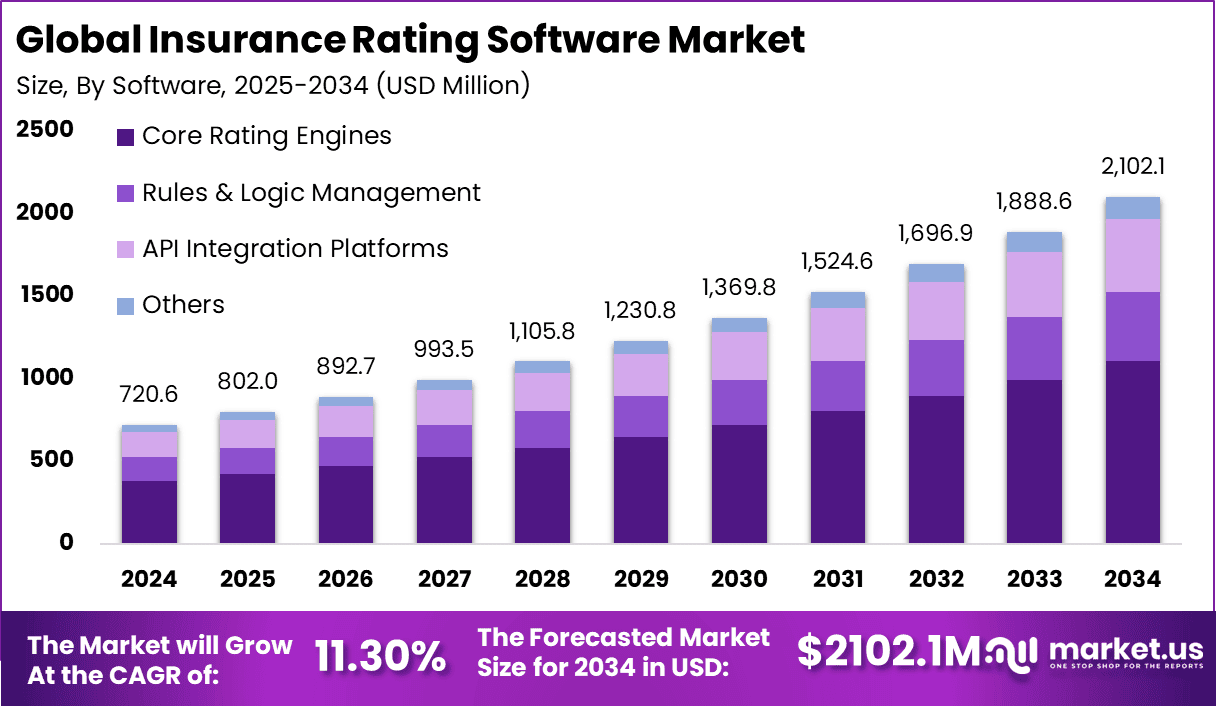
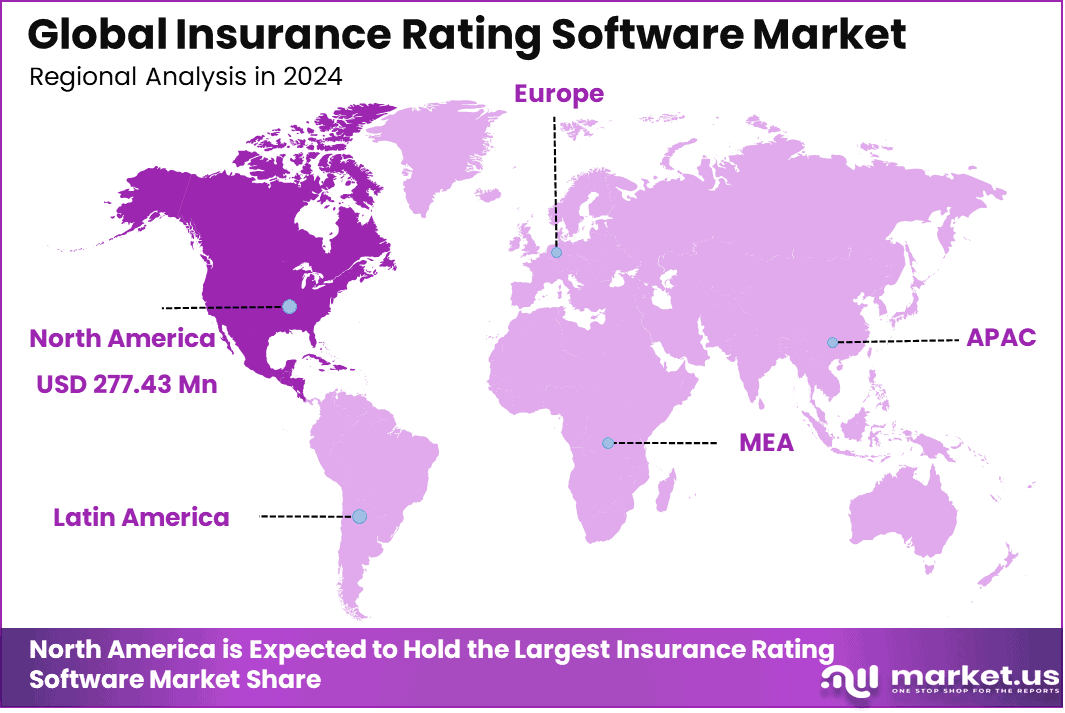
The Global Insurance Rating Software Market generated USD 720.6 million in 2024 and is predicted to register growth from USD 802.0 million in 2025 to about USD 2,102.1 million by 2034, recording a CAGR of 11.30% throughout the forecast span. In 2024, North America held a dominan market position, capturing more than a 38.5% share, holding USD 277.43 Million revenue.
Insurance rating software is used by insurers to calculate premiums based on risk factors, policy rules, and customer data. It helps standardize pricing across different products such as life, health, and property insurance while ensuring consistency and accuracy in underwriting decisions.
As insurance products become more complex, companies are relying on software solutions to manage rating logic, update pricing models, and respond quickly to market changes. These systems also support regulatory compliance by maintaining clear records of how premiums are calculated.
One of the main driving factors is the increasing need for accurate and flexible pricing in a competitive insurance environment. Insurers are handling large volumes of customer data and require tools that can process this information efficiently to generate precise premiums.
In addition, changing customer expectations are pushing companies to offer more personalized policies, which requires dynamic pricing models. Regulatory requirements are also encouraging the adoption of structured systems that can ensure transparency and consistency in pricing. The shift toward digital transformation in the insurance sector is further supporting the use of advanced rating solutions.
Demand for insurance rating software is rising as companies look for ways to improve efficiency and reduce manual errors in pricing processes. There is a strong preference for solutions that can integrate with policy administration and claims systems, allowing smooth data flow across operations.
Insurers are also seeking software that can support quick updates to pricing rules and adapt to changing market conditions. The demand is particularly strong among organizations that handle diverse insurance products and need scalable solutions. As the insurance industry continues to modernize, the need for reliable and adaptable rating software is expected to grow steadily.
Top Key Market Segment
- Core rating engines command 52.7%, automating premium calculations, risk assessments, and rule-based pricing across personal, commercial, and specialty lines.
- Cloud-based deployment dominates at 81.6%, enabling scalable processing, multi-channel quoting, and seamless integration with policy administration systems.
- Insurance carriers hold 48.2% end-user share, leveraging platforms for regulatory compliance, competitive quoting, and data-driven profitability optimization.
- North America drives 38.5% global value, with U.S. market at USD 249.7 million and 10.14% CAGR, fueled by insurtech adoption and complex product innovation.
How AI is Reshaping the Future of this market?
Artificial intelligence is changing how insurance rating software calculates pricing and risk. Traditional rating models rely on fixed rules and historical data, but AI enables dynamic pricing by analyzing real time data such as customer behavior, location patterns, and external risk factors.
This allows insurers to create more accurate and personalized premium structures. Machine learning models can continuously learn from new data, helping insurers adjust pricing strategies quickly as risk conditions change. This improves underwriting accuracy and reduces the chances of underpricing or overpricing policies.
AI is also improving automation and decision making within insurance rating platforms. Intelligent systems can process large volumes of data from multiple sources, including claims history, telematics, and third party databases, to generate instant quotes. This speeds up policy issuance and enhances customer experience.
In addition, AI helps detect anomalies and potential fraud during the rating process, which supports better risk control. As insurers focus on digital transformation, AI-driven rating software is expected to become more adaptive, scalable, and capable of supporting usage based and on demand insurance models.
Regional Analysis
In 2024, North America held a dominant market position, capturing more than a 38.56% share, holding USD 277.43 Million revenue. This leadership is mainly supported by the region’s mature insurance industry and early adoption of advanced digital technologies. Insurance providers across the US and Canada have been actively upgrading their core systems to improve pricing accuracy, underwriting efficiency, and regulatory compliance.
The strong presence of large insurers and technology vendors has created a favorable environment for the adoption of insurance rating software, especially as companies focus on real-time data processing and personalized policy pricing.
Another major factor behind North America’s dominance is the increasing focus on data-driven decision making and regulatory alignment. Insurers in the region are investing in modern rating engines that can handle complex risk models, integrate with third-party data sources, and support dynamic pricing strategies. In addition, the growing demand for usage-based insurance and digital policy management has accelerated the need for flexible and scalable software solutions. The region also benefits from high IT spending and a well-established cloud infrastructure, which supports faster deployment and continuous upgrades of rating platforms.
Europe is expected to witness steady growth, driven by strict regulatory frameworks and the need for standardized pricing models across multiple markets. Insurers in the region are focusing on system modernization to meet compliance requirements and improve operational efficiency. The shift toward digital insurance platforms and increasing adoption of automation in underwriting processes are anticipated to support market expansion.
Latin America is projected to experience gradual growth, supported by ongoing digital transformation in the insurance sector and rising awareness of advanced risk assessment tools. Meanwhile, the Middle East and Africa region is anticipated to show moderate growth, driven by expanding insurance penetration and increasing investments in digital infrastructure.
Although these regions are still developing in terms of technology adoption, improving economic conditions and regulatory advancements are expected to create opportunities for insurance rating software providers over the coming years.
Key Market Segment
By Software
- Core Rating Engines
- Rules & Logic Management
- API Integration Platforms
- Others
By Deployment
- Cloud-based
- On-premise
By End-User
- Insurance Carriers
- Managing General Agents (MGAs)
- Insurance Agencies & Brokers
- Third-Party Administrators (TPAs)
Competetive Analysis
The competitive landscape of the Insurance Rating Software Market includes a mix of established insurance technology providers and large enterprise software companies. Companies such as Guidewire, Duck Creek Technologies, Majesco, Sapiens, Insurity, and OneShield focus on core insurance platforms that include rating, policy administration, and underwriting capabilities.
These players provide flexible and configurable solutions that help insurers manage pricing, product changes, and regulatory requirements. Their strong focus on cloud-based systems and digital transformation supports their leading position in the market.
At the same time, companies such as Oracle, SAP, Salesforce, Vertafore, Applied Systems, EIS Group, EIS Ltd, BriteCore, and Cogitate offer rating solutions integrated with broader enterprise and customer management platforms.
These players emphasize scalability, data analytics, and ease of integration with existing insurance systems. Competition in this market is driven by the need for real-time pricing, improved accuracy, and the ability to quickly adapt to changing market conditions and customer demands.
Top Key Players
- Guidewire
- Duck Creek Technologies
- Oracle
- SAP
- Salesforce
- Vertafore
- Applied Systems
- EIS Group
- EIS Ltd
- Sapiens
- Majesco
- BriteCore
- Insurity
- OneShield
- Cogitate
- Others
Recent Development
- March, 2026 – Guidewire RatingConnect adds AI-driven usage-based insurance for 100+ connected car APIs. Instant commercial lines quoting cuts bind time 75% while PolicyCenter integrates ISO rating tables seamlessly. P&C market leader.
- February, 2026 – Duck Creek RatingRx uses ML to predict claim likelihood boosting accuracy 18%. SaaS rating engine processes 1M quotes/hour while Duck Creek Engage personalizes via customer data. Cloud insurtech specialist.
Conclusion
The insurance rating software market is expected to grow steadily as insurers continue to shift toward digital platforms and automated processes. The need for accurate pricing, faster policy generation, and improved customer experience is pushing companies to adopt advanced rating systems. These solutions help insurers manage complex pricing rules, reduce manual errors, and respond quickly to changing market conditions.
At the same time, the market is evolving with the integration of data analytics and cloud-based systems, allowing better flexibility and scalability. While some challenges remain around system integration and data security, the overall outlook stays positive as insurance providers focus on modernization and efficiency. The market is anticipated to expand gradually, supported by ongoing digital transformation across the insurance industry.
Discuss your needs with our analyst
Please share your requirements with more details so our analyst can check if they can solve your problem(s)