Introduction
The Global Subsea Navigation and Tracking Market generated USD 4.2 billion in 2024 and is predicted to register growth from USD 4.6 billion in 2025 to about USD 10.9 billion by 2034, recording a CAGR of 10% throughout the forecast span. In 2024, North America held a dominant market position, capturing more than a 36.8% share, holding USD 1.54 Billion revenue.
Subsea navigation and tracking systems are used to guide and monitor underwater vehicles, equipment, and operations where traditional positioning methods are not effective. These systems rely on acoustic signals, sensors, and mapping technologies to determine location and movement beneath the ocean surface.
They are widely used in offshore energy exploration, marine research, defense operations, and subsea infrastructure inspection. As underwater activities become more complex and deeper, accurate navigation and tracking are becoming essential for safety, efficiency, and operational control.
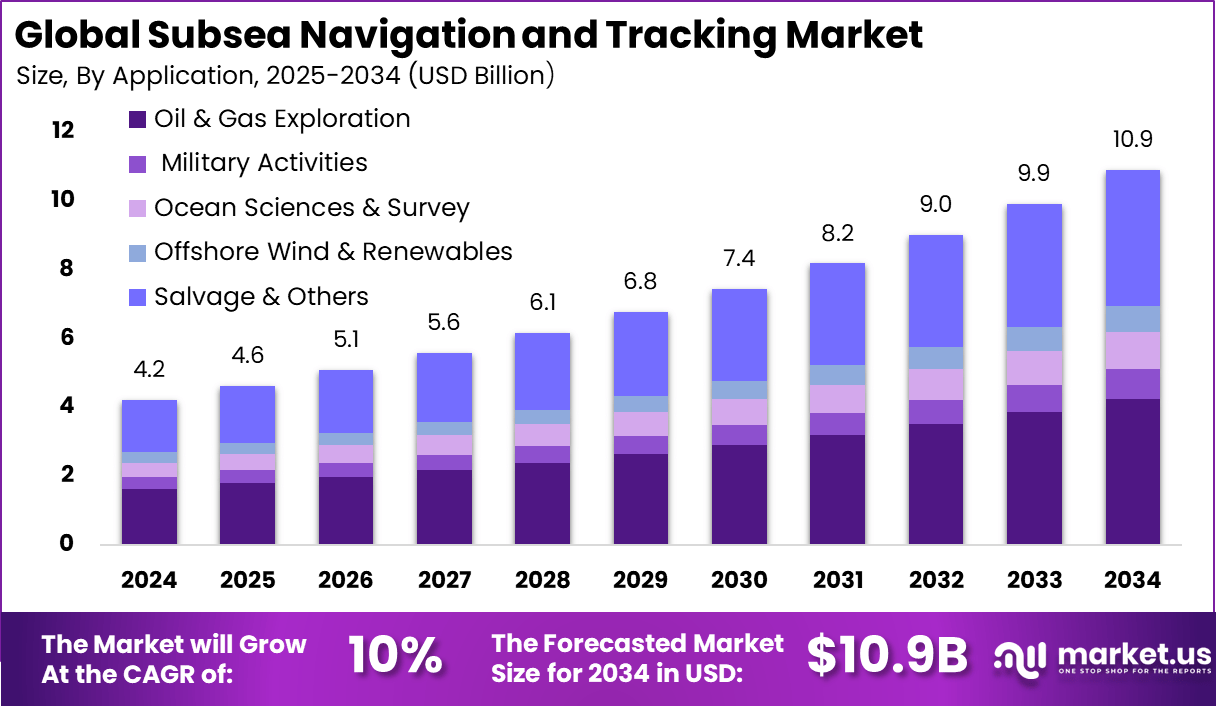
One of the main driving factors is the increasing level of offshore exploration and underwater infrastructure development. Industries are operating in deeper waters and more challenging environments, which requires reliable systems to track assets and ensure precise positioning.
In addition, the growing use of autonomous underwater vehicles is creating a need for advanced navigation solutions that can operate without continuous human control. The focus on reducing operational risks and improving data accuracy is also encouraging the adoption of these technologies. Advancements in sensor technology and underwater communication are further supporting their development and use.
Demand for subsea navigation and tracking solutions is rising as organizations seek better visibility and control over underwater operations. There is a strong preference for systems that can provide accurate positioning in real time and operate effectively in difficult conditions such as low visibility and high pressure.
Companies are also looking for solutions that can integrate with other subsea equipment and data systems to improve overall efficiency. The demand is particularly strong in sectors that require continuous monitoring and precise movement control. As underwater exploration and operations continue to expand, the need for reliable and efficient navigation and tracking systems is expected to grow steadily.
Top Key Market Segment
- Acoustic systems command 62.7%, delivering underwater positioning via USBL/LBL/SBL technologies for precise tracking in GPS-denied environments and multipath interference.
- Oil & gas exploration captures 38.9% application share, enabling pipeline inspection, wellhead monitoring, and seabed mapping with long-range signal propagation.
- ROVs hold 43.9% by platform, integrating inertial aids and Doppler velocity logs for station-keeping, intervention tasks, and tether management.
- North America drives 36.8% global value, with U.S. market at USD 0.84 billion and 17.2% CAGR, fueled by Gulf of Mexico projects and defense subsea operations.
How AI is Reshaping the Future of this market?
Subsea navigation systems are essential because satellite based positioning does not work underwater. These systems rely on acoustic positioning, inertial navigation, and velocity measurement technologies to determine location and movement. As offshore projects move into deeper waters, the need for precise and reliable navigation is becoming more critical for safe and efficient operations.
The market is strongly driven by offshore oil and gas exploration. As companies focus on deepwater reserves, accurate tracking is required for drilling, pipeline installation, and subsea infrastructure monitoring. This is increasing the adoption of advanced navigation systems that can operate effectively in harsh underwater conditions.
Another key growth area is the rising use of autonomous underwater vehicles and remotely operated vehicles. These platforms are widely used for inspection, mapping, and surveillance tasks, and they depend on accurate navigation systems to perform efficiently. Their growing deployment across commercial and defense sectors is supporting market expansion.
Technological advancements are improving system capabilities. Integration of AI, sensor fusion, and real time data processing is enhancing navigation accuracy and enabling more autonomous operations. Modern systems are becoming more compact, energy efficient, and capable of functioning in complex environments.
The market is also benefiting from the expansion of offshore renewable energy projects such as wind farms and subsea cable installations. These projects require continuous monitoring and precise positioning for maintenance activities, creating additional demand for subsea tracking solutions.
However, high costs and technical complexity remain key challenges. Deployment and maintenance of advanced subsea navigation systems require significant investment and expertise, which can limit adoption in some regions.
Overall, the subsea navigation and tracking market is moving toward intelligent and autonomous solutions. As underwater operations continue to grow, the demand for accurate, reliable, and efficient navigation systems is expected to increase across multiple industries.
Regional Analysis
In 2025, North America held a dominant market position, capturing more than a 36.8% share, holding USD 1.54 Billion revenue. This dominance is mainly supported by strong offshore oil and gas activities in the US and the Gulf of Mexico, where subsea navigation and tracking systems play a critical role in deep-water exploration and production.
The region has a mature offshore ecosystem with advanced vessels, subsea equipment, and skilled workforce, which increases the adoption of high-precision positioning and tracking technologies. Continuous investment in underwater infrastructure, including pipelines and subsea installations, further strengthens the demand for reliable navigation systems.
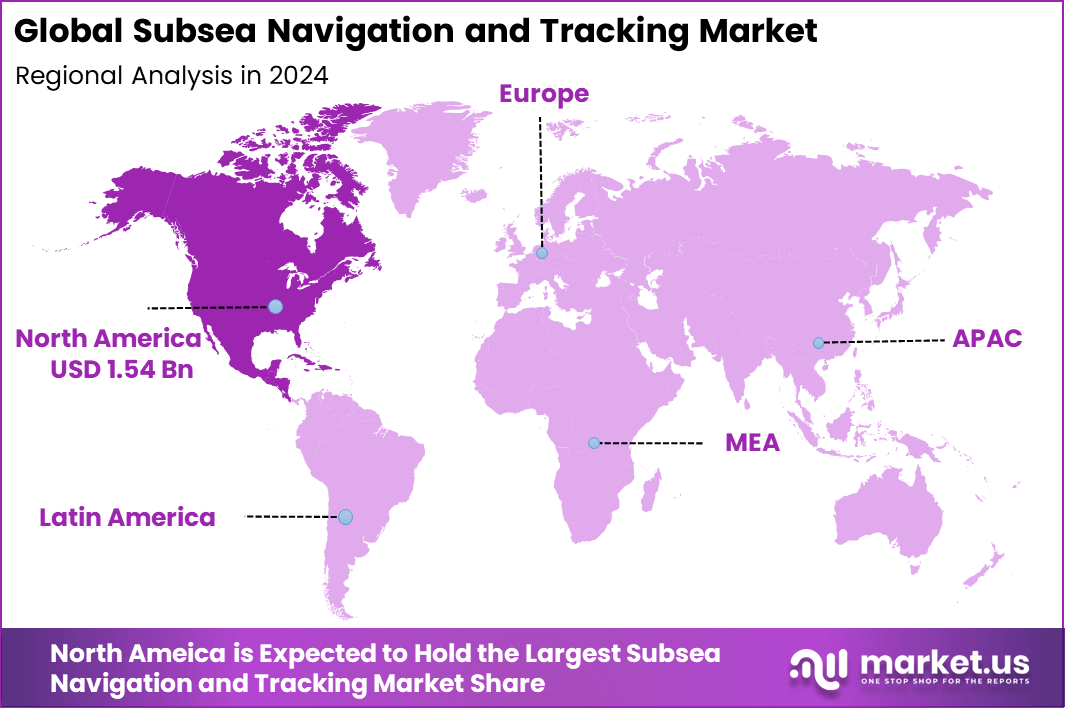
Another important reason behind North America’s leadership is its strong defense and naval capabilities. The region focuses heavily on maritime security, underwater surveillance, and naval modernization, which require accurate tracking and navigation solutions. The use of advanced technologies such as autonomous underwater vehicles and remotely operated systems is more widespread here compared to other regions. This early adoption of advanced systems enhances operational efficiency and supports complex underwater missions, reinforcing the region’s leading position in the market.
Europe follows as a significant region due to its strong focus on offshore renewable energy and subsea engineering expertise. Countries such as the UK and Norway are actively investing in offshore wind projects and oil field developments, which require advanced subsea tracking systems for installation and maintenance. The region also shows steady demand from marine research and environmental monitoring activities, contributing to market growth.
Latin America is gradually expanding in this market, driven by offshore exploration activities, especially in Brazil’s deep-water reserves. The region is improving its subsea capabilities, although growth remains moderate due to limited technological infrastructure and investment challenges compared to developed regions.
The Middle East and Africa region is also showing emerging potential, supported by offshore oil projects and increasing focus on subsea pipeline monitoring. While the region is still developing in terms of advanced technology adoption, growing energy demand and investments in offshore assets are expected to support future market expansion.
Driver
Growing offshore exploration and production activities are a key factor supporting the subsea navigation and tracking market. Energy companies are moving into deeper and more complex underwater environments where accurate positioning and navigation are critical. This is increasing the demand for reliable tracking systems that can operate in harsh subsea conditions.
Another important factor is the rising use of underwater vehicles such as remotely operated vehicles and autonomous underwater vehicles. These systems require precise navigation to perform inspection, maintenance, and survey tasks. As underwater operations become more advanced, the need for accurate tracking solutions continues to increase.
Restraint
High installation and maintenance costs remain a major barrier for adoption. Subsea systems require specialized equipment that can withstand pressure, corrosion, and long term exposure to harsh environments. This makes the overall cost of deployment and upkeep significantly high, limiting adoption among smaller operators.
Another limitation is the complexity of subsea communication systems. Unlike surface environments, underwater communication relies on acoustic signals, which can be slow and less reliable. This affects real time data transfer and reduces the efficiency of navigation and tracking systems.
Opportunity
The expansion of offshore renewable energy projects is creating new opportunities in the market. Activities such as underwater inspection, cable installation, and maintenance of wind farms require precise navigation and tracking systems. As investments in renewable energy increase, the demand for subsea technologies is expected to grow.
Another opportunity lies in marine research and environmental monitoring. Governments and research organizations are focusing on ocean mapping, biodiversity tracking, and climate studies. These activities require accurate positioning and data collection, creating a strong need for advanced subsea navigation solutions.
Challenge
Operating in extreme underwater conditions presents a major challenge for system performance. Factors such as high pressure, low visibility, and strong currents can affect the accuracy and reliability of navigation systems. Ensuring consistent performance in such conditions remains difficult for technology providers.
Another challenge is the limited availability of skilled professionals. Subsea navigation systems require specialized knowledge for installation, calibration, and operation. The shortage of trained personnel can slow down deployment and increase operational risks, especially in complex offshore projects.
Key Market Segment
By System Type
- Acoustic Systems
- USBL (Ultra-Short Baseline)
- LBL (Long Baseline)
- SBL (Short Baseline)
- Inertial Navigation Systems
- FOG (Fiber Optic Gyroscope)
- MEMS (Micro-Electro-Mechanical Systems)
- Ring Laser
- Strapdown INS
- Hybrid INS/Acoustic
By Application
- Oil & Gas Exploration
- Military Activities
- Ocean Sciences & Survey
- Offshore Wind & Renewables
- Salvage & Others
By Platform
- ROVs (Remotely Operated Vehicles)
- AUVs (Autonomous Underwater Vehicles)
- Seabed Networks & Surface/Support Vessels
Competetive Analysis
The competitive landscape of the Subsea Navigation and Tracking Market is led by a group of established marine technology and defense companies. Companies such as Kongsberg Gruppen, Teledyne Technologies, Sonardyne International, Exail (iXblue), and L3Harris Technologies (Nautronix) focus on advanced underwater navigation systems, acoustic positioning, and tracking solutions.
These players provide high-precision equipment used in offshore oil and gas, defense, and marine research operations. Their strong expertise in sonar technology, underwater communication, and system integration helps them maintain a leading position in the market.
At the same time, companies such as EdgeTech, EvoLogics, Ultra Maritime, Saab Seaeye Ltd., and Fugro N.V. compete by offering specialized solutions for subsea inspection, mapping, and autonomous underwater vehicles.
These players focus on improving real-time data transmission, reliability in deep-water environments, and ease of deployment. Competition in this market is driven by technological advancements in acoustic tracking, demand for accurate underwater positioning, and the need for efficient operations in complex marine environments.
Top Key Players
- Kongsberg Gruppen
- Teledyne Technologies
- Sonardyne International
- Exail (iXblue)
- EdgeTech
- EvoLogics
- L3Harris Tech nologies (Nautronix)
- Ultra Maritime
- Saab Seaeye Ltd.
- Fugro N.V.
- Others
Recent Development
- March, 2026 – Kongsberg Discovery signs framework deal with Fugro supplying cNODE USV transponders across global fleet. HiPAP USBL tracks AUVs at 4500m while cSound positioning supports uncrewed survey cutting emissions 95%. Norwegian hydroacoustics leader.
- February, 2026 – Teledyne Marine debuts SeaBat T51-R dual-head multibeam with integrated Compact Navigator at Oceanology International. SeaBat F50 forward-looking sonar detects UUV threats in busy harbors while live demos prove USV autonomy. US underwater tech giant.
Conclusion
The subsea navigation and tracking market is expected to grow steadily as offshore activities continue to expand in areas such as oil and gas exploration, marine research, and underwater infrastructure development.
The increasing need for accurate positioning and reliable communication in deep-water environments is supporting the adoption of advanced navigation systems. Technologies such as acoustic positioning, inertial navigation, and autonomous underwater vehicles are becoming more important for safe and efficient operations.
At the same time, rising focus on offshore renewable energy projects and ocean monitoring is further supporting market growth. Improvements in sensor technology, data processing, and system integration are helping to enhance performance and reliability in challenging underwater conditions.
However, high costs and technical complexity may still limit adoption for smaller operators. Overall, the market is expected to expand as demand for precise and dependable subsea operations continues to increase.