Introduction
The Global Partyline Intercom Systems Market generated USD 2.02 billion in 2024 and is predicted to register growth from USD 2.34 billion in 2025 to about USD 8.68 billion by 2034, recording a CAGR of 15.70% throughout the forecast span. In 2024, North America held a dominan market position, capturing more than a 38.6% share, holding USD 0.77 Billion revenue.
Partyline intercom systems are communication solutions that allow multiple users to share the same audio channel for instant group coordination. These systems are widely used in live events, broadcast production, theaters, industrial sites, transportation hubs, and security operations where fast team communication is essential. Users can speak and listen through headsets or belt packs connected to a common line, making coordination simple and reliable. Despite the growth of digital communication tools, partyline systems remain important because they are dependable, easy to operate, and effective in demanding environments.
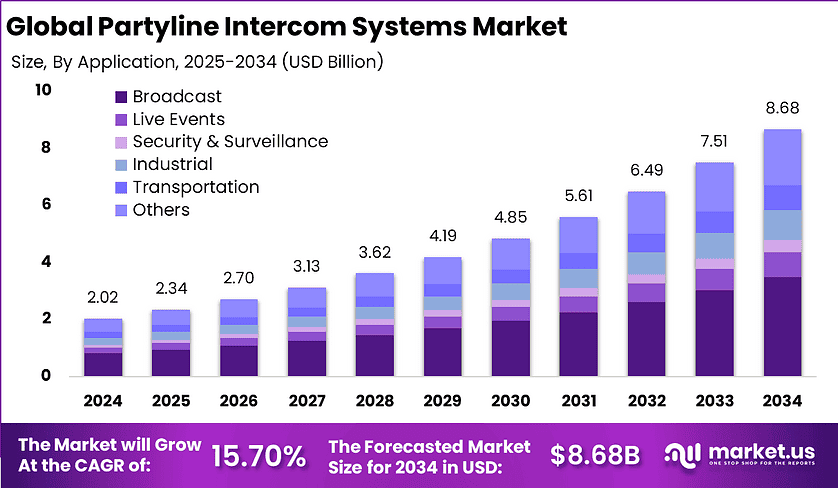
One of the main driving factors is the continuing need for real time team coordination in mission critical operations. Live production crews, stage managers, technicians, and safety teams rely on immediate voice communication to manage timing and respond quickly to changing conditions.
In addition, many organizations prefer systems that are straightforward to deploy and require minimal training. Partyline intercoms are also valued for their durability and stable performance in noisy or high pressure environments. The expansion of live entertainment, sports broadcasting, and industrial maintenance activities is further supporting demand for proven communication systems.
Demand for partyline intercom systems is rising as users seek cost effective and reliable group communication tools. There is a strong preference for systems that offer clear audio quality, rugged hardware, and compatibility with existing communication infrastructure. Buyers are also looking for solutions that can scale from small teams to larger operations and integrate with digital or wireless intercom networks when needed.
The demand is particularly strong among event venues, broadcasters, factories, transportation operators, and emergency response teams where uninterrupted communication is critical. As operational efficiency and coordination remain priorities, the need for dependable partyline intercom solutions is expected to grow steadily.
How AI is Reshaping the Future of this market?
AI is reshaping the Partyline Intercom Systems Market by making communication systems more intelligent, clear, and responsive in critical operating environments. Traditional partyline intercoms are mainly used for shared voice communication across production teams, control rooms, industrial sites, broadcast studios, live events, transportation hubs, and emergency operations. With AI, these systems are moving beyond basic voice exchange toward smarter coordination tools that can filter noise, improve speech clarity, and help users respond faster in busy or high-pressure settings.
One of the strongest impacts of AI is voice enhancement. Partyline intercom systems are often used in loud environments where background noise, overlapping speech, and signal disturbance can reduce communication quality. AI-based noise suppression, echo control, and voice isolation can help teams hear instructions more clearly. This is especially useful in live event production, factory floors, defense operations, rail networks, and broadcast environments where missed communication can affect safety, timing, and workflow accuracy.
AI is also improving operational control through speech recognition and automated alerts. Future intercom systems can support voice commands, keyword detection, and intelligent routing of messages to the right team or operator. For example, if a safety issue or urgent command is detected, the system can prioritize that communication and reduce delays. This makes partyline intercom platforms more valuable for mission-critical operations where speed, clarity, and coordination are essential.
AI is expected to increase demand for advanced partyline intercom systems as users look for better reliability, remote access, and smarter monitoring. Predictive maintenance features can detect equipment issues before failure, while usage analytics can help organizations understand communication load, channel activity, and system performance. As industries continue to modernize communication infrastructure, AI is expected to make partyline intercom systems more adaptive, efficient, and suitable for complex real-time operations.
Regional Analysis
In 2024, North America held a dominant Market position, capturing more than a 38.6% share, holding USD 0.77 Billion revenue. North America is leading the Partyline Intercom Systems Market due to strong use of reliable group communication systems across broadcast production, live events, industrial plants, transportation, defense, and public safety operations.
The region has a mature base of studios, event venues, command centers, manufacturing facilities, and mission-critical workplaces where clear, instant, and low-latency communication is essential. Partyline intercom systems remain important because they allow multiple users to communicate on a shared channel with simple operation, fast coordination, and dependable performance in demanding work environments.
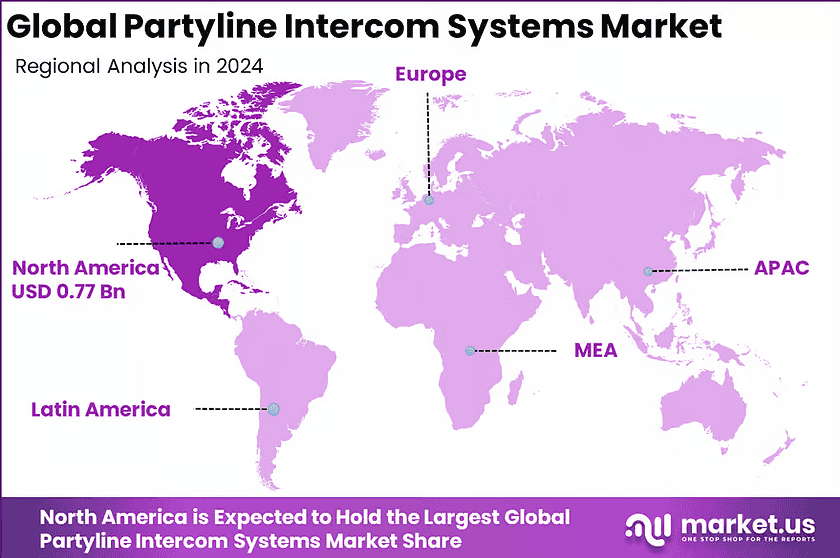
The region’s leadership is also supported by higher spending on professional audio communication infrastructure, strong replacement demand from aging wired systems, and wider adoption of hybrid communication setups that combine analog, digital, wired, and wireless intercom functions.
North American users often prioritize system reliability, audio clarity, rugged hardware, and easy integration with existing control rooms, production workflows, and facility communication networks. This has created steady demand from broadcasters, event production companies, theaters, security teams, emergency response units, and industrial operators that need coordinated team communication without complex setup.
Europe is expected to show consistent demand due to its strong broadcasting, live entertainment, transport, and industrial automation base. Latin America is gradually adopting these systems as event production, media infrastructure, and public safety communication improve.
The Middle East and Africa are also gaining demand through infrastructure development, hospitality projects, aviation, and large-scale event venues. However, North America remains the leading region because it has a larger installed base, stronger professional communication spending, higher adoption of advanced intercom technologies, and broader use across both commercial and mission-critical applications.
Driver
Need for clear group communication in critical operations
Partyline intercom systems are gaining importance because many industrial, transport, broadcast, defense, and event operations need instant group communication. These systems allow several users to stay connected on the same communication line, which supports faster coordination during live, noisy, or time-sensitive work.
The main driver is the need for reliable voice communication where delays can affect safety and workflow. In control rooms, production floors, field teams, and command areas, users need simple and direct communication without depending fully on mobile networks or complex digital tools.
Restraint
High installation and maintenance complexity
The market faces restraint because partyline intercom systems often need proper cabling, interface planning, and site-level configuration. In older facilities, installation can become difficult due to limited infrastructure space and compatibility issues with existing communication systems.
Maintenance also adds pressure for users. Faults in wiring, connectors, headsets, or power supply can affect the whole communication chain. This makes some buyers cautious, especially when they need a system that must work continuously with limited downtime.
Opportunity
Modernization of communication infrastructure
A strong opportunity exists as many facilities are upgrading their internal communication systems for better reliability and control. Partyline intercom systems can benefit from this shift because they offer simple group calling, hands-free operation, and stable communication in demanding environments.
There is also growing demand for systems that can connect with digital audio networks, wireless devices, and control platforms. This creates room for more flexible intercom solutions that support both traditional wired use and modern hybrid communication needs.
Challenge
Competition from wireless and software-based systems
A key challenge is the rising use of wireless headsets, mobile radios, and software-based communication tools. These alternatives are often easier to deploy and may seem more flexible for temporary or fast-changing work environments.
The challenge for partyline intercom systems is to remain relevant by offering stronger reliability, lower latency, and better audio clarity. Vendors must also make systems easier to install and manage, while keeping the core benefit of stable group communication intact.
Key Market Segment
By Type
- Wired Partyline Intercom Systems
- Wireless Partyline Intercom Systems
By Component
- Hardware
- Software
- Services
By Application
- Broadcast
- Live Events
- Security & Surveillance
- Industrial
- Transportation
- Others
By End-User
- Media & Entertainment
- Corporate
- Government
- Education
- Others
By Distribution Channel
- Direct Sales
- Distributors/Resellers
- Online Stores
- Others
Competetive Analysis
The competitive landscape of the Partyline Intercom Systems Market is led by specialized communication equipment manufacturers and professional audio companies. Companies such as Clear-Com, RTS Intercom Systems, Riedel Communications, HME (HM Electronics), ASL Intercom, and Pliant Technologies focus on professional intercom solutions used in broadcasting, live events, sports production, and industrial communication.
These players emphasize clear audio quality, reliable connectivity, rugged equipment design, and easy system expansion. Their strong experience in mission-critical communication systems helps them maintain a leading position in the market.
At the same time, companies such as Bose Corporation, Audio-Technica, Beyerdynamic, Williams Sound, Altair, Green-GO, Eartec, Telex, Sonifex, Datavideo, Yamaha Corporation, Hollyland Technology, Vega Global, and Sennheiser Electronic compete by offering audio communication devices, wireless intercom systems, and integrated production communication solutions.
These players focus on portability, digital features, and cost-effective systems for smaller venues and growing production environments. Competition in this market is driven by sound clarity, wireless mobility, system compatibility, and the ability to support fast and reliable team communication.
Top Key Players
- Clear-Com
- RTS Intercom Systems
- Riedel Communications
- HME (HM Electronics)
- ASL Intercom
- Bose Corporation
- Audio-Technica
- Beyerdynamic
- Williams Sound
- Altair
- Green-GO
- Eartec
- Telex
- Sonifex
- Datavideo
- Yamaha Corporation
- Hollyland Technology
- Pliant Technologies
- Vega Global
- Sennheiser Electronic
- Others
Recent Development
- February 2025, RTS Intercom Systems – RTS expands its ODIN/OMNEO‑based partyline features so broadcast trucks and fixed studios can link multiple wired partyline channels over IP, improving flexibility for touring sports and entertainment productions.
- April 2025, Riedel Communications – Riedel adds more Artist/SmartPanel partyline workflows, allowing production teams to create software‑defined partyline groups on top of matrix and IP networks without extra hardware.
Conclusion
The Partyline Intercom Systems Market is expected to grow steadily as live events, broadcast studios, theatres, production houses, defense operations, and industrial sites continue to need clear and instant team communication. These systems help many users speak and coordinate on the same communication line, which improves workflow, safety, and response time during critical operations. Demand is also supported by the shift toward hybrid production setups, better audio quality, wireless connectivity, and durable communication equipment for field use.
However, high setup costs, signal interference, and compatibility issues with older systems may slow adoption in some areas. Overall, the market is expected to remain important for organizations that need reliable, real-time, and coordinated communication across teams.
Discuss your needs with our analyst
Please share your requirements with more details so our analyst can check if they can solve your problem(s)