Introduction
The Global Mixed Reality Capture Card Market generated USD 2.7 billion in 2024 and is predicted to register growth from USD 3.3 billion in 2025 to about USD 18.3 billion by 2034, recording a CAGR of 21.10% throughout the forecast span. In 2024, North America held a dominan market position, capturing more than a 37.4% share, holding USD 1.00 Billion revenue.
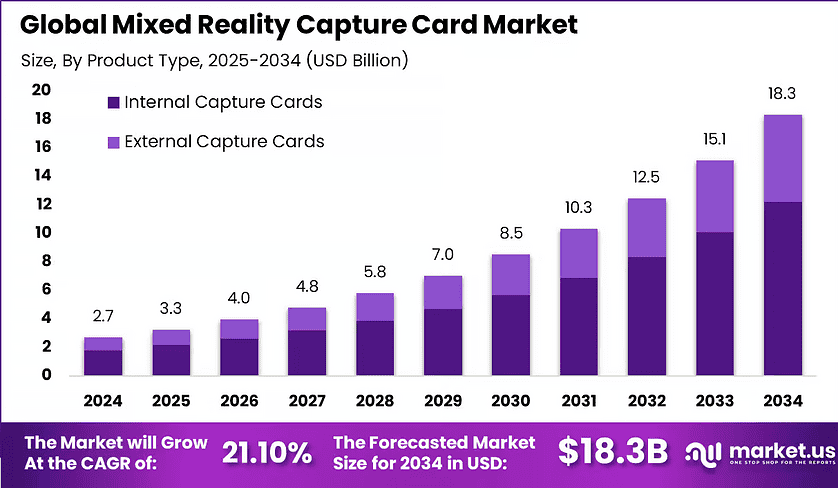
Mixed reality capture cards are hardware components used to record and process combined real world and virtual content for streaming, production, and development purposes. These devices capture video input from cameras and mixed reality systems, then merge or transmit the output with low delay for live or recorded use.
They are widely used in gaming, virtual production, training simulations, and content creation where immersive experiences need to be captured and shared. As mixed reality applications expand, capture cards are becoming an important part of the content pipeline.
One of the main driving factors is the growth of immersive content across gaming, entertainment, and enterprise training. Creators and developers are looking for tools that can capture both physical and virtual elements in a seamless way.
In addition, the rise of live streaming and interactive media is increasing the need for hardware that can handle high quality video capture with stable performance. The expansion of virtual production workflows in film and media is also supporting demand for reliable capture solutions. Improvements in video resolution, frame rates, and processing capability are further driving adoption.
Demand for mixed reality capture cards is rising as users seek efficient and dependable tools for content recording and streaming. There is a strong preference for devices that offer low latency performance, high resolution support, and compatibility with different cameras and mixed reality systems. Users are also looking for solutions that integrate easily with editing and broadcasting software.
The demand is particularly strong among content creators, game developers, production studios, and training organizations that rely on immersive media. As mixed reality continues to develop, the need for high performance capture solutions is expected to grow steadily.
How AI is Reshaping the Future of this market?
AI is reshaping the Mixed Reality Capture Card Market by making video capture smarter, faster, and more suitable for immersive content workflows. Mixed reality content often combines live camera feeds, virtual objects, gaming visuals, 3D environments, and real-time user interaction. AI helps capture cards handle these complex inputs more efficiently by improving scene detection, background separation, image correction, motion tracking, and real-time video enhancement. This allows creators, streamers, training teams, and studios to produce cleaner mixed reality output with less manual editing.
AI is also improving the role of capture cards in live streaming, virtual production, simulation, and enterprise training. Features such as noise reduction, auto framing, color correction, object recognition, and low-latency optimization are becoming more important as mixed reality content moves into education, healthcare, gaming, sports, defense training, and industrial design. Capture cards that can support AI-assisted encoding and better synchronization between physical and digital visuals are expected to gain stronger demand, especially where smooth performance and high visual quality are critical.
In the future, AI is expected to make mixed reality capture cards more than simple signal conversion devices. They are likely to become intelligent processing tools that help manage content quality, reduce production errors, and improve workflow speed. As mixed reality adoption grows across content creation, remote collaboration, training, and interactive entertainment, demand is expected to rise for capture cards that support high-resolution input, low latency, smart processing, and stable performance. Overall, AI is pushing the Mixed Reality Capture Card Market toward smarter, more automated, and more professional-grade capture solutions.
Regional Analysis
In 2024, North America held a dominant Market position, capturing more than a 37.4% share, holding USD 1 Billion revenue and why only North America leading is mainly due to the region’s strong base of gaming creators, esports production teams, immersive content studios, and enterprise training providers.
Mixed reality capture cards are gaining higher use in workflows where real-time video input, low-latency streaming, high-resolution recording, and device-to-platform compatibility are important. North America benefits from advanced creator infrastructure, strong adoption of AR and VR devices, and faster use of mixed reality in gaming, education, healthcare simulation, defense training, and live media production.
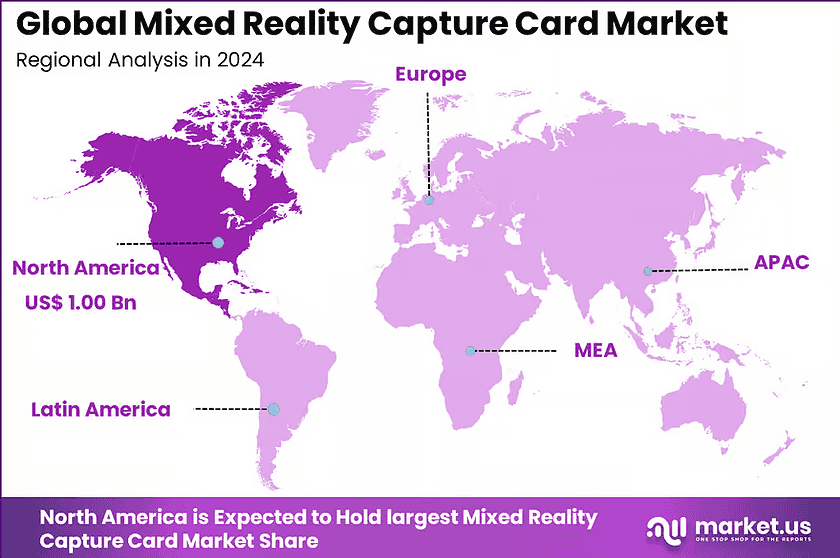
The US is the key contributor to North America’s leadership because it has a mature streaming ecosystem, a large base of professional content creators, and strong demand for high-performance capture hardware. Growth is also supported by wider use of mixed reality in virtual production, remote collaboration, sports broadcasting, and interactive training environments. Buyers in the region prefer capture cards that support stable frame rates, low delay, multi-device connectivity, and high-quality video output, which strengthens demand from both consumer and commercial users.
Europe is expected to show steady growth as mixed reality adoption expands across automotive design, industrial training, education, and broadcast production. Latin America is gradually adopting capture cards for gaming, online content creation, and small-scale media production, although pricing pressure and limited professional infrastructure slow wider usage.
The Middle East and Africa market is emerging through smart education, digital media, esports events, and enterprise innovation programs. However, North America remains ahead due to stronger technology spending, better creator economy maturity, wider immersive content adoption, and faster integration of mixed reality tools into professional workflows.
Driver
Rising need for high quality mixed reality content capture
The mixed reality capture card market is driven by growing use of immersive content in gaming, training, education, healthcare simulation, and virtual events. Users need smooth capture of real and virtual environments together, which creates demand for cards that can handle high resolution video, low delay, and stable performance.
As mixed reality content becomes more common, creators and businesses are focusing on better recording and streaming quality. Capture cards help improve visual output, reduce lag, and support more professional content workflows, making them important in mixed reality production setups.
Restraint
High cost of advanced capture hardware
A key restraint is the high cost of advanced capture cards that support demanding mixed reality workloads. These products often require strong processing support, reliable connectivity, and compatibility with complex hardware setups, which increases the overall setup cost.
This cost can slow adoption among small studios, independent creators, and training centers with limited budgets. Many users may choose basic recording tools instead of dedicated capture cards, especially when mixed reality usage is still at an early stage in their operations.
Opportunity
Growing use in training and enterprise simulation
A major opportunity lies in enterprise training, defense simulation, healthcare learning, design review, and remote collaboration. These areas need clear and accurate capture of mixed reality sessions for review, assessment, and knowledge sharing.
Capture card providers can gain from offering easier integration, better device compatibility, and stable performance for professional users. As organizations use mixed reality for practical work, demand for reliable capture solutions is expected to become stronger.
Challenge
Managing latency and device compatibility
One major challenge is keeping video delay low while maintaining strong image quality. Mixed reality experiences depend on smooth timing between the real world, virtual content, audio, and user movement, so even small delays can affect the final output.
Compatibility is another concern because mixed reality systems involve headsets, cameras, displays, computers, and software platforms. If capture cards do not work smoothly across these setups, users may face technical issues that limit adoption and reduce trust in the technology.
Key Market Segment
By Product Type
- Internal Capture Cards
- External Capture Cards
By Application
- Gaming
- Live Streaming
- Virtual Events
- Education
- Healthcare
- Others
By Platform
- PC
- Console
- Mobile Devices
By End-User
- Individual
- Commercial
By Distribution Channel
- Online
- Offline
Competetive Analysis
The competitive landscape of the Mixed Reality Capture Card Market is driven by a mix of professional video technology providers and consumer-focused gaming hardware brands. Companies such as AJA Video Systems, Blackmagic Design, Matrox Graphics, Datapath Ltd., and Euresys focus on high-performance capture solutions used in broadcasting, production, and enterprise applications.
These players emphasize low latency, high-resolution video capture, and reliable performance for complex mixed reality and live production environments. Their strong expertise in video processing and professional media workflows helps them maintain a leading position in the market.
At the same time, companies such as AVerMedia Technologies, Elgato (Corsair Gaming), Magewell, Epiphan Video, Razer Inc., Hauppauge Digital, StarTech.com, Yuan High-Tech Development, Teradek (Creative Solutions Division, Vitec Group), IO Industries, Bluefish444, DIGITNOW!, Shenzhen Uniscom Technology, Inogeni, and Bolin Technology compete by offering cost-effective and user-friendly capture devices for gamers, content creators, and small studios.
These players focus on plug-and-play functionality, streaming integration, and compact designs. Competition in this market is driven by video quality, ease of use, compatibility with multiple platforms, and the ability to support real-time mixed reality content creation.
Top Key Players
- AJA Video Systems
- Blackmagic Design
- AVerMedia Technologies
- Magewell
- Elgato (Corsair Gaming)
- Epiphan Video
- Hauppauge Digital
- Razer Inc.
- Yuan High-Tech Development
- Datapath Ltd.
- StarTech.com
- Matrox Graphics
- Bluefish444
- Teradek (Creative Solutions Division, Vitec Group)
- IO Industries
- Euresys
- DIGITNOW!
- Shenzhen Uniscom Technology
- Inogeni
- Bolin Technology
- Others
Recent Development
- September 2025, Magewell – Magewell refreshes its PCIe capture card lineup with new 4K cards that support higher frame rates and ultra‑low latency, aimed at live production, XR, and mixed‑reality pipelines needing multi‑channel 4K capture into game engines and compositing tools.
- September 2025, AJA Video Systems – AJA highlights KONA X as its next‑generation PCIe capture and playout card, with dual bidirectional 12G‑SDI, dual HDMI 2.0, and Streaming DMA to cut system latency, making it well‑suited for real‑time XR and mixed‑reality stages.
Conclusion
The Mixed Reality Capture Card Market is expected to grow steadily as demand increases for high quality video capture, real time streaming, and immersive content creation. These cards are becoming important for gaming, virtual production, training, education, healthcare simulation, and enterprise collaboration, where smooth visual output and low latency performance are needed. The market is also supported by rising use of mixed reality devices, professional streaming setups, and advanced content workflows.
However, high hardware cost, compatibility issues, and the need for powerful computing systems may limit adoption among small users. Overall, the market outlook remains positive as creators, developers, and businesses look for better tools to record, stream, and share mixed reality experiences with clear visuals and reliable performance.
Discuss your needs with our analyst
Please share your requirements with more details so our analyst can check if they can solve your problem(s)