Introduction
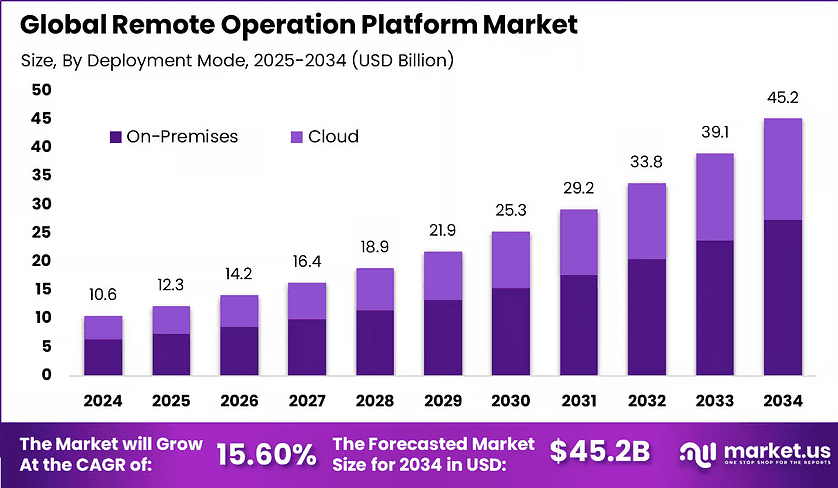
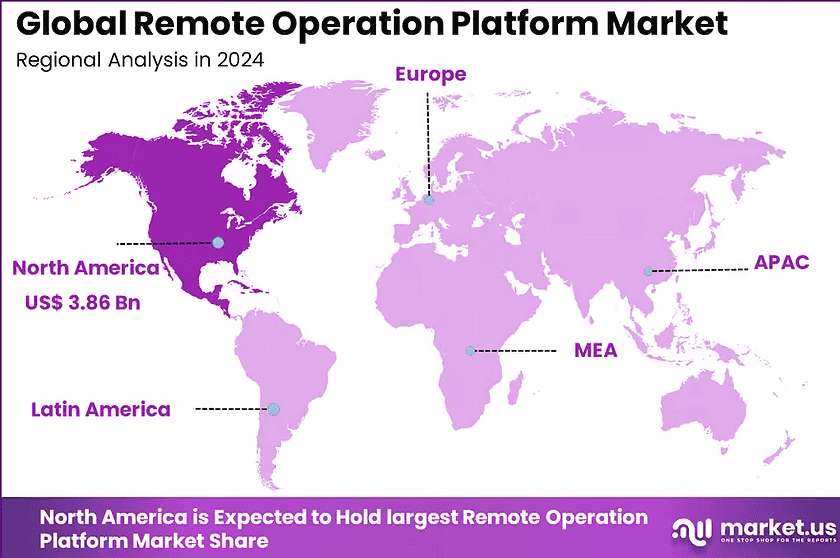
The Global Remote Operation Platform Market generated USD 10.6 billion in 2024 and is predicted to register growth from USD 12.3 billion in 2025 to about USD 45.2 billion by 2034, recording a CAGR of 15.60% throughout the forecast span. In 2024, North America held a dominan market position, capturing more than a 36.5% share, holding USD 3.86 Billion revenue.
Remote operation platforms are digital systems that allow users to monitor, control, and manage equipment or processes from a distance. These platforms connect machines, sensors, and control systems through networks, enabling operators to perform tasks without being physically present at the site.
They are widely used in industries such as energy, mining, manufacturing, logistics, and utilities where operations are spread across remote or hard to access locations. As industries adopt more connected infrastructure, remote operation platforms are becoming a key part of improving operational visibility and control.
One of the main driving factors is the increasing need to manage operations in remote and hazardous environments. Companies are focusing on reducing risk to workers by limiting on site presence and shifting control to centralized locations.
In addition, advancements in connectivity and sensor technology are making it easier to collect real time data and control equipment from a distance. The push toward automation and digital transformation is also encouraging the use of platforms that can support continuous monitoring and remote decision making. Rising pressure to improve efficiency and reduce downtime is further supporting adoption.
Demand for remote operation platforms is rising as organizations seek flexible and reliable ways to manage distributed operations. There is a strong preference for solutions that offer real time monitoring, secure access, and seamless control across multiple assets. Companies are also looking for platforms that can integrate with existing systems and provide clear insights for faster decision making.
The demand is particularly strong in industries that operate across large geographic areas or challenging conditions. As remote work and automation continue to expand in industrial settings, the need for efficient and scalable remote operation solutions is expected to grow steadily.
How AI is Reshaping the Future of this market?
AI is reshaping the future of the Remote Operation Platform Market by making remote monitoring, control, and decision support more intelligent and reliable. These platforms are moving beyond basic command and visibility functions toward systems that can analyze equipment behavior, detect early faults, recommend corrective actions, and support operators in real time. This is especially important in industries such as manufacturing, energy, mining, logistics, utilities, and offshore operations, where assets are spread across different locations and downtime can affect safety, output, and operating cost.
The use of AI is also improving predictive maintenance, automated workflow management, and remote diagnostics. Instead of waiting for equipment failure or manual inspection, AI-enabled platforms can study operating data and identify abnormal patterns before they become serious issues. This helps companies reduce unplanned shutdowns, improve asset life, and support faster response from centralized control rooms. As operations become more connected, AI is expected to make remote platforms more adaptive, secure, and efficient, turning them into a key part of modern industrial operations.
Regional Analysis
In 2024, North America held a dominant Market position, capturing more than a 36.5% share, holding USD 3.86 Billion revenue. North America is leading the Remote Operation Platform Market due to its strong industrial automation base, early use of connected operation systems, and high adoption of remote monitoring across energy, manufacturing, mining, logistics, utilities, and critical infrastructure.
The region has a mature digital ecosystem, where enterprises are shifting from site-based control to centralized command centers to improve safety, reduce downtime, and manage assets across multiple locations.
The US plays a major role in supporting North America’s dominance, as companies in the region are investing in cloud-based control platforms, AI-assisted monitoring, predictive maintenance, and secure remote access tools.
Demand is also rising because industries are facing skilled labor shortages, higher operational costs, and the need to manage complex equipment without keeping large teams on-site. Strong broadband coverage, advanced industrial IoT deployment, and strict focus on workplace safety are further helping remote operation platforms gain faster acceptance.
Europe is expected to show steady growth, supported by smart factory development, renewable energy operations, and digital transformation across industrial sectors. Asia Pacific is anticipated to grow at a strong pace as manufacturing hubs, telecom operators, ports, energy companies, and infrastructure operators increase spending on remote management systems.
Latin America and the Middle East and Africa are gradually adopting these platforms, mainly in oil and gas, mining, utilities, and logistics, where remote sites need better visibility, lower maintenance costs, and safer operating conditions.
Driver
Growing need for safer remote industrial control
The main driver for the Remote Operation Platform Market is the rising need to manage machines, sites, and field operations from a central location. Industries such as manufacturing, energy, mining, logistics, and utilities are using remote operation platforms to reduce on-site risk and improve work continuity.
These platforms help operators monitor equipment, control processes, and respond to issues without being physically present at every location. This is important for businesses that run complex or hazardous operations, where safety, uptime, and faster decision-making are key priorities.
Restraint
High integration complexity
A major restraint for the market is the difficulty of integrating remote operation platforms with existing systems. Many industrial sites still use older machines, legacy control systems, and different software tools that may not work smoothly with modern remote platforms.
This creates delays in deployment and raises the need for skilled technical support. For smaller firms, the cost and effort required to upgrade infrastructure can slow adoption, especially when daily operations cannot be interrupted.
Opportunity
Wider adoption of connected operations
A strong opportunity lies in the growing shift toward connected and automated operations. Businesses are looking for platforms that can bring equipment data, worker activity, maintenance alerts, and control systems into one view.
Remote operation platforms can support this shift by helping teams manage several locations with better visibility. As industries focus on operational efficiency and asset performance, demand is increasing for solutions that support real-time monitoring, remote control, and faster issue resolution.
Challenge
Data security and operational reliability
One key challenge is protecting remote operation systems from cyber risks. Since these platforms connect critical equipment and operational data through digital networks, any security gap can affect business continuity and worker safety.
Reliability is also a major concern. Remote operations require stable connectivity, low delay, and secure access at all times. Any disruption in the platform or network can affect decision-making, equipment control, and overall site performance.
Key Market Segment
By Component
- Software
- Hardware
- Services
By Deployment Mode
- On-Premises
- Cloud
By Enterprise Size
- Small and Medium Enterprises
- Large Enterprises
By Application
- Industrial Automation
- Oil & Gas
- Mining
- Utilities
- Transportation
- Healthcare
- Others
Competetive Analysis
The competitive landscape of the Remote Operation Platform Market is led by global industrial automation and technology companies. Companies such as ABB, Siemens, Schneider Electric, Honeywell International, Rockwell Automation, Emerson Electric, Yokogawa Electric Corporation, and General Electric focus on advanced remote monitoring and control platforms used in manufacturing, energy, and process industries.
These players provide integrated solutions that combine automation, data analytics, and cloud connectivity to enable remote operations and improve efficiency. Their strong engineering capabilities and global presence help them maintain a leading position in the market.
At the same time, companies such as Mitsubishi Electric, Cisco Systems, AVEVA Group, Hitachi, FANUC Corporation, Bosch Rexroth, Omron Corporation, Aspen Technology, Toshiba Corporation, IBM Corporation, Oracle Corporation, and SAP SE compete by offering software platforms, industrial networking, and data management solutions that support remote operations.
These players focus on real-time data access, system integration, and user-friendly interfaces to simplify operations across distributed environments. Competition in this market is driven by automation capabilities, cybersecurity, scalability, and the ability to support remote decision making across industrial processes.
Top Key Players
- ABB
- Siemens
- Schneider Electric
- Honeywell International
- Rockwell Automation
- Emerson Electric
- Yokogawa Electric Corporation
- General Electric
- Mitsubishi Electric
- Cisco Systems
- AVEVA Group
- Hitachi
- FANUC Corporation
- Bosch Rexroth
- Omron Corporation
- Aspen Technology
- Toshiba Corporation
- IBM Corporation
- Oracle Corporation
- SAP SE
- Others
Recent Development
- December 2025, ABB – Market reports highlight ABB as a leading remote‑operation‑platform vendor providing centralized monitoring and control for manufacturing, energy, utilities, and transport, with strong focus on cyber‑secure remote access and predictive maintenance.
- December 2025, Siemens – Siemens is cited as a top player with remote operations built around its industrial automation stack (SIMATIC, PCS 7, MindSphere), letting customers supervise and optimize distributed plants from central control rooms or the cloud.
Conclusion
The Remote Operation Platform Market is expected to grow steadily as industries shift toward safer, faster, and more flexible ways to manage field assets, machines, and remote work sites. Demand is rising from sectors that need real-time monitoring, better control, lower downtime, and reduced dependence on on-site staff. These platforms are becoming important for improving operational visibility, supporting remote decision-making, and managing complex systems from centralized locations. As connectivity, automation, and AI tools continue to improve, remote operation platforms are expected to become a key part of modern industrial and enterprise operations.
Discuss your needs with our analyst
Please share your requirements with more details so our analyst can check if they can solve your problem(s)