Overview
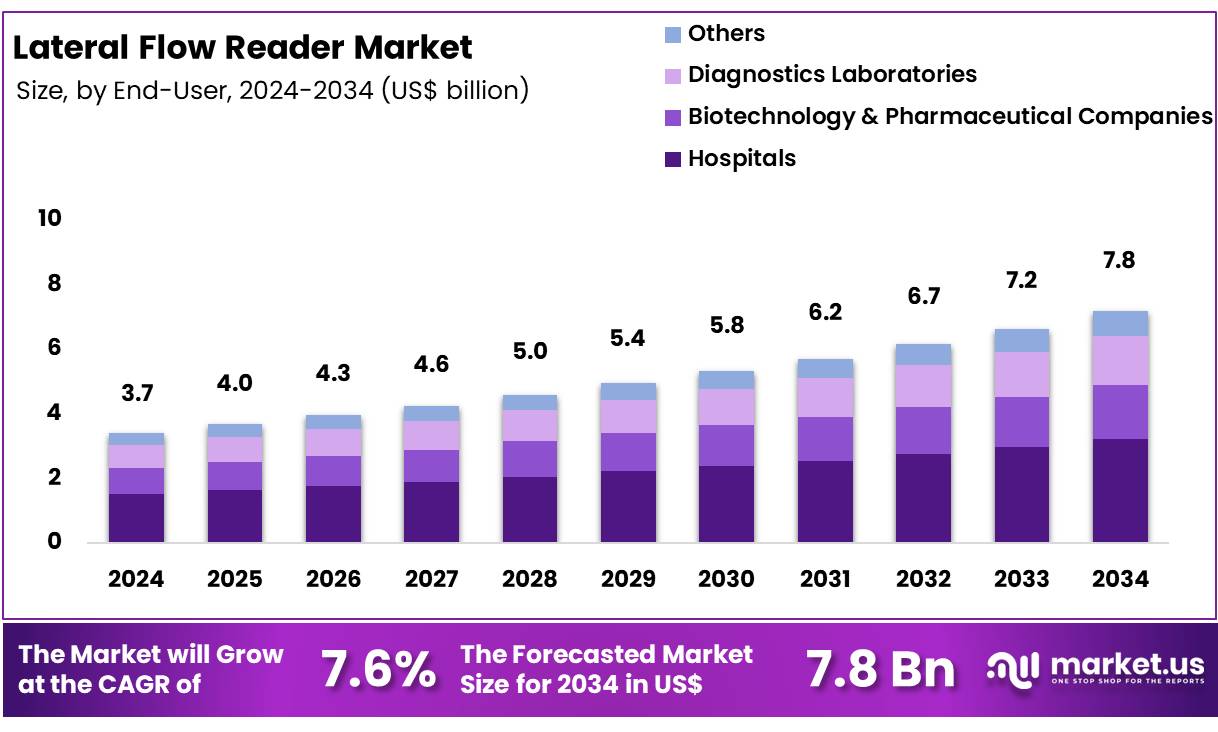
New York, NY – June 09, 2026 – Global Lateral Flow Readers Market size is expected to be worth around US$ 7.8 Billion by 2034 from US$ 3.7 Billion in 2024, growing at a CAGR of 7.6% during the forecast period from 2025 to 2034. In 2024, North America led the market, achieving over 39.7% share with a revenue of US$ 1.4 Billion.
Lateral flow readers are advanced analytical devices designed to interpret and quantify results from lateral flow assays (LFAs), commonly used in rapid diagnostic testing. These readers enhance the accuracy, sensitivity, and reliability of test results by minimizing human interpretation errors and providing digital output for data recording and analysis.
The growing adoption of point-of-care diagnostics across healthcare, veterinary, food safety, environmental monitoring, and pharmaceutical applications is driving demand for lateral flow readers. These devices support the detection of various biomarkers, infectious diseases, pregnancy indicators, and contaminants, enabling faster decision-making and improved patient outcomes.
Technological advancements, including smartphone-based readers, portable handheld systems, and cloud-connected platforms, are expanding the capabilities of lateral flow testing. Integration with digital health systems and laboratory information management platforms has further strengthened the value proposition of these devices in clinical and research settings.
The increasing prevalence of infectious diseases, rising emphasis on decentralized healthcare, and growing investments in diagnostic technologies are contributing to market expansion. Furthermore, regulatory support for rapid testing solutions and the need for efficient screening methods in resource-limited environments continue to create growth opportunities for manufacturers.
As healthcare systems increasingly prioritize rapid, accurate, and cost-effective diagnostic solutions, lateral flow readers are expected to play a critical role in supporting next-generation testing workflows and advancing global diagnostic capabilities.
Key Takeaways
- The global lateral flow reader market was valued at USD 3.7 billion in 2024 and is projected to reach USD 7.8 billion by 2034, expanding at a CAGR of 7.6% during the forecast period.
- The benchtop readers segment dominated the market in 2024, accounting for 56.4% of the overall revenue share.
- Based on end use, hospitals emerged as the leading segment, contributing 41.3% of the global market revenue in 2024.
- Among applications, infectious disease testing held the largest market share, representing 24.3% of total revenue in 2024.
- North America remained the largest regional market, capturing more than 39.7% of the global revenue share in 2024.
Regional Analysis
North America accounted for the largest share of the global lateral flow reader market, driven primarily by the increasing prevalence of infectious diseases and the growing need for rapid diagnostic solutions. The region has experienced multiple outbreaks of infectious diseases, including influenza, tuberculosis, and COVID-19, creating significant demand for accurate and timely testing technologies. Lateral flow readers have emerged as essential diagnostic tools due to their ability to deliver fast, reliable, and easy-to-interpret results, supporting effective disease surveillance and management.
The COVID-19 pandemic significantly accelerated the adoption of lateral flow readers across North America, particularly in the United States. The unprecedented testing requirements associated with monitoring and controlling the spread of the virus highlighted the importance of rapid diagnostic technologies in public health response strategies. Healthcare providers, government agencies, and diagnostic laboratories increasingly relied on lateral flow testing solutions to conduct large-scale screenings, identify infections at an early stage, and support timely intervention measures.
Furthermore, substantial government investments in testing infrastructure contributed to market growth. For example, in January 2022, the Biden Administration allocated nearly USD 6 billion through the American Rescue Plan (ARP) to support free testing for uninsured individuals and facilitate the distribution of one billion free at-home rapid COVID-19 tests. Such initiatives strengthened the adoption of lateral flow reader technologies and supported disease prevention efforts throughout the region.
Emerging Trends
- Smartphone-Based Reading Systems: Smartphones are increasingly being used as lateral flow readers because they combine high-resolution cameras, data processing, storage, and internet connectivity in a single device. Recent studies show that smartphone readers can deliver quantitative results with accuracy comparable to benchtop readers, supporting decentralized testing and remote healthcare services.
- AI-Powered Result Interpretation: Artificial intelligence is being integrated into lateral flow readers to reduce human interpretation errors. Recent AI-enabled systems achieved over 91% overall diagnostic accuracy and improved to approximately 98% after additional training data were added. This trend supports standardized interpretation across multiple test types and healthcare settings.
- Quantitative Diagnostic Testing: Traditional lateral flow tests provide positive or negative results. Modern readers are increasingly designed to measure analyte concentrations quantitatively. Technologies such as fluorescence, electrochemical, magnetic, and photothermal sensing are enabling more precise measurements, expanding applications beyond simple screening into clinical monitoring.
- Connectivity with Digital Health Platforms: Healthcare providers are increasingly demanding automatic reporting and data transmission capabilities. The World Health Organization (WHO) notes that reader systems improve result reporting and surveillance by ensuring that test outcomes are captured and transmitted quickly for clinical decision-making and public health monitoring.
- Enhanced Sensitivity Technologies: Researchers are developing advanced reader technologies to improve detection limits and identify lower concentrations of biomarkers. Emerging enhancement methods have demonstrated up to 400-fold improvement in detection sensitivity compared with conventional lateral flow approaches, supporting earlier disease detection and broader diagnostic applications.
Key Use Cases
- Infectious Disease Diagnosis: Lateral flow readers are widely used for infectious disease testing, including COVID-19, HIV, and malaria. WHO recognizes rapid diagnostic tests as critical tools for disease management. Readers improve consistency and accuracy by reducing visual interpretation errors and enabling digital documentation of results.
- Point-of-Care Testing in Clinics: Healthcare facilities use lateral flow readers to obtain rapid results near patients rather than sending samples to centralized laboratories. Many tests provide results within 15–30 minutes, allowing faster treatment decisions and reducing delays in patient management.
- Home and Self-Testing Applications: The growing availability of over-the-counter diagnostic kits has increased demand for reader technologies. Digital readers help consumers correctly interpret results, improve accessibility, and reduce user errors during self-testing, particularly for infectious disease screening and health monitoring.
- Environmental and Food Safety Monitoring: Lateral flow readers are increasingly used to detect contaminants, pathogens, and harmful substances in food products and environmental samples. Reader systems provide objective measurement and digital record keeping, supporting quality control programs in agriculture, food processing, and environmental monitoring.
- Chronic Disease and Biomarker Monitoring: Advanced quantitative readers are expanding into chronic disease management by measuring biomarkers and health indicators. New applications include monitoring cholesterol, vitamin levels, inflammatory markers, and other health parameters, allowing more frequent testing outside traditional laboratory environments.
Frequently Asked Questions on Lateral Flow Readers
- How does a lateral flow reader work?
A lateral flow reader detects optical signals such as color intensity, fluorescence, or luminescence generated on a lateral flow test strip. The device converts these signals into measurable data, enabling qualitative, semi-quantitative, or quantitative analysis with improved sensitivity and reliability. - What are the key advantages of using lateral flow readers?
The primary advantages include enhanced accuracy, reduced operator variability, digital result storage, rapid test interpretation, and quantitative analysis capabilities. These devices improve workflow efficiency and support data management, making them suitable for both laboratory and field-based testing environments. - What types of lateral flow readers are available?
Lateral flow readers are available as portable handheld devices, benchtop systems, smartphone-based readers, and fluorescence-enabled analyzers. Selection depends on testing requirements, throughput needs, sensitivity levels, and the intended application within healthcare, research, or industrial settings. - What technologies are commonly integrated into lateral flow readers?
Modern lateral flow readers incorporate technologies such as optical imaging, fluorescence detection, artificial intelligence algorithms, cloud connectivity, and wireless data transfer. These features enhance analytical performance, facilitate remote monitoring, and improve overall diagnostic efficiency and data accessibility. - What factors influence the performance of lateral flow readers?
Performance is influenced by detection technology, assay compatibility, optical sensitivity, software capabilities, calibration accuracy, and environmental conditions. High-quality readers provide consistent results, improved detection limits, and reliable performance across a broad range of testing applications. - Which regions dominate the lateral flow readers market?
North America currently leads the market due to advanced healthcare infrastructure and high adoption of diagnostic technologies. Europe maintains a significant share, while Asia-Pacific is experiencing rapid growth driven by healthcare expansion, population growth, and increasing diagnostic awareness. - How is technology shaping the lateral flow readers market?
Technological advancements such as smartphone integration, artificial intelligence, fluorescence detection, and cloud-based data management are transforming the market. These innovations enhance sensitivity, enable real-time data analysis, and improve accessibility of diagnostic testing across diverse environments. - What opportunities exist in the lateral flow readers market?
Significant opportunities are emerging from growing demand for decentralized healthcare, expanding use of home-based diagnostics, increasing investments in healthcare infrastructure, and rising adoption of digital health technologies that support connected and data-driven testing solutions.
Conclusion
The global lateral flow reader market is experiencing steady growth, driven by the increasing demand for rapid, accurate, and decentralized diagnostic solutions across healthcare, veterinary, food safety, and environmental applications. Technological advancements such as smartphone integration, artificial intelligence, quantitative testing capabilities, and cloud connectivity are significantly enhancing device performance and usability.
North America continues to lead the market, supported by strong healthcare infrastructure and diagnostic investments, while emerging regions present substantial growth opportunities. As point-of-care and home-based testing gain wider acceptance, lateral flow readers are expected to play an increasingly important role in improving diagnostic efficiency, accessibility, and healthcare outcomes worldwide.
Discuss your needs with our analyst
Please share your requirements with more details so our analyst can check if they can solve your problem(s)