
Market Overview
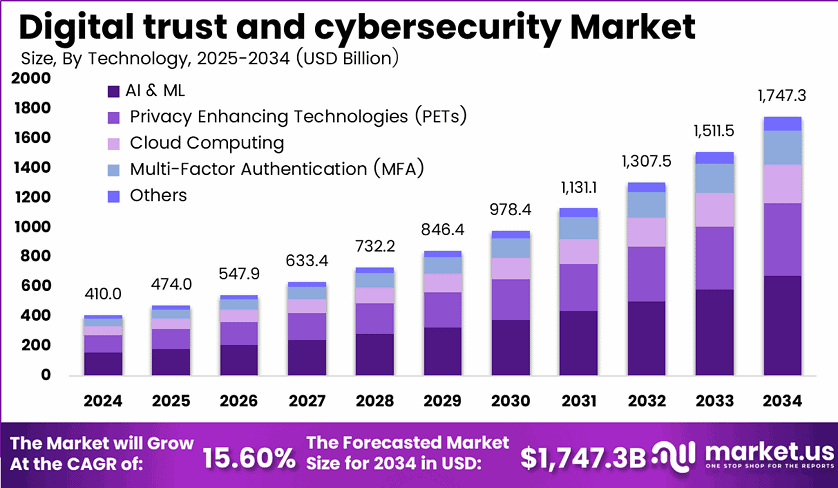
New York, NY – August 25, 2026 – The Global Digital Trust and Cybersecurity Market reached USD 410.0 billion in 2024. The market is expected to reach USD 1,747.3 billion by 2034, growing at a CAGR of 15.6%. This growth shows that companies now treat cyber protection as a core business requirement. North America led the global cybersecurity sector in 2024. The region generated about USD 157.4 billion and held more than 35.3% of market share.
Moreover, cloud adoption expands the need for digital trust solutions across business systems. According to Eurostat, 52.7% of EU enterprises used paid cloud services in 2025. Security software served 65.5% of those users, which raises demand for encryption, identity controls, threat detection, and compliance monitoring.
Additionally, cybercrime losses push leaders to strengthen prevention and recovery plans. According to the FBI, organizations reported 859,532 suspected cybercrime complaints in 2024. Reported losses exceeded USD 16 billion, showing why businesses invest in faster detection, incident response, and digital identity protection.
Consequently, enterprises adopt continuous monitoring, zero-trust access, and cyber resilience programs. According to CISA, federal networks blocked 2.62 billion malicious connections during 2025. Critical infrastructure environments blocked another 371 million, confirming that threats affect essential services and daily business operations.
Key Takeaways
- The market reached USD 410.0 billion in 2024 and may reach USD 1,747.3 billion by 2034, supported by a 15.6% CAGR.
- Solutions held a 75.4% component share because enterprises want integrated platforms for compliance, automation, and threat detection.
- AI and ML held a 38.7% technology share, helping teams predict threats, monitor systems, and automate responses.
- Endpoint security captured a 35.5% security share as remote work, mobile devices, and connected endpoints expand attack exposure.
- Large enterprises represented a 72.8% share because they manage broad digital systems, higher risk, and strict compliance obligations.
- BFSI held a 34.6% end-use share, driven by fraud prevention, encryption, multi-factor authentication, and financial-data protection.
- North America generated approximately USD 157.4 billion in revenue and held more than 35.3% of global demand.
➤ See the Full TOC, Market Tables & Figures in Your Sample Copy – https://market.us/report/digital-trust-and-cybersecurity-market/request-sample/
Market Segmentation
Solutions lead the component segment with a 75.4% share, while services hold 24.6%. Enterprises choose unified security platforms because integrated tools simplify threat detection, policy management, and compliance work. Moreover, modular solutions help companies protect cloud systems, applications, identities, and sensitive data through one coordinated approach.
Services support planning, deployment, monitoring, and incident response for organizations that need specialist assistance. However, solution demand remains strong because businesses want scalable software that supports ongoing automation. Vendors can increase value by combining software subscriptions with managed services, training, and tailored implementation support.
AI and ML lead the technology segment with a 38.7% share, while privacy-enhancing technologies hold 22.3%. AI tools identify unusual behavior and support rapid action against threats. Consequently, security teams use predictive analytics and automated workflows to reduce manual investigation workloads.
Cloud computing, multi-factor authentication, privacy tools, and other technologies strengthen enterprise protection strategies. Additionally, organizations combine these capabilities to secure access, preserve data privacy, and meet compliance duties. This technology mix helps security leaders build flexible defenses as cloud workloads and digital transactions continue expanding.
Endpoint security leads the security segment with a 35.5% share, followed by cloud security at 21.7%. Companies protect laptops, phones, servers, and connected devices because attackers often target these access points. Moreover, hybrid work and bring-your-own-device policies increase demand for centralized endpoint defenses.
Network security, application security, data security, and cloud protection address different layers of enterprise risk. However, buyers increasingly seek platforms that connect these controls in one environment. Integrated coverage improves visibility, helps teams respond faster, and reduces gaps created by separate security products.
Large enterprises account for a 72.8% share, while small and medium businesses hold 27.2%. Large companies fund layered defenses because they operate complex infrastructure and face greater regulatory scrutiny. Therefore, these buyers often deploy advanced identity, cloud, endpoint, and analytics capabilities together.
Small and medium businesses increasingly seek affordable managed protection and subscription-based security services. Additionally, vendors can simplify onboarding and automate routine monitoring for these customers. Easier deployment helps smaller firms gain stronger cyber resilience without building large internal security teams.
BFSI leads end-use demand with a 34.6% share, followed by healthcare and life sciences at 21.8%. Financial institutions protect high-value transactions and customer records from fraud and theft. Consequently, they invest heavily in encryption, authentication, fraud detection, and continuous compliance controls.
Healthcare, retail, e-commerce, telecommunications, government, and other sectors also expand cybersecurity spending. Moreover, each sector must protect customer information, service availability, and operational systems. Industry-specific security offerings can help vendors address different risk profiles, compliance needs, and technology environments.
Regional Analysis
North America leads the market because regional organizations invest heavily in cloud security, AI threat detection, and zero-trust programs. The region generated USD 157.4 billion during 2024. According to the report data, more than 40% of firms use zero-trust models, strengthening demand for identity and access controls.
Asia Pacific shows strong expansion as e-commerce and mobile activity grow across India and China. However, Europe maintains steady demand through GDPR compliance and endpoint modernization. Latin America and the Middle East and Africa offer emerging potential because buyers increasingly adopt affordable software-as-a-service protection tools.
Drivers
Mandatory cyber disclosure drives faster security purchases because boards now manage cyber risk as a business issue. U.S. rules require listed companies to disclose material incidents within 4 business days after a materiality decision. Therefore, companies strengthen monitoring, reporting, forensics, and incident response capabilities.
Cloud workload expansion also increases demand for identity security, data encryption, and continuous threat monitoring. According to Eurostat, paid cloud service adoption reached 52.7% among EU enterprises in 2025. This wider cloud use creates more systems to protect and expands demand for scalable cybersecurity platforms.
Use Cases
Financial institutions use digital trust tools to secure online banking, payment processing, customer identities, and fraud investigations. Moreover, authentication systems help banks verify users before high-risk transactions. These controls reduce unauthorized access while supporting smooth experiences for customers using mobile and digital financial services.
Healthcare providers use cybersecurity platforms to protect patient information, connected medical devices, and clinical operations. Additionally, threat detection tools help teams identify suspicious activity before it disrupts care. Strong protection supports service continuity and helps healthcare organizations meet privacy obligations with greater confidence.
Business Opportunities
Managed security services create a strong opportunity among smaller businesses that lack specialist staff and predictable technology budgets. Moreover, providers can bundle monitoring, identity protection, backup, and response services into simple subscriptions. This approach lowers customer complexity while creating stable recurring revenue for security vendors.
AI governance and machine identity management offer additional growth paths for platform providers. Consequently, companies need controls for automated agents, connected devices, software accounts, and cloud workloads. Vendors that provide clear policy management and reliable visibility can help customers operate new technology with greater trust.
Major Challenges
Cybersecurity talent shortages limit the value organizations receive from advanced protection tools. According to ISC2, the global workforce gap reached about 4.8 million professionals in 2024. This shortage delays deployment, raises managed-service costs, and increases demand for automation and easier security operations.
Tool stack complexity creates another challenge because organizations often manage separate products across networks, endpoints, applications, and cloud systems. However, disconnected controls can create blind spots and slow investigations. Buyers increasingly expect vendors to integrate security functions, simplify workflows, and improve visibility across their technology environments.
Top Key Players in the Market
- Amazon Web Services, Inc.
- Cisco Systems, Inc.
- DigiCert, Inc.
- IBM Corporation
- Microsoft Corporation
- Oracle
- OneTrust, LLC
- RSA Security USA LLC
- Salesforce, Inc.
- Symantec by Broadcom
- Fortinet, Inc.
- BAE Systems Plc
- Centrify Corporation
- Check Point Software Technology Ltd.
- Palo Alto Networks, Inc.
- Proofpoint, Inc.
- Sophos Ltd.
Conclusion
The digital trust and cybersecurity market will expand as companies protect cloud systems, identities, endpoints, and sensitive data. Moreover, regulation, cybercrime exposure, and digital business growth will sustain investment across major industries. Vendors that deliver simple integrated platforms, managed services, and reliable automation can address talent gaps while helping organizations build stronger operational resilience and customer confidence.
Discuss your needs with our analyst
Please share your requirements with more details so our analyst can check if they can solve your problem(s)