
Market Overview
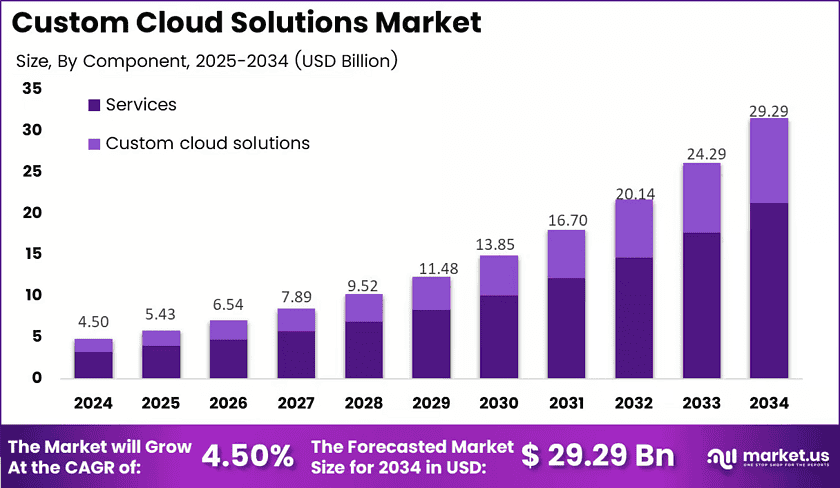
New York, NY – August 21, 2026 – The Global Custom Cloud Solutions Market reached USD 4.5 billion in 2024. The market could reach about USD 29.2 billion by 2034, expanding at a 4.5% CAGR from 2025 to 2034. Custom cloud platforms help businesses build secure systems that match their operating needs.
Moreover, cloud adoption supports the market’s higher growth case. According to the provided survey data, 59.0% of U.S. organizations used cloud technology in 2024, while 40.0% used cloud-based AI tools. These users need tailored data integration, workload migration, governance, and application support.
Additionally, the U.S. digital economy generated USD 2.41 trillion in value added during 2021. This represented 10.3% of U.S. GDP and showed cloud infrastructure’s importance for digital business activity. According to the provided data, cloud services grew 21.8%, supporting further technology investment.
North America led the custom cloud solutions market during 2024, generating about USD 1.65 billion in revenue. Finance, healthcare, retail, software, hosting, and public-sector organizations drove regional demand. These industries require scalable systems, stronger security controls, and reliable data handling for complex business operations.
Consequently, artificial intelligence adoption creates new demand for specialized cloud environments. According to the provided data, U.S. business AI adoption rose from 3.7% in September 2023 to 5.4% in February 2024. This increase encourages companies to build advanced data pipelines, computing capacity, and governance frameworks.
Key Takeaways
- The market reached USD 4.5 billion in 2024 and could reach USD 29.2 billion by 2034, growing at a 4.5% CAGR.
- Custom cloud solutions held a 72.8% component share because companies need tailored infrastructure and applications.
- Infrastructure as a Service held a 45.7% share, supported by flexible computing capacity and reduced hardware spending.
- Public cloud captured a 48.8% share because pay-as-you-go pricing improves affordability and scalability.
- Large enterprises held a 70.4% share due to higher spending on secure, customized cloud environments.
- BFSI led industry demand with a 34.8% share, driven by secure data handling and compliance needs.
- North America generated approximately USD 1.65 billion in revenue during 2024, leading global demand.
➤ See the Full TOC, Market Tables & Figures in Your Sample Copy – https://market.us/report/custom-cloud-solutions-market/request-sample/
Market Segmentation
Component Analysis
Custom cloud solutions held a 72.8% share of the component market. Companies select personalized infrastructure and applications to improve efficiency across different operating environments. Moreover, tailored platforms help businesses align security, workflows, data access, and performance needs with strategic business goals.
Services support implementation, migration, monitoring, and ongoing management for cloud customers. Analysts expect adoption to increase by 20% over the next two years. This growth shows that companies value flexible cloud support when they modernize systems and manage changing technology requirements.
Type Analysis
Infrastructure as a Service held a 45.7% share because organizations need scalable computing resources without major hardware purchases. IaaS supports rapid deployment and flexible capacity planning. Consequently, businesses can expand or reduce resources as application demand changes across their operations.
Platform as a Service and Software as a Service broaden custom cloud adoption. According to the provided forecast, IaaS usage could grow by 25% by 2028. This expansion indicates that flexible infrastructure remains important for innovation, application development, and faster digital service delivery.
Deployment Model Analysis
Public cloud-led deployment models have a 48.8% share in the market. Businesses choose shared resources and pay-as-you-go pricing to control technology costs. Moreover, public environments help organizations test tailored cloud applications without making large upfront infrastructure commitments.
Private cloud and hybrid cloud models serve companies with stronger control or integration needs. Analysts expect public cloud adoption to increase by 22% by 2029. This forecast signals continued demand for accessible capacity, especially for data-heavy applications and expanding digital workloads.
Organization Size Analysis
Large enterprises accounted for a 70.4% market share because they manage complex networks, sensitive data, and broad compliance duties. These firms invest in customized cloud environments that improve security and operational control. Additionally, tailored systems support business expansion across multiple locations and teams.
Small and medium enterprises use cloud services to gain scalable tools without building extensive internal infrastructure. The report expects large-firm adoption to rise by 30% by 2026. This increase shows that major companies will continue setting standards for cloud security and artificial intelligence integration.
Industry Vertical Analysis
BFSI led industry demand with a 34.8% share because financial firms manage sensitive transactions and customer information. These organizations need secure, compliant, and reliable cloud environments. Consequently, customized platforms help banks, insurers, and financial service providers strengthen data protection and operational continuity.
Healthcare, retail, IT and telecommunications, government, and other industries also expand cloud spending. Analysts expect BFSI cloud adoption to increase by 28% by 2027. This forecast reflects the sector’s need to streamline operations while meeting strict security and regulatory requirements.
Regional Analysis
North America generated about USD 1.65 billion in custom cloud solutions revenue during 2024. Technology hubs, financial institutions, and healthcare organizations drive regional demand for tailored infrastructure. Moreover, companies use customized systems to connect data, scale AI workloads, and manage security requirements across business units.
Europe, Asia Pacific, Latin America, and the Middle East and Africa present expanding opportunities. Europe emphasizes data sovereignty and compliance, while Asia Pacific benefits from digital transformation. Consequently, providers can serve regional requirements through localized delivery, secure architectures, and industry-specific cloud services.
Market Drivers
Critical-sector compliance modernization drives custom cloud procurement in Europe and North America. Buyers increasingly combine identity controls, monitoring tools, recovery capabilities, and sector-specific data management. According to Eurostat, 52.7% of EU enterprises used paid cloud services in 2025, expanding demand for tailored compliance layers.
Enterprise cloud adoption also supports market growth across global industries. Companies need flexible infrastructure for applications, storage, artificial intelligence, and digital services. Additionally, custom providers help clients integrate workloads across existing systems, reducing operational disruption while improving the speed of technology modernization.
Use Cases
Financial institutions use tailored cloud environments to protect transaction records, customer data, and compliance workflows. Custom systems combine access controls, encrypted storage, monitoring, and recovery processes. Moreover, banks and insurers can connect legacy applications with modern digital services while maintaining stronger operational oversight.
Healthcare providers use customized cloud platforms to manage patient information, clinical systems, and research workloads. These environments support secure data sharing across authorized teams. Consequently, hospitals can improve service coordination, strengthen privacy practices, and scale digital health tools without relying on generic technology designs.
Business Opportunities
Energy-optimized cloud modernization offers a major opportunity for service providers. Companies can redesign workloads, storage, and computing systems to reduce power use while maintaining performance. Moreover, providers can combine sustainability goals with cost management, helping enterprise customers improve efficiency across their cloud operations.
Industry-specific sovereign cloud platforms create growth potential across regulated markets. Providers can build solutions for finance, healthcare, government, and other sensitive sectors. Consequently, localized platforms can help customers meet data residency needs, improve trust, and simplify compliance planning within complex operating environments.
Major Challenges
Cloud security talent shortages can delay custom cloud delivery and increase project complexity. Organizations need specialists who understand network design, identity management, encryption, compliance, and migration. However, limited access to skilled professionals can slow implementation schedules and raise costs for providers and their enterprise clients.
Multicloud interoperability creates another challenge for businesses using several technology providers. Teams must connect applications, data, policies, and monitoring tools across different environments. Consequently, integration work can become difficult, extend delivery timelines, and require stronger planning before companies move critical workloads.
Top Key Players in the Market
- Amazon Web Services
- Microsoft Azure
- Google Cloud Platform
- IBM Cloud
- Oracle Cloud
- Alibaba Cloud
- Salesforce
- SAP Cloud Platform
- VMware
- Rackspace Technology
- Tencent Cloud
- Hewlett Packard Enterprise Cloud
- Dell Technologies Cloud
- Cisco Cloud Solutions
- Adobe Cloud Services
- Fujitsu Cloud
- Huawei Cloud
- CenturyLink Cloud
- ServiceNow
Conclusion
The custom cloud solutions market will expand as companies pursue secure, flexible, and industry-ready digital infrastructure. North America leads current demand, while regulated sectors create strong need for tailored platforms. Moreover, providers that combine cloud modernization, compliance support, energy efficiency, and skilled managed services can build durable customer relationships across global markets.
Discuss your needs with our analyst
Please share your requirements with more details so our analyst can check if they can solve your problem(s)