
Market Overview
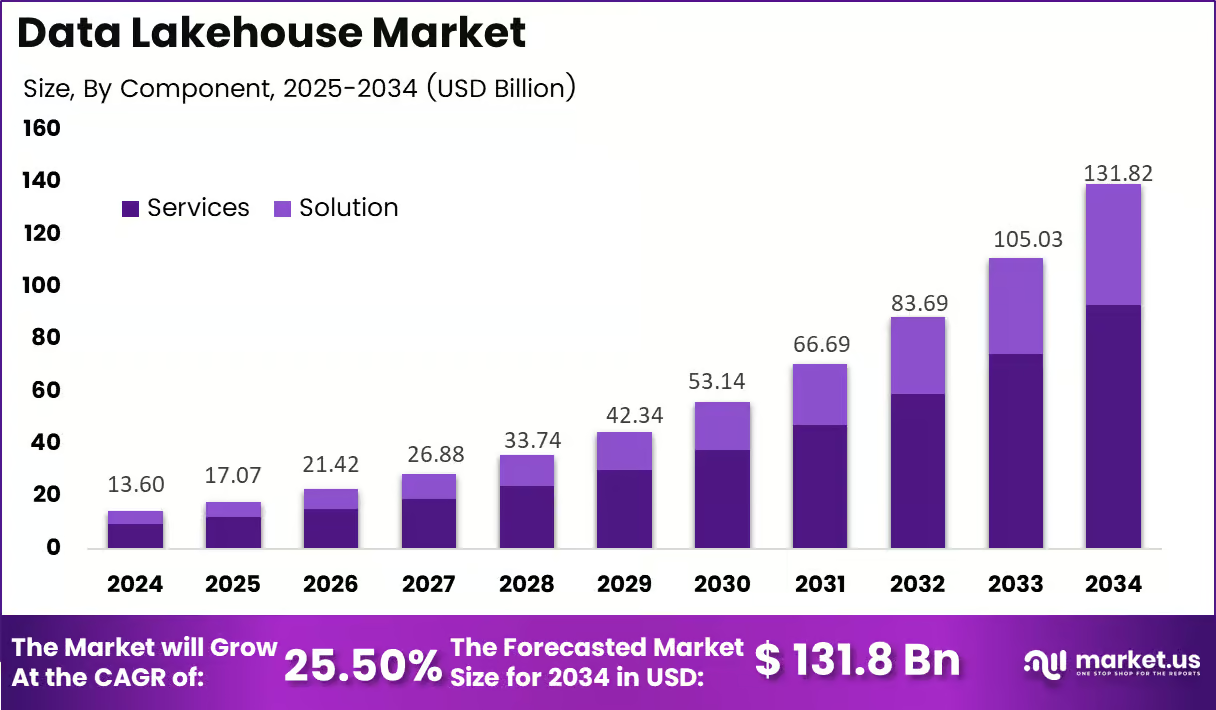
New York, NY – August 25, 2026 – The Global Data Lakehouse Market reached USD 13.6 billion in 2024. According to the report, the sector should expand at a 25.5% CAGR during 2025–2034 and approach USD 131.8 billion by 2034. Moreover, this outlook shows enterprises are prioritizing unified platforms for analytics, governance, and artificial intelligence. Buyers view data readiness as strategic infrastructure.
Enterprise data growth now strengthens demand for scalable storage and analytics. The U.S. Bureau of Economic Analysis says the digital economy created nearly USD 2.6 trillion in value added during 2022. Consequently, businesses need modern systems that organize customer, machine, transaction, and AI-generated information for faster decisions and controlled access. Modern platforms therefore become essential for enterprise insight and automation.
Data lakehouse architecture combines economical data-lake storage with warehouse-level performance, SQL analytics, and governance. Additionally, one environment can support structured records, unstructured content, business intelligence, and machine-learning workloads. This approach limits duplicate datasets, simplifies administration, and helps teams use trusted information without maintaining many disconnected platforms. Therefore, leaders can reduce handoffs, improve data quality, and speed project delivery across departments.
Cloud modernization and enterprise AI programs also accelerate platform investment. Moreover, organizations want open formats, real-time processing, reliable catalogs, and policy controls across hybrid environments. Major technology providers now connect storage, computing, analytics, and model development, which helps buyers modernize data estates while preserving flexibility across cloud and on-premises systems. Consequently, vendors compete through simpler operations, interoperability, and integrated security.
North America captured more than 35.3% of global revenue and generated about USD 4.8 billion in 2024, according to the report. However, Europe and Asia Pacific continue building strong growth pipelines through regulation, cloud investment, and industrial digitization. Competitive momentum should therefore broaden adoption across regulated and data-intensive industries. Consequently, vendors need compliance, partnerships, and service capacity to compete effectively.
Key Takeaways
- The Data Lakehouse Market revenue rises from USD 13.6 billion in 2024 to USD 131.8 billion by 2034, reflecting a 25.5% CAGR.
- Solutions held 70.7% in 2025, showing that buyers prioritize core storage, integration, and governance tools.
- Large enterprises captured 65.4%, reflecting their stronger budgets and complex data estates.
- Operations represented 30.4%, as companies sought process efficiency and lower operating costs.
- On-premises deployment led with 58.5%, supported by control, security, and customization needs.
- BFSI held 28.8%, driven by secure financial data management and strict governance demands.
- North America exceeded 35.3% and generated nearly USD 4.8 billion in 2024, confirming its early technology lead.
➤ Evaluate the Report Quality with an Exclusive Sample Download – https://market.us/report/data-lakehouse-market/request-sample/
Market Segmentation
The component view places solutions at 70.7% in 2025, according to the report. Moreover, storage and management represent about 35% of solutions, integration and ETL hold 25%, and governance holds 20%. Other tools cover 20%, while services represent the remaining 29.3% through professional and managed support.
Large enterprises lead in organization size with 65.4%, while SMEs account for 34.6%, according to the report. Additionally, large companies fund data infrastructure for workloads and controls. Smaller businesses increasingly choose cloud services that reduce spending, shorten deployment cycles, and provide access to modern analytics capabilities.
Operations lead applications with 30.4%, followed by finance at 25.6% and marketing at 20.8%, according to the report. Moreover, human resources hold 15.2%, while other uses contribute 8%. These shares show that process improvement, financial control, campaign insight, and workforce management drive demand.
On-premises systems command 58.5%, while cloud deployment holds 41.5%, according to the report. However, cloud adoption is expanding because capacity and usage-based costs support workloads. Regulated organizations favor local control, customization, and security oversight for sensitive information and critical business processes.
BFSI leads end use with 28.8%, followed by IT and telecom at 22.3% and healthcare at 18.5%. Additionally, energy and utilities hold 12.7%, retail and e-commerce capture 10.4%, manufacturing represents 5.3%, and other sectors contribute 2%. Digitization supports demand.
Regional Analysis
North America accounts for more than 35.3% of the market and produced USD 4.8 billion in 2024, according to the report. Moreover, cloud infrastructure, big-data adoption, and a technology ecosystem support leadership. The United States and Canada remain buyers across finance, healthcare, retail, and public services.
Europe could grow at 25%, while Asia Pacific may expand at 23–25%, according to the report. However, Europe emphasizes compliance and industrial modernization, whereas Asian markets prioritize digitization. Latin America and the Middle East and Africa gain momentum as cloud access and infrastructure improve.
Drivers
Enterprise AI programs drive demand for unified, governed information across engineering, analytics, and model development. Additionally, the U.S. Bureau of Labor Statistics expects data-scientist employment to grow 34% from 2024 to 2034, with about 23,400 annual openings. This growth signals sustained investment in skilled teams and modern data platforms.
Cloud-stack modernization also pushes companies toward scalable, real-time architecture. Moreover, the International Energy Agency expects data-center electricity use to rise from 485 TWh in 2025 to 950 TWh in 2030. This doubling encourages efficient storage, workload controls, and edge filtering that can limit infrastructure costs.
Use Cases
Financial institutions use lakehouse platforms to combine transaction, risk, customer, and compliance information. Consequently, analysts can detect unusual activity, improve credit decisions, and produce governed reports from consistent datasets. Shared controls also help security teams track access while business users run timely analysis without creating uncontrolled copies.
Manufacturers and energy companies connect machine, logistics, maintenance, and field-service data within unified environments. Additionally, operations teams can predict equipment issues, improve asset use, and coordinate supply decisions. The architecture supports streaming information and historical analysis together, giving managers a clearer view of performance across plants and remote sites.
Business Opportunities
Industrial edge-data services create opportunities for vendors that filter local machine information before central processing. Moreover, providers can package governed datasets, industry models, and recurring analytics for manufacturing, logistics, and energy customers. Open formats and shared policy controls can also help clients exchange valuable information without surrendering ownership or platform flexibility.
Managed governance services offer another attractive growth path for platform companies and consulting firms. Additionally, customers need catalogs, lineage, quality testing, privacy controls, and policy automation across hybrid estates. Vendors that bundle these functions with clear business outcomes can support regulated buyers, reduce implementation strain, and build durable subscription relationships.
Major Challenges
Data quality and lineage remain difficult because central storage does not correct inconsistent definitions, missing metadata, or weak permissions. Consequently, poor inputs can damage reports and AI outputs while increasing processing waste. Enterprises must strengthen ownership, testing, cataloging, and monitoring before they can gain reliable value from unified data architecture.
Cloud costs and specialist shortages can also slow migration programs. However, leaders can address these barriers through workload planning, storage optimization, open standards, and focused training. Buyers also need clear return measures because uncertain computing and transfer charges can delay approvals, extend procurement, and weaken confidence in large transformation projects.
Top Key Players in the Market
- Databricks
- Snowflake Inc.
- Microsoft
- Amazon Web Services, Inc.
- Google LLC
- IBM Corporation
- Cloudera, Inc.
- Teradata
- Dremio
- Starburst Data, Inc.
- Others
Conclusion
Data lakehouse platforms are becoming central to enterprise analytics, governance, and AI strategies. Moreover, solutions, large enterprises, operational applications, controlled deployments, and financial services currently shape demand. North America leads adoption, while other regions build momentum through cloud and digital programs. Vendors that improve quality, cost control, openness, and managed governance can capture expanding opportunities across industries.
Discuss your needs with our analyst
Please share your requirements with more details so our analyst can check if they can solve your problem(s)