
Market Overview
New York, NY – September 22, 2026 – The Global Enterprise Metadata Management Market reached USD 10.6 billion in 2024. Analysts expect the market to reach USD 84.2 billion by 2034. Therefore, enterprise metadata management should expand at a strong 23.0% CAGR between 2025 and 2034. North America leads the market with a 40.7% share and USD 4.3 billion in 2024 revenue.
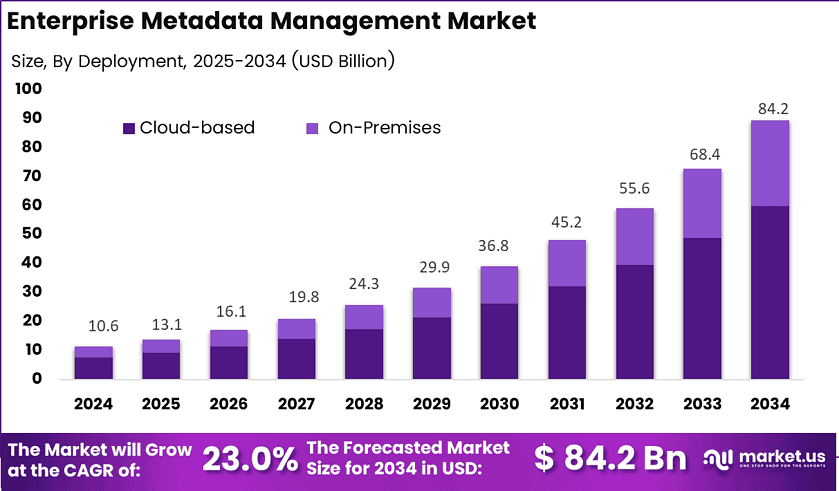
Enterprises now run far more complex data estates than before. Cloud platforms, artificial intelligence, digital services, and regulatory rules multiply records every day. Consequently, metadata platforms help companies find data, record ownership, trace lineage, apply quality rules, and prove compliance. These tools turn scattered information into governed business assets.
According to the International Telecommunication Union, 6 billion people used the internet in 2025, a rise of more than 240 million within the year. This growth produces more customer, transaction, device, and operational records. Therefore, enterprises need stronger classification, cataloging, and governance systems to stay in control.
UNCTAD reported that data centers consumed about 460 terawatt-hours of electricity in 2022 and could consume 1,000 terawatt-hours in 2026. This jump shows how fast digital processing capacity keeps rising. Consequently, buyers invest more in automated catalogs, lineage tools, governance software, and managed metadata services.
Mature cloud infrastructure, large technology suppliers, and strict data rules support this lead. Moreover, the World Bank reported that high-income economies held 77% of global colocation data-center capacity in June 2025.
Key Takeaways
- The Enterprise Metadata Management Market reached USD 10.6 billion in 2024 and should reach USD 84.2 billion by 2034. at a 23.0% CAGR from 2025 to 2034.
- Solutions and software led the component segment with a 65.3% share.
- Cloud-based deployment led the deployment segment with a 60.1% share.
- Technical metadata led the metadata type segment with a 45.6% share.
- Large enterprises led the organization size segment with a 71.4% share.
- Data governance and compliance led the application segment with a 30.8% share.
- IT and telecommunications led the industry vertical segment with a 25.2% share.
- North America led the market with a 40.7% share and USD 4.3 billion in revenue.
➤ Evaluate the Report Quality with an Exclusive Sample Download – https://market.us/report/global-enterprise-metadata-management-market/request-sample/
Market Segmentation
By Component
Solutions and software hold 65.3% of the component segment. Enterprises want one control layer for catalogs, lineage, policy, quality, and access. Moreover, Informatica reported cloud subscription annual recurring revenue of USD 827.3 million at the end of 2024, up 34%. That rise shows firm budgets for active metadata tooling.
By Deployment
Cloud-based deployment leads with 60.1% because it links spread-out data sources without extra hardware. Eurostat reported that 52.7% of EU enterprises bought cloud services in 2025, up from 45.2% in 2023. This 7.4 point gain signals wider cloud readiness, which lifts demand for hosted metadata platforms.
By Metadata Type
Technical metadata holds 45.6% because systems constantly create schemas, tables, fields, and job logs. NielsenIQ processed about 4 trillion records weekly in 2025 and roughly 173 trillion records for the year. Such volumes make manual documentation impossible. Therefore, automated scanners become the practical way to map dependencies.
By Organization Size
Large enterprises command 71.4% because they run data across many units, countries, and legacy platforms. However, smaller firms should grow faster as cloud delivery cuts cost barriers. Small and medium businesses form about 90% of companies worldwide, so even modest adoption creates a very large new buyer pool.
By Application
Data governance and compliance leads with 30.8% because firms must prove ownership, usage rights, retention, and access. European data protection authorities issued roughly EUR 1.255 billion in fines during 2024. These penalties raise board attention. Consequently, buyers fund audit trails, policy mapping, and searchable records.
By Industry Vertical
IT and telecommunications hold 25.2% due to heavy traffic across networks, billing, and digital platforms. The ITU recorded about 1.5 zettabytes of mobile broadband traffic and 7.3 zettabytes of fixed broadband traffic in 2025. Such flows demand automated catalogs, dependency maps, and operational metadata for daily service reliability.
Regional Analysis
North America dominates with a 40.7% share and USD 4.3 billion in revenue. The United States and Canada combine heavy internet use, deep cloud ecosystems, and strict privacy controls. ITU data placed internet use across the Americas between 88% and 93% in 2024, which supports steady enterprise data growth.
Asia Pacific offers strong expansion potential. The ITU reported that 77% of the region’s population used the internet in 2024. Moreover, the WTO recorded 10% growth in Asian computer-services exports during early 2024. Rising digital records push local firms toward catalogs, consent tracking, and compliance workflows.
Drivers
AI readiness mandates drive demand, adding an estimated 4.2% to CAGR. Enterprise AI budgets rose roughly 30% to 40% yearly through 2026. Teams spend that money on tagging, lineage, and semantic layers because models need trusted inputs before they deliver reliable business answers.
Data preparation can absorb about 60% to 80% of total AI project time without automated classification. This delay pushes buyers toward active metadata platforms. Additionally, cloud data platform migration contributes another 2.8% to growth, since every migration creates fresh mapping and documentation work.
Use Cases
Banks and insurers use metadata platforms to answer regulator questions quickly. Teams trace where a customer record started, who changed it, and where it moved. Consequently, audit preparation becomes routine work instead of a costly project. Clear ownership records also reduce disputes between business and technology teams.
Healthcare providers apply the same tools across clinical, laboratory, and claims systems. Analysts locate approved datasets, check quality rules, and confirm consent before any study begins. Therefore, research teams move faster while privacy protection stays intact. Hospitals also reuse trusted definitions across reporting and care programs.
Business Opportunities
Vendors can open the mid-market, which most suppliers still overlook. Self-service cloud platforms remove heavy onboarding work and long setup projects. Moreover, prebuilt connectors, guided templates, and automatic discovery let smaller firms start within weeks. This approach widens the customer base well beyond large corporations.
Industry-specific governance modules create a second opening. Banking, healthcare, and public sector buyers want ready policy templates that match their own rules. Therefore, vendors who ship sector content can shorten sales cycles. Emerging market digitalization adds further room through partner-led delivery and local language support.
Major Challenges
Talent shortages slow deployments across the industry. Few professionals combine data engineering, semantic modeling, and governance policy skills. Consequently, governance roles stay open far longer than general engineering roles, which pushes project timelines back. Many buyers respond with managed services, low-code tagging, and internal upskilling programs.
Fragmented multi-cloud estates create a second hurdle. Data sits across several public clouds, legacy databases, and partner systems with different formats. Therefore, teams struggle to build one reliable lineage view. Weak interoperability standards and complex schema migrations add further friction during rollout.
Top Key Players in the Market
- Informatica LLC
- Collibra NV
- Alation Inc.
- IBM Corporation
- Oracle Corporation
- SAP SE
- Microsoft Corporation
- Talend S.A.
- Snowflake Inc.
- Data.World, Inc.
- Atlan Pte. Ltd.
- Quest Software Inc.
- Precisely Software Incorporated
- Erwin Inc. (Quest)
- MANTA Software, Inc.
- Solidatus Ltd.
- Global IDs Inc.
- Smartlogic Semaphore Ltd.
- ASG Technologies Group, Inc.
- Alex Solutions Pty Ltd.
- Denodo Technologies Inc.
- Syniti (Capgemini SE)
- Octopai Ltd.
- Cloudera, Inc.
- Cambridge Semantics Inc.
Conclusion
The Enterprise Metadata Management Market shows strong long-term momentum. Cloud migration, artificial intelligence programs, and tighter rules keep pushing companies toward governed data. Software platforms, cloud delivery, and technical metadata lead demand, while North America holds the largest position. However, talent gaps and scattered cloud estates still limit speed. Therefore, vendors offering simple setup and sector-ready governance should gain ground.
Discuss your needs with our analyst
Please share your requirements with more details so our analyst can check if they can solve your problem(s)