
Market Overview
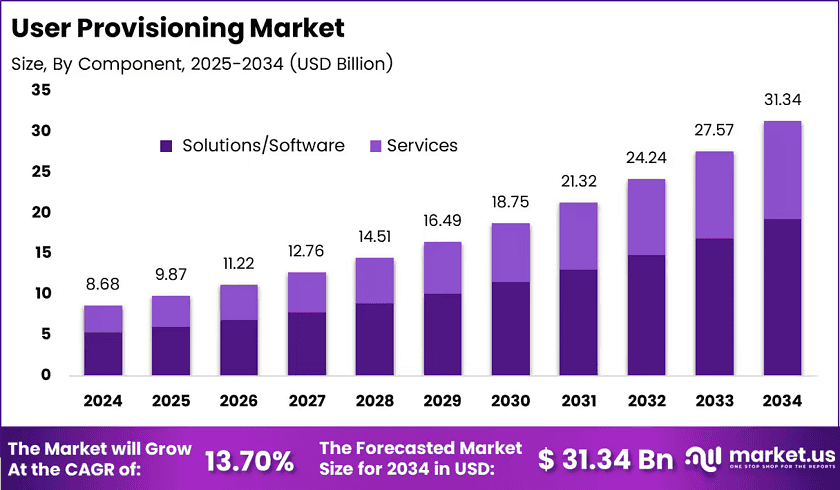
New York, NY – September 22, 2026 – The Global User Provisioning Market reached USD 8.6 billion in 2024 and will reach USD 31.3 billion by 2034. The market will grow at a 13.7% CAGR. North America led the market with a 45.2% share and USD 3.92 billion in revenue during 2025.
The World Bank reported that East Asian firms investing in digital tools rose from 13% in 2020 to 54% in 2022. Large firms worldwide moved from 20% to 60%. Consequently, IT teams manage far more accounts and permissions than before. This growth lifts demand for automated account creation.
Automated provisioning lowers manual work, speeds onboarding, and reduces access errors. Automation also builds a clear record for compliance reviews. Moreover, security teams gain faster control over role changes and account removal. Therefore, buyers treat identity lifecycle automation as a core operating tool rather than an optional upgrade.
Canada reported that 16% of businesses faced a cyber incident in 2023, which pushes firms to tighten access control. Microsoft also operated more than 400 data centers across 70 regions in fiscal 2025. Therefore, identity platforms must protect a very large cloud footprint.
Key Takeaways
- The User Provisioning Market stood at USD 8.6 billion in 2024 and will reach USD 31.3 billion by 2034. at a 13.7% CAGR from 2025 through 2034.
- Solutions and software led the component segment with a 61.4% share.
- Large enterprises led the organization size segment with a 73.5% share.
- Onboarding and offboarding led the application segment with a 35.8% share.
- North America led all regions with a 45.2% share and USD 3.92 billion in revenue.
➤ Explore the Premium Report Sample with Full Table of Contents & Insights – https://market.us/report/user-provisioning-market/request-sample/
Market Segmentation
By Component
Solutions and software led with a 61.4% share because buyers want one control layer for accounts, roles, passwords, access requests, and audit evidence. This wide coverage replaces manual admin work. Therefore, companies connect identity rules across cloud and on-site systems from a single console.
Okta reported more than 19,650 customers and over 7,000 technology integrations as of January 2025, which shows the scale of software platform support. Moreover, ISC2 counted 5.5 million cybersecurity workers in 2024 against a further 4.8 million needed. Consequently, managed services will grow fastest.
By Organization Size
Large enterprises held a 73.5% share because they manage many employees, contractors, business units, applications, and legal duties together. IBM operated in 175 countries with about 264,300 employees during 2025. Therefore, global firms need consistent access rules that never slow daily work.
The OECD states that SMEs form about 99% of firms in member countries and create roughly 50% to 60% of average value added. This wide base gives vendors a clear growth path. Additionally, simple pricing and ready connectors help small teams deploy strong controls.
By Application
Onboarding and offboarding led with a 35.8% share because every hire, transfer, and exit creates an instant access task. Automated workflows give new staff the correct tools on day one. Moreover, fast account removal stops former workers from keeping company data.
The US Bureau of Labor Statistics recorded 5.3 million hires and 5.4 million separations in June 2026, which creates repeated identity workload for IT and HR teams. The FBI also logged 859,532 crime complaints in 2024. Consequently, firms review user rights far more often.
By Industry Vertical
BFSI led the vertical segment because banks, insurers, and payment firms guard valuable data and money flows. The Federal Reserve processed 20.1 billion commercial ACH transactions in 2024, up 6.6%. Therefore, one wrong account can expose payment, customer, or trading systems.
Healthcare and life sciences will grow fastest as providers link clinical systems, laboratories, insurers, and outside partners. The US Department of Health and Human Services reported large breaches rising 102% from 2018 through 2023. Consequently, hospitals invest heavily in controlled access and audit trails.
Regional Analysis
North America dominated with a 45.2% share and USD 3.92 billion in revenue. The United States supports this lead through a large software industry, advanced cloud base, and mature cybersecurity market. Moreover, the US market alone reached USD 3.59 billion in 2024.
Europe remains a mature market shaped by privacy rules, digital public services, and cloud sovereignty. ITU reported that 91% of Europeans used the internet in 2024, while 5G covered 72% of the population. Therefore, European buyers demand regional hosting and documented approval workflows.
Drivers
Zero Trust mandates drive adoption and add about 2.8% to forecast CAGR. Enterprises replace static role access with session-aware entitlements under NIST SP 800-207 guidance. ENISA linked credential attacks to more than 60% of tracked incidents in 2025. Consequently, security budgets shift toward automated provisioning.
SCIM standardization across SaaS stacks adds roughly 2.1% to growth, since common connectors cut integration effort. Passwordless and FIDO2 rollouts contribute a further 1.6%. Therefore, vendors win faster deployments, and buyers lower the cost of adding new cloud applications each year.
Use Cases
Human resources teams link staff records directly to business applications, so joiner, mover, and leaver changes flow automatically. New employees receive correct tools immediately, while exits trigger instant account removal. Consequently, help-desk tickets fall, and access mistakes during urgent departures become far less common.
Compliance teams use provisioning platforms to prove who approved each permission and when. Auditors review role changes, access requests, and dormant accounts from one record. Moreover, banks and hospitals apply separation of duties across older and cloud systems without slowing service delivery.
Business Opportunities
AI agent and non-human identity governance opens a new revenue layer for identity vendors. Providers can attach agent governance modules to existing contracts with limited extra infrastructure. Therefore, early movers capture premium pricing before agent identity control becomes a standard enterprise requirement.
Mid-market and small business self-service provisioning remains largely unserved. Vendors can offer simple plans, guided setup, and prebuilt connectors for lean IT teams. Additionally, identity fabric consolidation and decentralized credential wallets create room for partnerships, acquisitions, and specialist service providers across regions.
Major Challenges
Identity talent shortages slow deployments worldwide. Enterprises struggle to hire governance engineers, so rollout schedules stretch well beyond original plans. Moreover, specialist consulting rates keep climbing. Consequently, many buyers delay full automation or hand daily identity operations to managed service partners.
Legacy application integration debt creates further friction. Older systems lack modern identity standards, so teams build custom connectors that need constant upkeep. Additionally, cross-border compliance rules and drifting vendor standards complicate design choices. Therefore, projects often expand in scope and cost.
Top Key Players in the Market
- IBM Corporation
- Microsoft Corporation
- Oracle Corporation
- SAP SE
- Okta, Inc.
- CyberArk Software Ltd.
- Broadcom Inc.
- Atos SE
- SailPoint Technologies Holdings, Inc.
- SolarWinds Corporation
- Happiest Minds Technologies Ltd.
- Motorola Solutions, Inc.
- Hitachi Ltd.
- Micro Focus International plc
- ForgeRock, Inc.
- Symantec Corporation
- OneSpan Inc.
- BeyondTrust Corporation
- Centrify Corporation
Conclusion
The user provisioning market grows steadily as enterprises automate account creation, role changes, and access removal. Software platforms lead demand, large enterprises drive spending, and North America holds the strongest position. However, talent gaps and legacy integration slow delivery. Therefore, vendors that simplify deployment and govern machine identities will gain a lasting advantage.
Discuss your needs with our analyst
Please share your requirements with more details so our analyst can check if they can solve your problem(s)