
Market Overview
New York, NY – October 07, 2026 – The Global Magnetic Sensor Market reached USD 3.1 billion in 2024. The report forecasts USD 6.2 billion by 2034, reflecting annual growth of 7.1%. Moreover, this projected doubling highlights commercial demand across vehicle systems, consumer devices, and factory equipment, where contactless sensing supports reliable operation and product development across industries.
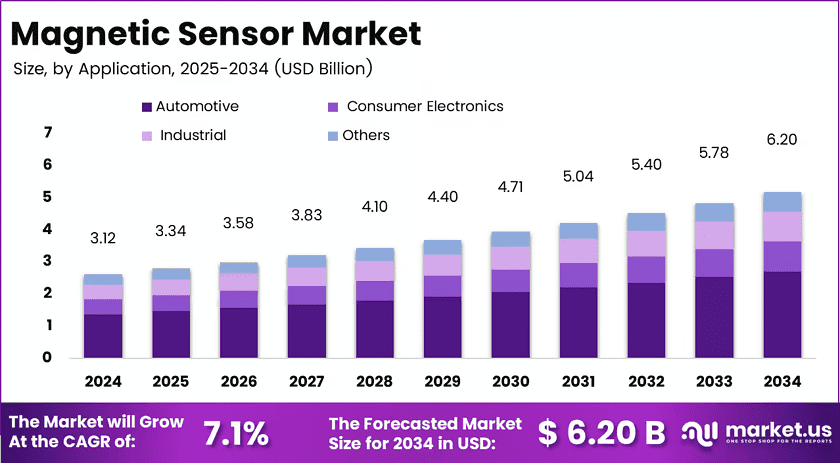
Vehicle manufacturers create demand for magnetic sensing through braking, steering, motor control, and position monitoring applications. Moreover, electric powertrains expand sensing needs across batteries, charging systems, and traction motors. Suppliers can pursue higher content per vehicle by developing reliable products that measure current and movement without direct physical contact between sensing components during everyday operation.
Electronics manufacturers also support market expansion through smartphones, wearables, folding devices, and connected appliances that require compact sensing components. Additionally, industrial buyers use magnetic feedback to improve motor control and equipment monitoring. These applications broaden the customer base beyond automotive production and encourage suppliers to balance product size, energy use, accuracy, and cost during development.
Asia Pacific anchors the market through its automotive production base, electronics manufacturing network, and established semiconductor supply chains. Moreover, China supports regional demand through electric vehicle production and industrial investment. Nearby packaging and assembly operations help suppliers serve customers efficiently, while India, Japan, and South Korea provide further opportunities across manufacturing and advanced electronic applications.
Generative AI offers development support through design exploration, simulation assistance, and analysis of manufacturing data. Additionally, suppliers can combine sensing information with maintenance software to help customers identify equipment problems earlier. However, the supplied report contains conflicting forecast dates, so publishers should confirm the reporting period before using its market estimates in external commercial communications.
Key Takeaways
- The Magnetic Sensor Market value stood at USD 3.1 billion in 2025 and could reach USD 6.2 billion by 2035.
- Hall Effect technology holds 29.3% of revenue. Its leading share highlights demand for affordable, durable sensing products.
- Automotive applications account for 43.7% of revenue. This concentration makes vehicle programs a major commercial priority.
- Asia Pacific holds 48.3% of revenue and generates USD 1.5 billion. This position emphasizes the region’s importance for customer access and manufacturing partnerships.
➤ Download the Detailed Sample Report with TOC, Tables, and Visual Figures – https://market.us/report/global-magnetic-sensor-market/request-sample/
Market Segmentation
By Technology
Hall Effect devices lead the technology mix through affordable, rugged sensing for vehicles and appliances. Moreover, anisotropic magnetoresistance, giant magnetoresistance, and tunnel magnetoresistance address different accuracy and power needs. Other technologies complete the segment, giving buyers choices based on operating conditions, design limits, and the performance required by each application.
By Application
Automotive applications lead demand across steering, braking, powertrain control, and battery monitoring. Additionally, consumer electronics use compact sensors for orientation, hinge detection, and device interaction. Industrial applications support motors, robotics, and equipment feedback, while other applications extend demand into specialized products that need dependable magnetic measurement and contactless operation.
Regional Analysis
Asia Pacific dominates the Magnetic Sensor Market, holding a 48.3% share and generating USD 1.5 billion in revenue. Asia Pacific leads through strong vehicle output, electronics assembly, and close links between component suppliers and manufacturers. Moreover, China anchors regional scale, while Japan and South Korea support advanced automotive and electronic applications. India and Southeast Asian manufacturing locations offer suppliers additional routes for assembly, customer support, and supply diversification.
North America supports demand through automotive engineering, industrial customers, and specialized sensor development. Additionally, Europe creates opportunities through electrification and factory automation. Latin America and the Middle East and Africa broaden regional coverage through vehicle production, infrastructure, and equipment markets, although the supplied report provides limited detail on their relative performance.
Market Drivers
Electric Powertrain Expansion
Electric vehicles increase demand for current, angle, and position sensing across batteries, motors, and charging equipment. Moreover, manufacturers need dependable feedback to manage power flow and protect critical components. Suppliers that combine accuracy, electrical isolation, and compact packaging can pursue design opportunities across electric platforms and related power management systems.
Safety and Automation Demand
Vehicle manufacturers use sensing feedback to support braking, steering, and driver assistance functions. Additionally, industrial companies adopt motor control and position monitoring to improve equipment performance. These needs favor durable components that maintain accuracy under heat, vibration, and electrical interference, creating demand beyond basic switches and general position detection.
Use Cases
Automotive engineers place magnetic sensors in pedal assemblies, steering systems, door mechanisms, and electric drivetrains. Moreover, contactless measurement helps teams monitor movement without relying on mechanical contact. These applications support responsive control and dependable operation, making sensor selection an important part of vehicle design, testing, and long-term platform planning.
Factory operators use magnetic feedback to track motor movement, robot joints, and equipment status during production. Additionally, maintenance teams can connect sensor readings with monitoring software to identify changing operating conditions. This approach helps businesses plan service work, investigate faults, and improve equipment availability without interrupting normal workflows unnecessarily.
Business Opportunities
Robotics developers create opportunities for compact magnetic encoders that track joint movement and support precise control. Moreover, suppliers can offer integrated modules that simplify customer design work. Companies that combine sensing hardware, calibration support, and application expertise can build stronger relationships with manufacturers developing robotic arms and advanced automated equipment.
Sensor suppliers can expand through localized assembly, testing partnerships, and services built around equipment monitoring. Additionally, customers may value products that combine dependable measurements with useful maintenance insights. These offerings can help vendors strengthen regional support, diversify supply arrangements, and compete through service quality rather than component pricing alone.
Major Challenges
Sensor manufacturers face production constraints when mature semiconductor processes compete for limited foundry capacity. Moreover, transferring production requires testing and customer approval, which slows supply changes. Companies must balance inventory, manufacturing commitments, and qualification costs while protecting product reliability and maintaining dependable deliveries for automotive and industrial customers.
Magnetic sensing suppliers also face trade uncertainty, material sourcing risks, and customer pressure to reduce prices. Additionally, engineering teams must address unwanted magnetic interference and demanding safety requirements. Alternative sensing technologies can compete for selected applications, encouraging vendors to improve performance while controlling development costs and protecting customer relationships.
Top Key Players in the Market
- NXP Semiconductors
- Asahi Kasei
- Baumer Ltd.
- iC-Haus
- MEMSIC Semiconductor Co., Ltd.
- MultiDimension Technology Co., Ltd.
- NVE Corporation
- Alps Alpine Co., Ltd.
- Elmos Semiconductor SE
- Honeywell International, Inc.
- Allegro MicroSystems, Inc.
Conclusion
Magnetic sensing offers growth opportunities across electric vehicles, consumer devices, and industrial automation. Moreover, Asia Pacific provides a strong manufacturing base, while other regions support specialized demand. Suppliers that improve accuracy, secure production capacity, and strengthen customer support can pursue expansion, although publishers must resolve the report’s conflicting forecast dates before release.
Discuss your needs with our analyst
Please share your requirements with more details so our analyst can check if they can solve your problem(s)