
Market Overview
New York, NY – November 20, 2026 – The Global Fatigue and Durability Software Market reached USD 955.3 million in 2025. According to the report, it should reach about USD 3,020.3 million by 2035, growing at a 12.2% CAGR. This steady growth shows that manufacturers now rely more on digital testing tools.
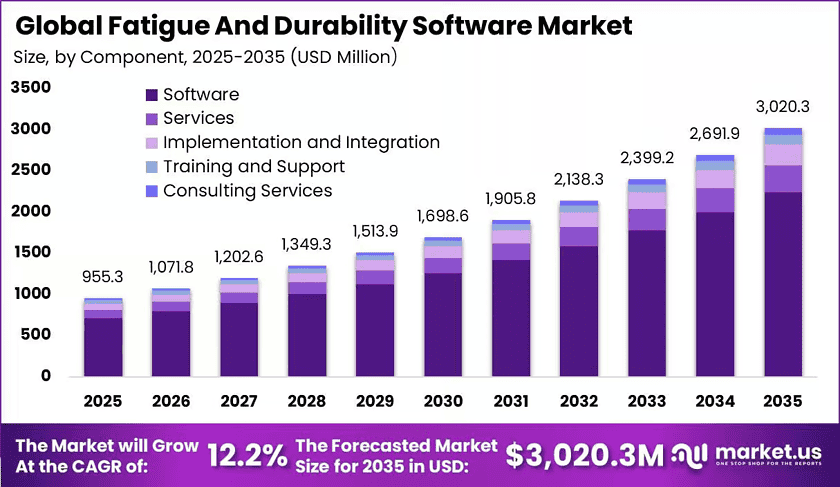
Manufacturers use durability simulation tools to study stress, part life, and structural strength before they build physical prototypes. Moreover, global vehicle production rose from 92.7 million units in 2024 to 96.4 million units in 2025. This 3.9% increase means more engines, chassis, and battery packs need durability checks.
Global vehicle sales also rose 4.7% to 99.8 million units, according to the report. Consequently, automakers face more pressure to validate new designs quickly. Higher sales push engineering teams toward faster fatigue analysis software, which cuts testing time and lowers the cost of building physical prototypes.
Aerospace makers add strong demand as well. According to the report, Airbus delivered 793 aircraft in 2025, up 4%. Additionally, industry orders reached about 1,000 gross units. Aircraft parts must survive tens of thousands of flight cycles, so digital fatigue analysis has become a key part of design work.
Manufacturing value added made up 15.12% of global GDP in 2024, which points to a large industrial customer base. Furthermore, China produced 34.53 million vehicles in 2025, up 10.4%. Therefore, Asia-Pacific gives structural simulation vendors strong room to win new customers through 2035.
Key Takeaways
- The Fatigue and Durability Software Market was valued at USD 955.3 million in 2025 and should reach USD 3,020.3 million by 2035 at a 12.2% CAGR.
- Software led the Component segment with a 74.3% share, helped by rising engineering jobs and R&D spending.
- On-premises deployment held a 66.1% share because aerospace and defense users need strict data security.
- Large Enterprises accounted for a 63.7% share, backed by bigger R&D budgets and testing setups.
- Automotive and Transportation led End-User Industry demand with a 27.6% share, driven by EV platform testing.
- North America led the market in 2025 with more than 34.5% share and USD 327.7 million in revenue.
➤ Get Instant Access to the Premium Report Sample Before Purchase – https://market.us/report/fatigue-and-durability-software-market/request-sample/
Fatigue and Durability Software Market Segmentation
By Component
Software led the component segment with a 74.3% share. According to the U.S. Bureau of Labor Statistics, mechanical engineering jobs should grow 9.1% from 2024 to 2034, adding about 26,500 roles. Consequently, more engineers will use stress and durability tools during product development.
Global R&D spending reached about USD 3.48 trillion in 2024, according to the report. Moreover, transportation equipment makers accounted for around 10% of U.S. business R&D spending. This large research budget keeps demand for simulation software strong. Meanwhile, services such as integration, training, and consulting help buyers get full value.
By Deployment Mode
On-Premises deployment held a 66.1% share because sensitive industries need tight data control. According to the report, global military spending hit a record USD 2,887 billion in 2025. The U.S. alone spent about USD 954 billion. Therefore, defense programs keep fatigue testing data on secure local systems rather than in the cloud.
By Organization Size
Large Enterprises held a 63.7% share of the market. According to the report, Fortune Global 500 companies earned a record USD 43.1 trillion in 2025. Additionally, the OECD reports that firms with 500 or more employees fund over 70% of business R&D. These budgets support long software licensing contracts.
By End-User Industry
Automotive and Transportation led end-user demand with a 27.6% share. According to the International Energy Agency, global electric car sales passed 20 million units in 2025, up 20%. Furthermore, EV battery use reached about 1.2 TWh. New battery packs need heavy vibration, thermal, and fatigue checks before launch.
Regional Analysis
North America held more than a 34.5% share and earned about USD 327.7 million in 2025, according to the report. Automakers, aerospace firms, and defense contractors in the region use structural simulation to meet strict safety rules. Moreover, high U.S. R&D spending keeps regional demand steady.
Asia Pacific should grow the fastest. According to the report, China’s equipment manufacturing grew 9.2% in 2025. India also built 34.7 million vehicles in FY2025-26, up 11.8%. Consequently, this region should narrow its gap with North America by 2035, while Europe holds steady through its aerospace base.
Market Drivers
CAE vendors are moving from one-time licenses to subscription and cloud pricing, which adds about 3.1% to CAGR, according to the report. The USD 34.9 billion Synopsys-Ansys deal sped up this change. Therefore, mid-sized engineering teams now face lower upfront costs and can adopt the tools faster.
Electric vehicle platform redesigns add about 2.4% to CAGR, according to the report. Additionally, Airbus held a record widebody backlog of 1,124 aircraft at the end of 2025. These two trends create heavy structural testing workloads. Consequently, carmakers and aircraft makers need more fatigue analysis software to keep projects on schedule.
Key Use Cases
Automakers use durability software to test battery packs, chassis frames, and suspension parts on screen before building prototypes. Engineers can spot weak points early and fix designs quickly. Consequently, car companies cut physical testing rounds and launch new electric models faster. Moreover, digital testing helps them meet strict safety standards.
Wind energy firms use fatigue analysis to check blades, towers, hubs, and bearings that face repeated loads. Aircraft makers apply the same tools to wings and fuselage parts over long flight cycles. Therefore, both industries extend part life and lower maintenance costs. Additionally, early checks reduce the risk of costly failures in the field.
Business Opportunities
Software vendors can earn more by pricing AI-driven fatigue modeling on design results instead of user seats. AI tools can automate meshing and load setup, which saves engineers a lot of time. Consequently, vendors can improve margins while customers finish projects sooner. Moreover, this pricing model remains largely untapped across the industry.
Small and mid-sized manufacturers are a large untapped customer group. Vendors can offer low-code simulation tools with simple pricing for these buyers. Therefore, smaller firms in Asia Pacific and Europe can adopt durability testing without big upfront spending. Additionally, vendors can expand into life sciences and industrial IoT markets.
Major Challenges
Engineering firms struggle to find skilled simulation engineers. Specialized durability roles often stay open for long periods, which slows software setup and customization. Consequently, vendors must invest in AI-assisted tools and university partnerships. However, these investments raise operating costs before they deliver real productivity gains.
Many manufacturers run older on-premises systems that do not connect easily with modern simulation platforms. Moreover, different CAE vendors use mixed data standards, which makes file sharing harder. Therefore, companies spend extra time and money on integration work. Additionally, recent vendor mergers may disrupt product roadmaps for some customers.
Top Key Players in the Market
- HBK
- ANSYS Inc.
- Siemens Digital Industries Software
- Altair Engineering Inc.
- ATA Engineering
- Hexagon
- Dassault Systèmes
- Komachine
- Endurica LLC
- Dewesoft
- Simulia
- Femfat
- Comsol
- ESI Group
Conclusion
The Fatigue and Durability Software Market shows strong growth potential, driven by electric vehicle testing, aircraft production, and defense programs. Software and on-premises deployment lead the market, while large enterprises remain the main buyers. Moreover, North America leads regional demand, and Asia Pacific grows fastest. However, talent shortages and hardware tariffs pose real risks. Therefore, vendors that offer AI tools and flexible pricing will gain ground.
Discuss your needs with our analyst
Please share your requirements with more details so our analyst can check if they can solve your problem(s)