
Market Overview
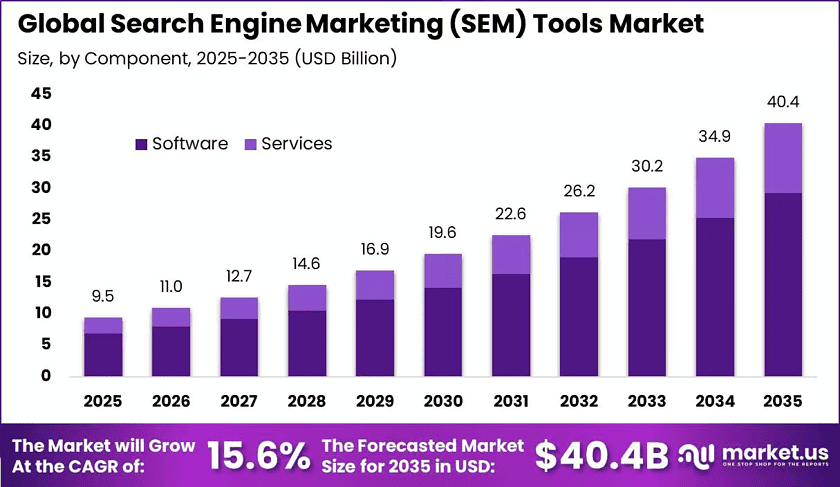
New York, NY – November 19, 2026 – The Global Search Engine Marketing (SEM) Tools Market reached USD 9.5 billion in 2025. Analysts expect it to hit about USD 40.4 billion by 2035, growing at a CAGR of 15.6%. This steady growth shows that businesses now treat paid search software as a core part of how they grow revenue. North America led the market in 2025 with more than 38.4% share and about USD 3.7 billion in revenue.
Businesses keep moving their budgets to online channels. Consequently, companies depend on paid search campaigns, keyword tracking, bid management, and ad performance reports. According to the Interactive Advertising Bureau (IAB), U.S. digital advertising revenue reached nearly USD 300 billion in 2025. This large spending base gives SEM platforms a strong and growing customer pool.
Search advertising remained the largest digital ad category. According to IAB, it generated USD 114.2 billion, or 38.8% of total digital ad revenue, after rising 11.0% from 2024. Therefore, advertisers need automation tools to control budgets, track keywords, and link ad spending to leads and sales.
Moreover, e-commerce growth adds strong demand for paid search software. According to the U.S. Census Bureau, retail e-commerce sales reached USD 317.9 billion in the fourth quarter of 2025. That figure equaled 16.7% of total U.S. retail sales. Online retailers therefore use SEM platforms to find profitable keywords and cut wasted clicks.
Key Takeaways
- The SEM Tools Market was worth USD 9.5 billion in 2025 and should reach USD 40.4 billion by 2035 at a CAGR of 15.6%.
- Software was the leading component, with 72.6% of total market share in 2025.
- Cloud-based deployment led with an 82.7% share, as teams want constant shared access to campaign data.
- Large enterprises held 58.6% of the market, since they need central platforms that run across many markets.
- Retail and e-commerce was the top end-use industry, with 26.2% of market share.
- North America led the market with a 38.4% share, worth about USD 3.7 billion, in 2025.
➤ Preview Key Insights with an Exclusive Sample Report Download – https://market.us/report/search-engine-marketing-sem-tools-market/request-sample/
SEM Tools Market Segmentation Analysis
By Component
Software led the component segment in 2025 with 72.6% market share. According to the International Telecommunication Union (ITU), about 6 billion people, or 74% of the world, were online in 2025. Consequently, a bigger online audience creates more searches. Advertisers then need software to manage bids and track conversions in real time.
Moreover, search-based software creates large business value. According to Google, its search and ad tools supported about USD 947 billion in U.S. economic activity in 2025. Services still help with planning and running campaigns. However, software gives advertisers the scalable automation and reporting they rely on every day.
By Deployment Mode
Cloud-based deployment led in 2025 with an 82.7% share. Marketing, sales, and agency teams need live campaign data and easy teamwork. Additionally, browser access removes the cost of running local servers. According to Eurostat, 52.7% of EU enterprises used paid cloud services in 2025. That rise points to wider business trust in hosted platforms.
Furthermore, cloud systems match the technical needs of search ad platforms. They support real-time reports, automatic bid changes, AI suggestions, and central security updates. According to Eurostat, 40.9% of EU enterprises used at least one advanced cloud service. Therefore, vendors can offer more advanced features to a ready customer base.
By Enterprise Size
Large Enterprises held 58.6% of the market in 2025. These firms run wide product ranges across many countries with big ad budgets. According to Eurostat, 84.67% of large EU enterprises used paid cloud services in 2025. Consequently, large firms adopt central SEM platforms with role controls and shared agency access.
Meanwhile, small and medium enterprises form a growing user group. Many SMEs want simple, low-cost tools that run campaigns without large in-house teams. However, tight budgets and limited skills slow their adoption. Therefore, vendors design self-service plans and guided automation to help smaller firms compete in paid search.
By End-Use Industry
Retail and e-commerce led end-use industries with a 26.2% share in 2025. According to Eurostat, 78% of EU internet users bought goods or services online in 2025, up from 62% in 2015. This shift means retailers need tools that tie ad spending directly to orders and revenue.
Additionally, IT and telecom, media, BFSI, travel, healthcare, and education also use paid search platforms. Each sector depends on search to capture buyers when they show intent. Moreover, banks and travel firms face high keyword costs. Consequently, these industries value bid control and accurate conversion tracking to protect returns.
Regional Analysis of the SEM Tools Market
North America held 38.4% of global revenue, or about USD 3.7 billion. According to IAB and PwC, U.S. internet ad revenue reached USD 294.6 billion in 2025, rising 13.9%. Consequently, the region’s large ad spending keeps demand high for keyword research, bid management, and return-on-ad-spend tools.
Asia Pacific is the fastest-growing regional market. According to ESCAP, digitally delivered services exports in the region grew 1.6 percentage points faster than the global average between 2015 and 2023. Therefore, mobile-first users, cross-border selling, and SME digital growth support demand for local-language, multi-market search tools.
Growth Drivers in Paid Search Software
AI-led search automation is the strongest driver, adding about 2.4% to CAGR. Platforms now manage bids, match queries, and create ad assets automatically. According to Alphabet, more than 70% of its 2025 revenue came from online ads. Consequently, advertisers need tools that monitor and audit AI-driven campaign actions.
Retail search monetization adds about 1.8% to the CAGR in North America and Europe. According to the U.S. Census Bureau, e-commerce sales reached USD 1.2337 trillion in 2025, up 5.4%. Therefore, retailers spend more on search ads. They also need platforms that track conversions and reduce wasted clicks.
Use Cases of SEM Platforms
Online retailers use SEM tools to find high-intent keywords and manage shopping campaigns. These platforms adjust bids based on product margins and stock levels. Moreover, retailers link ad clicks directly to orders. Consequently, marketing teams can move budgets quickly toward the best-selling products and pause weak keywords before losses grow.
Digital agencies use SEM platforms to manage many client accounts from one dashboard. Teams build reports, test ad copy, and track competitor bidding across search engines. Additionally, approval controls keep client budgets safe. Therefore, agencies save time on manual work and focus more on strategy and client growth.
Business Opportunities in Search Advertising
AI-search visibility analytics offers a strong new opportunity. AI-generated search results change how brands appear and get recommended. Consequently, advertisers want tools that track brand mentions, source selection, and product suggestions. Vendors that build clear AI-search dashboards can win new clients and improve service value for current accounts.
Retail media integration creates another growth path. Retailers now run their own ad networks alongside traditional search engines. However, advertisers struggle to compare results across these separate channels. Therefore, vendors that combine search and retail media data in one view can help brands plan budgets and measure returns more clearly.
Major Challenges for SEM Tool Providers
Attribution signal fragmentation remains a key challenge. Advertisers must connect search clicks with actions on websites, apps, call centres, and physical stores. However, privacy rules reduce the data available for tracking. Consequently, vendors must build privacy-safe data connectors and server-side tracking to keep campaign results reliable.
Regulatory intervention adds further pressure, especially in Europe. Search platforms face rules that can change result layouts, data access, and traffic flows. Moreover, these changes affect ad placement and reporting accuracy. Therefore, tool providers face higher compliance costs and slower product updates while serving global clients with consistent measurement.
Top Key Players in the Market
- Google (Google Ads)
- Semrush
- Microsoft Advertising
- AdEspresso
- Skai
- SpyFu
- WordStream
- Optmyzr
- AdRoll
- Marin Software
- Adobe Advertising Cloud
- Serpstat
- Ahrefs
- Moz
Conclusion
The SEM tools market is growing quickly as businesses move ad budgets online and adopt AI-based automation. Software and cloud deployment lead the market, while large enterprises and retailers drive most demand. North America leads today, and Asia Pacific grows fastest. However, attribution gaps and regulation create pressure. Consequently, vendors that offer AI-search analytics and unified measurement will capture the strongest future growth.
Discuss your needs with our analyst
Please share your requirements with more details so our analyst can check if they can solve your problem(s)