
Market Overview
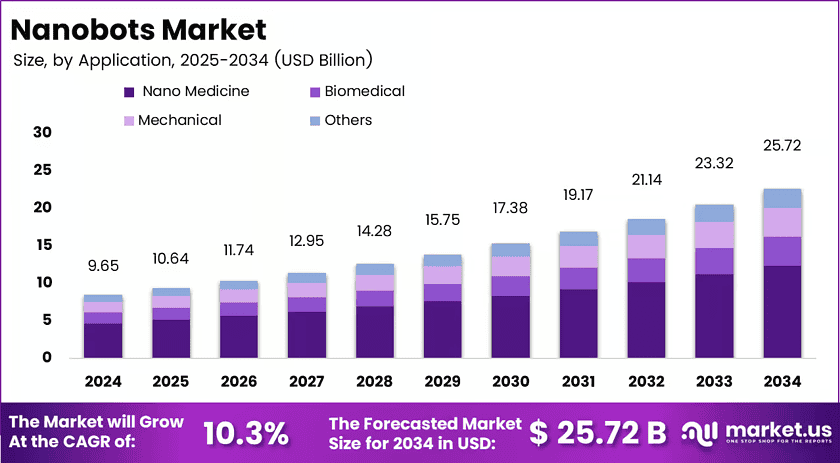
New York, NY – October 09, 2026 – The Global Nanobots Market stands at USD 9.6 billion in 2024, according to the latest industry report. The market will reach USD 25.7 billion by 2034 at a CAGR of 10.3%. This steady growth shows that hospitals, drug makers, and labs now see nanoscale robotics as a serious investment.
Moreover, health systems keep raising their spending. According to the OECD, member countries spent about 9.3% of GDP on health in 2024, which is above pre-pandemic levels. This higher spending pulls nanoscale devices into clinics and labs. Consequently, medical nanorobotics now has a stronger budget base across developed economies.
Additionally, research budgets continue to climb. According to China’s National Bureau of Statistics, China spent 3,926.2 billion yuan on R&D in 2025, up 8.1% year on year. This amount equals 2.80% of GDP. Therefore, drug makers and hospitals have more money to test targeted drug carriers and imaging platforms.
Furthermore, every new research program needs nanomanipulators, atomic force systems, and electron beam tools. As a result, demand for these instruments rises with each research cycle. Suppliers of precision lab equipment gain directly from this pattern. The nanorobotics industry therefore ties its growth closely to steady public and private research funding.
However, public funding explains most of the US lead. According to the US Congress, the NIH base budget reached $47.2 billion for fiscal 2026, a rise of $415 million. Roughly 80% of that money flows to universities and institutes. Those grants buy the exact tools that nanobot developers need.
Key Takeaways
- The Global Nanobots Market holds a value of USD 9.6 billion and will reach USD 25.7 billion, growing at a CAGR of 10.3% during the forecast period.
- Microbivore nano robots lead the type segment with a 38.2% share.
- Nano medicine leads the application segment with a 48.1% share.
- Hospitals and clinics lead the end-use segment with a 44.8% share.
- North America leads the market with a 40% share and USD 3.8 billion in revenue.
➤ Get Instant Access to the Premium Report Sample Before Purchase – https://market.us/report/nanobots-market/request-sample/
Nanobots Market Segmentation
By Type
Microbivore nano robots lead the type segment with a 38.2% share. According to WHO, bacterial antimicrobial resistance contributed to more than 4.7 million deaths in 2021. This high death toll explains the strong interest in robots that capture and destroy bacteria. Consequently, hospitals and researchers make these devices a priority for bloodstream infection work.
Meanwhile, cellular repair nanorobots are growing fastest as populations age. According to UN DESA, 703 million people are aged 65 or older today, and that number will rise to 1.5 billion by 2050. This shift raises demand for less invasive care. Therefore, developers are building nanorobots that repair tissue without open surgery.
By Application
Nano medicine leads the application segment with a 48.1% share. According to the US National Nanotechnology Initiative, the 2026 budget request reached US$1.45 billion across 10 federal agencies. This funding supports drug delivery, imaging, and targeted therapy work. Consequently, nanomedicine holds a clear lead over other applications.
Additionally, biomedical applications are growing quickly as more products clear regulatory review. According to the FDA, the agency approved 46 novel medicines in 2025, after 50 in 2024. This steady flow builds confidence in nano-scale delivery and diagnostics. Therefore, biosensor and tissue engineering teams are adopting more nanomanipulation systems.
By End Use
Hospitals and clinics lead the end-use segment with a 44.8% share. These facilities already have the beds, specialists, and monitoring systems that nano-scale procedures need. According to the OECD, member countries averaged 4.2 hospital beds per 1,000 people in 2023. This ready capacity helps hospitals adopt new treatments faster.
Moreover, biopharmaceutical companies are expanding fastest because they can fund in-house nano-fabrication. According to company filings, Thermo Fisher Scientific reported US$44.56 billion in revenue for 2025, up 4%. This financial strength supports spending on pilot lines and specialist talent. Consequently, drug makers are building their own delivery platforms.
Regional Analysis
North America leads the nanobots market with a 40% share and USD 3.8 billion in revenue. According to the US Congress, combined NIH and ARPA-H funding reached $48.933 billion for fiscal 2026. ARPA-H alone holds $1.5 billion for high-risk health technology. Consequently, federal science funding anchors the region’s strong position.
Meanwhile, Asia Pacific is the fastest-growing region as national science budgets rise. According to China’s National Bureau of Statistics, China put 277.8 billion yuan into basic research in 2025, an 11.1% jump. India also raised health research funding by 26%. Therefore, the region is drawing new nanorobotics labs and programs.
Market Growth Drivers
According to the report, clinically validated magnetic microrobot navigation adds about 2.1% to the CAGR forecast. In November 2025, an ETH Zurich-led team guided magnetic microrobots inside sheep and pigs. The robots delivered their payloads in a controlled way. Consequently, investors now see navigation inside the body as a realistic step toward clinical use.
Additionally, sustained federal funding for nanoscale R&D adds about 1.6% to the CAGR forecast, according to the report. The United States, Japan, and South Korea keep funding programs across several agencies. This steady support lowers risk for early-stage developers. Therefore, startups can move their platforms toward preclinical testing faster.
Key Use Cases
Hospitals use microbivore nanobots to target drug-resistant bloodstream infections. These tiny robots capture and destroy bacteria directly. Moreover, this approach can reduce reliance on antibiotics that no longer work well. Consequently, infection control teams see nanobots as a promising tool for critical care units and long hospital stays.
Additionally, oncology centres use targeted intra-arterial delivery to send drugs straight to tumours. Magnetic microrobots can carry payloads through blood vessels under external control. This method limits damage to healthy tissue. Therefore, cancer specialists gain a precise option that may reduce side effects and improve patient comfort.
Business Opportunities
Water utilities offer a large untapped opportunity for catalytic nanorobots that destroy PFAS chemicals. Today, utilities rely mainly on activated carbon, ion exchange, and reverse osmosis. However, reusable nanorobots could lower treatment costs over many cycles. Consequently, early suppliers can win long-term contracts as stricter drinking water rules take effect.
Moreover, precision nano-delivery of farm chemicals opens new markets in India, Brazil, ASEAN, and Sub-Saharan Africa. Small farmers need better results from fewer chemicals. Nanobots can release nutrients and crop protection exactly where plants need them. Therefore, agritech firms can offer cost savings along with lower environmental impact.
Major Challenges
Nanobot makers face a serious talent shortage. They compete with semiconductor plants for the same nanoscale process engineers. Moreover, senior roles take many months to fill, and wages keep rising. Consequently, empty positions slow production lines and delay technology transfer. This pushes companies toward apprenticeships and automated testing.
Additionally, EU medical device rules create a heavy approval burden. Regulators place most injectable nanomaterial devices in the highest risk class. However, only a limited number of notified bodies can review these files. Therefore, developers face long certification timelines, higher costs, and delayed launches across European markets.
Top Key Players in the Market
- Oxford Instruments plc
- Thermo Fisher Scientific
- Bruker Corporation
- Teledyne Technologies Incorporated
- Agilent Technologies, Inc.
- Cavendish Capital Markets Limited
- Nanonics Imaging Ltd.
- Angstrom Advanced Inc.
- Kleindiek Nanotechnik GmbH
Conclusion
The global nanobots market shows strong momentum as health spending, research funding, and clinical progress line up. Microbivore robots, nano medicine, and hospitals lead their segments, while North America holds the top regional spot. However, talent gaps and strict rules still slow progress. Consequently, companies that invest in skills, partnerships, and regulatory readiness will capture the biggest gains in this fast-moving field.
Discuss your needs with our analyst
Please share your requirements with more details so our analyst can check if they can solve your problem(s)