
Market Overview
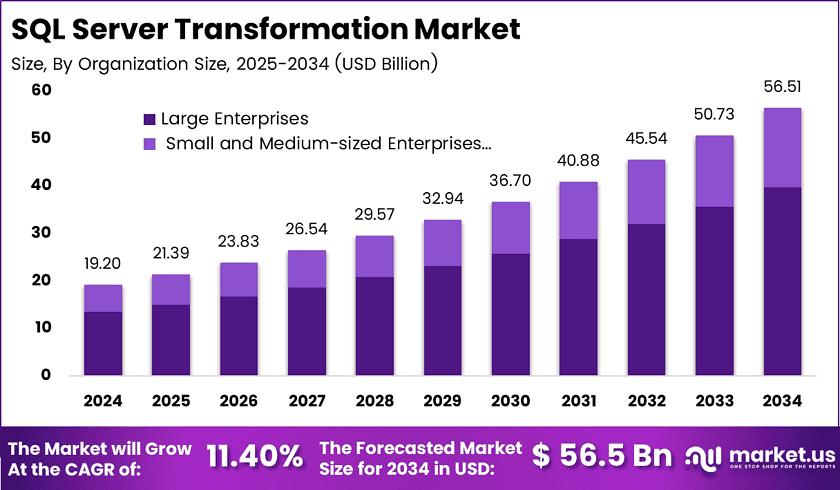
New York, NY – October 08, 2026 – The SQL Server Transformation Market reached USD 19.2 billion in 2024. The report projects USD 56.5 billion by 2034, reflecting demand for database modernization. Revenue will grow at an 11.4% CAGR during 2025–2034, indicating sustained demand rather than isolated upgrades. North America contributes 45.3% of global revenue, representing USD 8.7 billion in market value.
Enterprise technology teams increasingly connect database upgrades with broader cloud and artificial intelligence plans across their business operations. Generative AI tools can assist with query review, data modeling, and error detection. Moreover, these capabilities support modernization work, although engineers must validate results carefully before introducing changes into systems that handle sensitive records or support essential customer services every business day.
Database transformation providers compete through assessment, code conversion, testing, and ongoing performance management rather than infrastructure delivery alone for enterprise customers. Customers seek clearer costs, dependable implementation schedules, and stronger data controls. Consequently, suppliers that combine migration skills with practical automation can address technical risks while helping organizations prepare their information assets for analytics and future AI applications across departments.
Key Takeaways
- The SQL Server Transformation Market value rises from USD 19.2 billion in 2024 to USD 56.5 billion by 2034, growing at a 11.4% CAGR during 2025–2034, signaling sustained service demand.
- Information Retrieval holds 40.3%, highlighting the importance of everyday data access.
- Large Enterprises account for 70.4%, reflecting extensive legacy environments.
- Business Operations contributes 56.5%, emphasizing essential transaction systems.
- BFSI holds 25.9%, reflecting financial institutions’ audit and reliability needs.
- North America generates 45.3% and USD 8.7 billion, establishing regional revenue leadership.
➤ Evaluate the Report Quality with an Exclusive Sample Download – https://market.us/report/sql-server-transformation-market/request-sample/
Market Segmentation
By Type
Information Retrieval leads with 40.3%, reflecting frequent demand for customer, invoice, and inventory records. Analytical Queries support planning, while Data Integration Scripts connect applications and reporting environments. Additionally, the Others category covers remaining transformation requirements, giving providers opportunities across different database functions.
By Organization Size
Large Enterprises hold 70.4%, showing how extensive legacy systems shape purchasing decisions. These organizations require detailed assessments and coordinated migration programs. Moreover, Small and Medium-sized Enterprises seek simpler delivery models, managed databases, and predictable costs that reduce dependence on large internal technical teams.
By Use Case
Business Operations leads with 56.5%, reflecting the importance of billing, orders, payroll, and inventory systems. Enterprise Data Warehousing supports consolidated analysis across finance, sales, and supply functions. Additionally, providers must balance reliable transaction processing with customers’ need for accessible historical information.
By Vertical
BFSI leads with 25.9%, reflecting strong requirements for transaction tracking and controlled database changes. Healthcare, Retail and Ecommerce, Government, and IT and Telecom also require modernization. Moreover, the Others category extends coverage to additional industries with distinct reporting, integration, and operational needs.
Regional Analysis
North America leads the supplied report’s regional assessment, supported by established enterprise systems and substantial modernization requirements. The United States and Canada provide opportunities across regulated industries and public services. Moreover, Europe represents another important market, where Germany, France, and the United Kingdom emphasize governance and controlled cloud deployment.
Asia Pacific represents the fastest-growing region in the supplied report, reflecting expanding digital services and transaction workloads. China, Japan, India, South Korea, and Australia offer varied modernization opportunities. Additionally, Latin America and the Middle East and Africa broaden the market through enterprise upgrades, cloud adoption, and local delivery partnerships.
Drivers
Cloud migration drives demand as enterprises move existing databases toward managed platforms and hybrid environments. These projects require query changes, compatibility checks, and performance testing rather than simple data transfers. Moreover, customers seek scalable systems that support growing workloads without increasing the burden on their internal database administration teams.
Support lifecycle changes encourage organizations to review older SQL Server installations and plan upgrades. Regulated businesses also need dependable security maintenance, recovery processes, and clear audit records. Consequently, migration providers can position modernization as a business continuity program, linking technical improvements with stronger operational controls and manageable platform costs.
Use Cases
Retailers and service businesses modernize operational databases to improve order processing, billing, and inventory access. Migration teams preserve application links while checking transaction accuracy and response times. Additionally, refreshed systems help employees retrieve current information, reducing delays that can disrupt customer service or weaken coordination across business departments.
Enterprise analytics teams transform database environments to combine sales, finance, and supply information within shared reporting platforms. These projects improve access to consistent historical records and support clearer planning. Moreover, data integration work prepares useful inputs for forecasting and AI applications, while governance teams retain control over sensitive information.
Business Opportunities
AI-ready database services create opportunities beyond basic migration by improving data quality, access controls, and information structure. Providers can support ongoing model governance and database maintenance after deployment. Additionally, these services help customers connect modernization spending with practical analytics goals rather than treating migration as an isolated technical exercise.
Standardized migration packages offer opportunities for businesses that lack extensive internal engineering resources. Providers can combine assessment, conversion, testing, and managed support within clearly defined delivery plans. Moreover, regional hosting options and ongoing cost management services help address customer concerns about data location, spending visibility, and long-term platform dependence.
Major Challenges
Legacy database code creates challenges when applications depend on customized procedures, scheduled jobs, and complex system connections. Migration teams must identify these dependencies before changing platforms. Moreover, incomplete assessments can trigger unexpected rework, making thorough discovery, compatibility testing, and business involvement essential for protecting delivery schedules and operational reliability.
Limited engineering capacity and tight downtime windows can slow transformation programs across critical business systems. Customers must also manage overlapping platform costs during testing and transition. Consequently, providers need realistic schedules, clear responsibilities, and spending controls to prevent rushed deployments, avoid service interruptions, and maintain confidence throughout the migration process.
Top Key Players in the Market
- Oracle
- Microsoft
- SAP SE
- IBM
- Alphabet
- Amazon Web Services Inc.
- Teradata
- NuoDB Inc.
- MemSQL Inc.
- Actian Corporation
- Qlik
Conclusion
The SQL Server Transformation Market offers growth opportunities as enterprises modernize essential databases and prepare information for cloud services and AI applications. Large organizations and regulated industries anchor demand, while regional digital expansion broadens adoption. However, providers must address legacy code, delivery constraints, and cost uncertainty through careful assessment, reliable testing, and ongoing support that protects customers’ daily business operations.
Discuss your needs with our analyst
Please share your requirements with more details so our analyst can check if they can solve your problem(s)